Agaricus bisporus (J. E. Lange) Imbach - Cultivated (Button) Mushroom
Phylum: Basidiomycota - Class: Agaricomycetes - Order: Agaricales - Family: Agaricaceae
Distribution - Taxonomic History - Etymology - Identification - Culinary Notes - Reference Sources
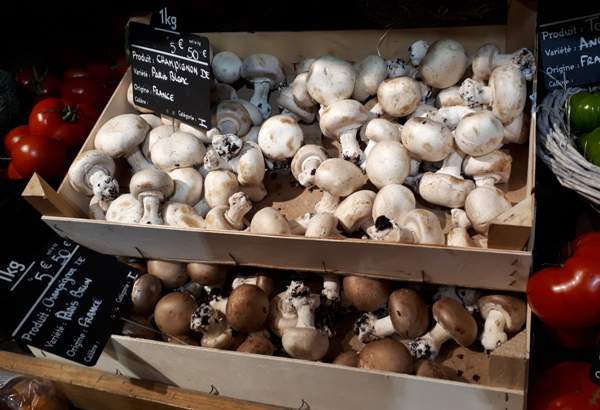
Agaricus bisporus is not particularly common in the wild, where like the Field Mushroom and the Horse Mushroom it springs up in fields and appears after rain. The specific name bisporus refers to the fact that each of the basidia bear just two spores - most Agaricus species have four-spored basidia. (You will need a powerful microscope if you want to see these features on the gill faces of agaricoid fungi.)
Distribution
An uncommon to rare mushroom in the wild, in Britain and Ireland Agaricus bisporus is found nearly always in grassland. This species occurs also in mainland Europe and elsewhere in the world including parts of North America. The specimens shown on this page are cultivated 'Chestnut Mushrooms'.
Taxonomic history
Although known for many years beforehand, this mushroom was recognised as a species distinct from the Field Mushroom Agaricus campestris by the Danish mycologist Jakob Emanuel Lange (1864 - 1941) in 1926; it was transferred to the genus Agaricus by German mycologist Emil J Imbach (1897 - 1970) twenty years later.
Synonyms of Agaricus bisporus are many and includePsalliota hortensis (Cooke) J. E. Lange, Psalliota hortensis f. bispora J.E. Lange, Psalliota bispora (J. E. Lange) F.H. Møller & Jul. Schäff., Agaricus campestris var. bisporus Kligman, Agaricus bisporus var. bisporus (J. E. Lange) Imbach, Agaricus hortensis (Cooke) Pilát, and Agaricus bisporus var. albidus (J. E. Lange) Singer.
Etymology
The specific epithet bisporus means having two spores - there are two spores on each basidium, whereas other Agaricus species (and indeed the majority of the Basidiomycota) have four-spored basidia.
Identification guide
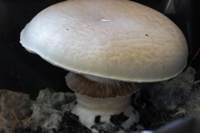 |
CapInitially hemispherical, becoming convex and eventually flattening. At maturity, the cap diameter is usually between 5 and 10cm. |
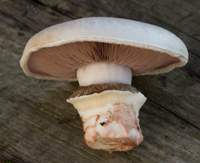 |
GillsThe crowded gills are narrow and free; initially pink they turn reddish and then chocolate brown as the fruitbody matures. StemAt 3 to 6cm tall and 1.5 to 2cm. Below the insubstantial membranous double ring, the surface of the stem is flaky. |
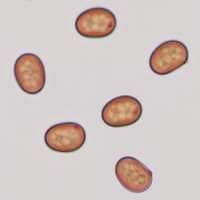 |
SporesOviod to subglobose, smooth, 4-7.5 x 4-5.5µm.
Spores of Agaricus bisporus Spore printDeep chocolate brown. |
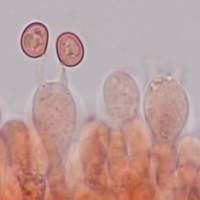 |
BasidiaTwo-spored - hence the specific name bisporus. |
Odour/taste |
They have a 'mushroomy' odour, of course... |
Habitat & Ecological role |
Saprobic, in permanent pastures and other grassy places. |
Season |
Late spring to autumn. |
Similar species |
Agaricus campestris, the Field Mushroom, is very similar but has four-spored basidia. |
Culinary Notes
It surely goes without saying that this is a good edible mushroom and one of the tiny minority of edible fungi that are considered safe to eat raw. The very pale-capped mushrooms sold in most supermarkets are a derived form of Agaricus bisporus, which in the wild has a brown cap as shown in the main picture, above. When fully expanded, the caps are sometimes referred to as Portobello Mushrooms (sometimes spelt Portobella).
Reference Sources
Fascinated by Fungi, 2nd Edition, Pat O'Reilly 2016, reprinted by Coch-y-bonddu Books in 2022.
BMS List of English Names for Fungi.
The genus Agaricus in Britain, 3rd Edition, self-published, Geoffrey Kibby 2011
Dictionary of the Fungi; Paul M. Kirk, Paul F. Cannon, David W. Minter and J. A. Stalpers; CABI, 2008
Taxonomic history and synonym information on these pages is drawn from many sources but in particular from the British Mycological Society's GB Checklist of Fungi.

Fascinated by Fungi. Back by popular demand, Pat O'Reilly's best-selling 450-page hardback book is available now. The latest second edition was republished with a sparkling new cover design in September 2022 by Coch-y-Bonddu Books. Full details and copies are available from the publisher's online bookshop...