Trees Birds Mammals Fish Amphibians Reptiles
Wild Algarve
Bookshop
Amanita excelsa var. spissa (Fr.) P. Kumm. - Grey Spotted Amanita
Phylum: Basidiomycota - Class: Agaricomycetes - Order: Agaricales - Family: Amanitaceae
Distribution - Taxonomic History - Etymology - Identification - Culinary Notes - Reference Sources
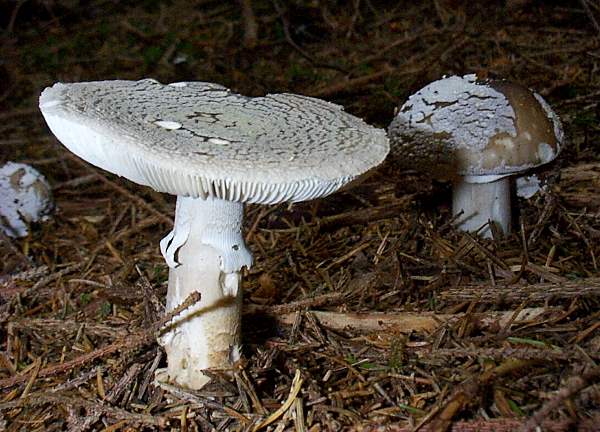
Sometimes referred to as the False Panthercap, Amanita
excelsa is very variable in appearance and samples are sometimes mistakenly recorded as Panthercap, Amanita pantherina. Its most commonly cited synonym is Amanita spissa.
Distribution
Quite a frequent find in many parts of Britain and Ireland, Amanita excelsa var. spissa occurs also in most parts of mainland Europe and on thec eastern side of North America.
Amanita excelsa var. excelsa has a pale brown cap and is more slender in structure. It is rather less common than var. spissa.
Taxonomic history
Described in 1821 and named Agaricus excelsus by the great Swedish mycologist Elias Magnus Fries, this mushroom was placed in the Amanita genus by Paul Kummer in 1871 and renamed Amanita excelsa. Synonyms of Amanita excelsa var. excelsa include Agaricus excelsus Fr., Agaricus excelsus var. cariosus Fr., Agaricus validus Fr., Amanita cariosa (Fr.) Gillet, Amanita excelsa (Fr.) P. Kumm., and Amanita spissa var. valida (Fr.) E.-J. Gilbert.
Two varieties of Amanita excelsa occur in Britain: Amanita excelsa var. excelsa (Fr.) P. Kumm. (syn. Amanita spissa (Fr.) Opiz), and Amanita excelsa var. spissa (Fr.) Neville & Poumarat.
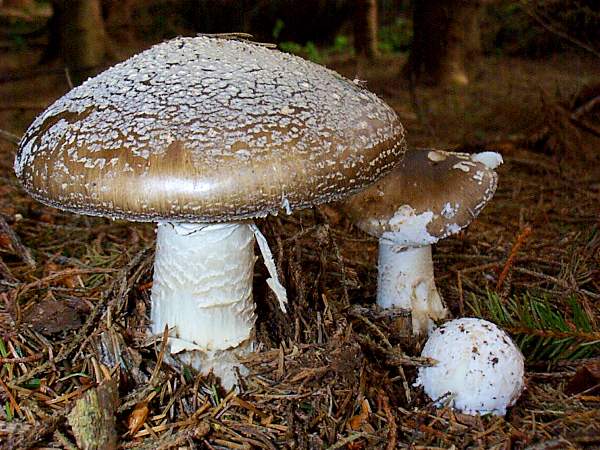
(Amanita spissa var. valida (Fr.) E.-J. Gilbert is a synonym of Amanita excelsa var. spissa (Fr.) Neville & Poumarat.) The two varieties are similar in colour but Amanita excelsa var. spissa is the more robust of the two forms (and in Britain and Ireland the more common) and is said by some to smell faintly of radish when the flesh is cut. Most of the pictures shown on this page are of Amanita excelsa var. spissa, but the specimens seen here are probably of Amanita excelsa var. excelsa, having pale caps and and, when cut, smelling slightly of radish. Separating the two varieties is difficult, however, and many authorities still treat them as merely minor form differences.
Etymology
The specific epithet excelsa is a Latin adjective that translates to elevated or lofty, while spissa means dense or crowded - a reference to the closely-spaced gills of these fungi.
Although the stem flesh of Amanita excelsa (both varieties) does not turn pink when cut or bruised as the Blusher Amanita rubescens does), some people refer to these mushrooms as the European False Blusher. In stature they have much more in common with Blushers than with Panthercaps, the origin of their former common name False Panthercap.)
For a detailed description of the Amanita genus and identification of common species see our Simple Amanita Key...
Identification guide
|
Cap
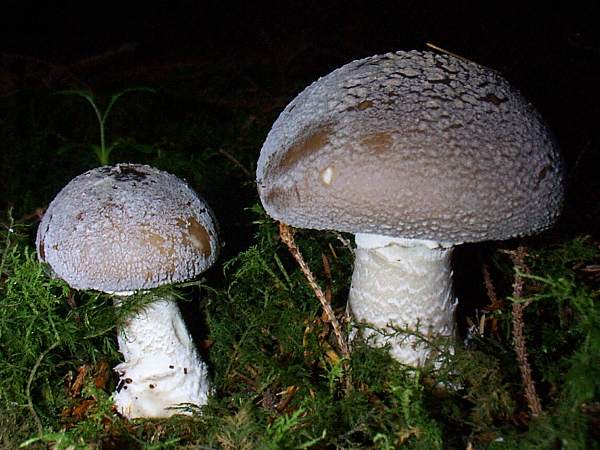
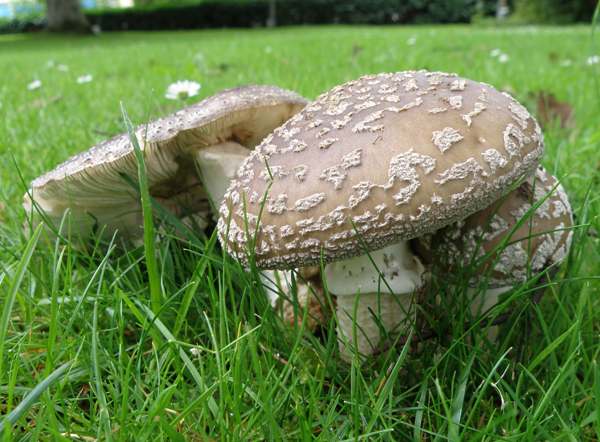
8 - 15cm diameter; brown or grey-brown;
usually retaining irregular grey patches or fragments of the universal
veil, the cap of Amanita excelsa is initially domed, becoming almost flat or occasionally slightly
concave at maturity. The velar patches are easily washed or wiped off
the cap surface. Beneath the pellicle the flesh of the cap is white and
firm. |
 |
Gills
While most Amanita species have free
gills, the gills of Amanita spissa are adnexed. They are white
and crowded.
Stem
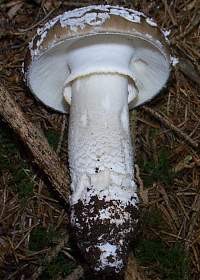
The stem of Amanita excelsa var. spissa is 8 - 12cm long and 1.5 - 2.5cm in diameter; white and with a robust ring that is usually grooved on
its upper surface. The stipe is smooth or lined above the ring; covered
in white scales below.
At the swollen base there is no clear volval gutter and the volva
itself is no longer evident when the fruitbody reaches maturity. |
 |
Spores
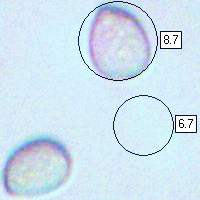
Broadly ellipsoid, 8-11 x 6.5-8.5μm; amyloid.
Spore print
White. |
Odour/taste |
var. spissa: a faint, unpleasant odour (not of radish), but no distinctive
taste.
var. excelsa: a faint odour of radish, but no distinctive
taste. |
Habitat & Ecological role |
Mycorhizal with hardwood and softwood trees,
often most abundant near the edge of mixed woodland. |
Season |
July to November in Britain and Ireland. |
Similar species |
Amanita pantherina has white (not grey) velar remains on the cap,
free gills an ungrooved ring, and a distinct volval ridge at the
base of the stem. |
Culinary Notes
Because of the risk of misidentification it is inadvisable to eat the Grey Spotted Amanita, although some authorities claim that these neat but sombre-looking fungi are edible, although nothing special in terms of flavour.
Reference Sources
Fascinated by Fungi, 2nd Edition, Pat O'Reilly 2016, reprinted by Coch-y-bonddu Books in 2022.
Funga Nordica: 2nd edition 2012. Edited by Knudsen, H. & Vesterholt, J. ISBN 9788798396130
BMS List of English Names for Fungi
Geoffrey Kibby, (2012) Genus Amanita in Great Britain, self-published monograph.
Paul M. Kirk, Paul F. Cannon, David W. Minter and J. A. Stalpers (2008). Dictionary of the Fungi; CABI
Taxonomic history and synonym information on these pages is drawn from many sources but in particular from the British Mycological Society's GB Checklist of Fungi.
Top of page...
Fascinated by Fungi. Back by popular demand, Pat O'Reilly's best-selling 450-page hardback book is available now. The latest second edition was republished with a sparkling new cover design in September 2022 by Coch-y-Bonddu Books. Full details and copies are available from the publisher's online bookshop...