Bolbitius titubans (Bull.) Fr. - Yellow Fieldcap
Phylum: Basidiomycota - Class: Agaricomycetes - Order: Agaricales - Family: Bolbitiaceae
Distribution - Taxonomic History - Etymology - Identification - Culinary Notes - Reference Sources
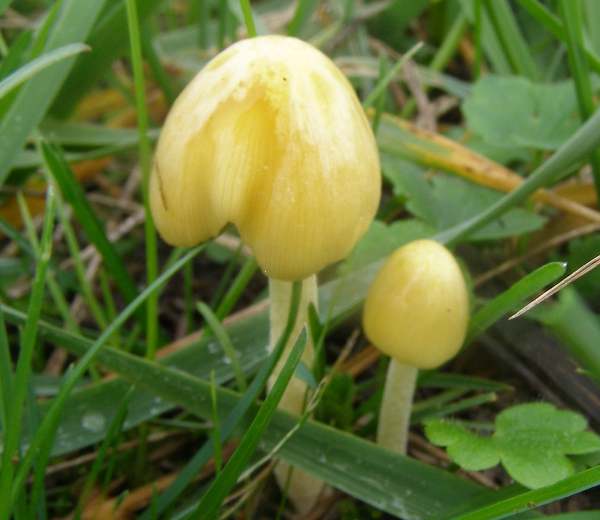
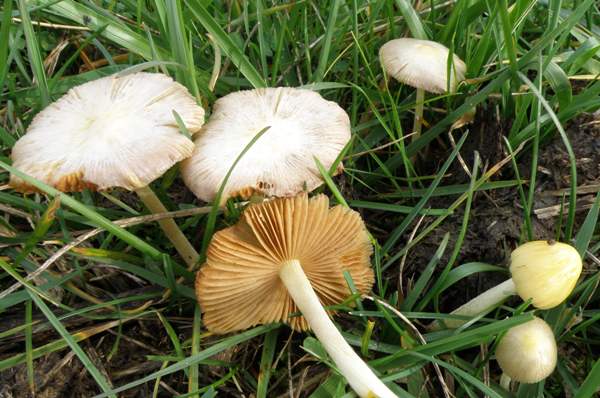
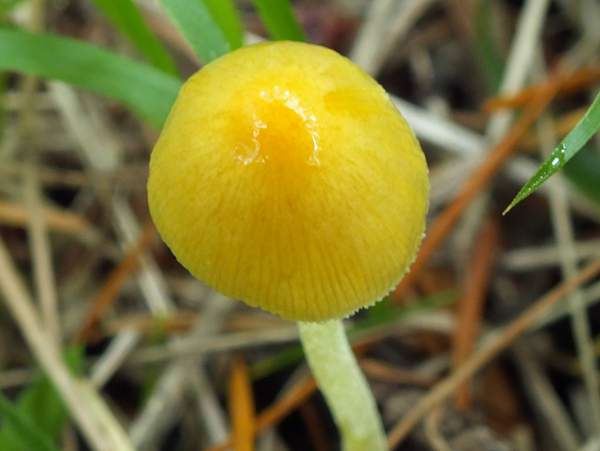
This colourful little mushroom of rich grassland and roadside verges (and found occasionally also on damp woodchip mulch) is one of the shortest-lived of all mushrooms. It goes from a yellow 'egg on a stick' via a pinkish parasol stage to a mid-to-dark brown or, in hot dry weather, light ochre mushroom in less than a day. This mushroom, better known until recently as Bolbitius vitellinus (previously thought to be a separate species but now merged with Bolbitius titubans) is still quite commonly referred to as the Egg Yolk Fungus.
Distribution
Common and widespread in most parts of Britain and Ireland, this little mushroom of manured grassland is found also throughout mainland Europe as well as in many other parts of the world including North America.
Taxonomic history
Described in 1789 by French mycologist Jean Baptiste Francois Pierre Bulliard, who gave it the scientific name Agaricus titubans, this little mushroom was renamed Bolbitius titubans in 1838 - a time when most gilled fungi were initially placed in a giant Agaricus genus, now redistributed to many other genera - by Swedish mycologist Elias Magnus Fries. A very rare variety Bolbitius titubans var. olivaceus was defined in 2000, and so the nominate variety of the Yellow Fieldcap is now formally referred to as Bolbitius titubans var. titubans.
Synonyms of Bolbitius titubans include Agaricus fragilis L., Agaricus equestris Bolton, Agaricus titubans Bull., Agaricus flavidus Bolton, Agaricus boltonii Pers., Agaricus vitellinus Pers., Prunulus boltonii (Pers.) Gray, Prunulus titubans (Bull.) Gray, Bolbitius boltonii (Pers.) Fr., Bolbitius fragilis (L.) Fr., Bolbitius titubans (Bull.) Fr., Bolbitius vitellinus (Pers.) Fr., Bolbitius flavidus (Bolton) Massee, Bolbitius vitellinus var. fragilis (L.) M.M. Moser ex Bon & Courtec., and Bolbitius vitellinus var. titubans (Bull.) Bon & Courtec.
Etymology
Bolbitius, the genus name, means 'of cow dung', although note that the Yellow Fieldcap prefers well rotted dung and tends to shun fresh cow pats.
The specific epithet titubans means staggering or wavering, and these little mushrooms do indeed tend to lean and eventually fall in what could be construed as a a slow-motion stagger!
 |
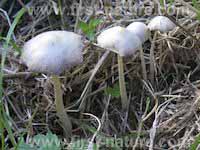
Rotting hay and old cow pats are the main habitats of this delicate little fungus. It fruits through most of the year, often in full sunlight. In the picture on the left, taken at midday, the caps of four young fruit bodies are just beginning to expand... |
 |
...and in this picture, taken five hours later, the caps have expanded fully, faded from yellow to white, and are now beginning to shrivel. By the following day there was almost no evidence of the fruit bodies left. |
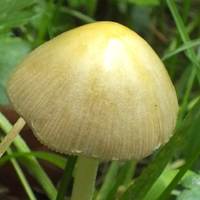 |
Only at the in-between stage are the marginal striations clearly visible. On warm summer days the sticky surface of young caps dries to a silky finish, and then the caps begin greying from the margin. Pale brown spores fall from adnexed and almost free gills that age from straw-yellow through cinnamon to rusty-brown. |
Identification guide
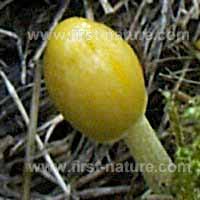 |
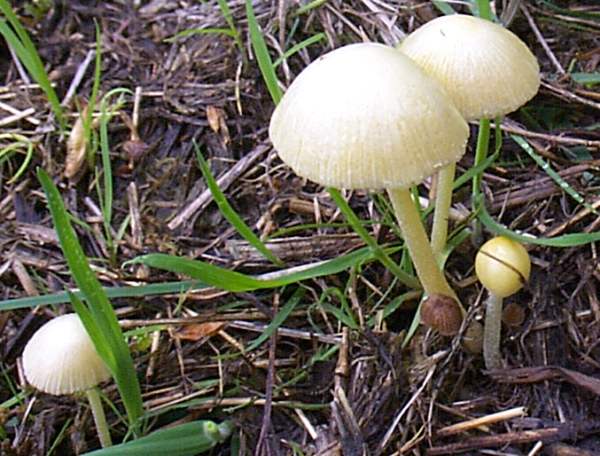
Cap1 to 4cm in diameter at maturity, the caps are at first egg-shaped and chrome-yellow, soon expanding like a parasol as they mature and rapidly greying from the margin. The surface is smooth and viscid. The cap flesh is very thin and easily splits from the edge. |
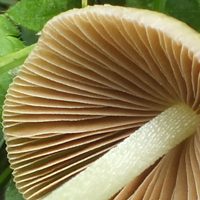 |
GillsAdnate and pale yellow, the moderately spaced gills become cinnamon coloured as the spores mature. Stem2 to 4mm in diameter, white with a yellow tint; slightly granular near the apex and downy as the base. The stem, which has no ring, is hollow and very fragile. |
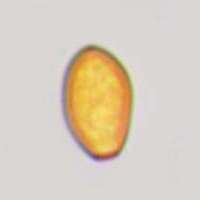 |
SporesEllipsoidal, smooth, 11-15 x 6-9µm.
Spores of Bolbitius titubans, Yellow Fieldcap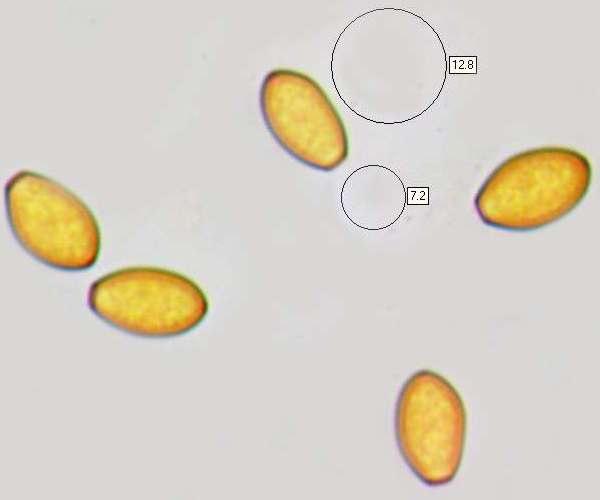 Spore printCinnamon to rust brown. |
Odour/taste |
Not distinctive. |
Habitat & Ecological role |
Saprobic, on rotting straw and in recently manured grassland; occasionally on woodchip mulch; appearing within two days of rain, but then lasting little more than 24 hours. |
Season |
June to October in Britain and Ireland. |
Similar species |
Pluteus chrysophaeus is a longer lasting mushroom; it grows on wood rather than on grass, and its spores are pink rather than cinnamon brown. |
Culinary Notes
The Yellow Fieldcap is generally regarded as inedible, and its small size and thin flesh mean that there is little temptation to try eating this insubstantial mushroom..
Reference Sources
Fascinated by Fungi, 2nd Edition, Pat O'Reilly 2016, reprinted by Coch-y-bonddu Books in 2022.
BMS List of English Names for Fungi
Funga Nordica: 2nd edition 2012. Edited by Knudsen, H. & Vesterholt, J. ISBN 9788798396130
Dictionary of the Fungi; Paul M. Kirk, Paul F. Cannon, David W. Minter and J. A. Stalpers; CABI, 2008
Taxonomic history and synonym information on these pages is drawn from many sources but in particular from the British Mycological Society's GB Checklist of Fungi.

Fascinated by Fungi. Back by popular demand, Pat O'Reilly's best-selling 450-page hardback book is available now. The latest second edition was republished with a sparkling new cover design in September 2022 by Coch-y-Bonddu Books. Full details and copies are available from the publisher's online bookshop...