Coprinopsis lagopus var. lagopus (Fr.) Redhead, Vilgalys & Moncalvo, Johnson & Hopple - Hare'sfoot Inkcap
Phylum: Basidiomycota - Class: Agaricomycetes - Order: Agaricales - Family: Psathyrellaceae
Distribution - Taxonomic History - Etymology - Identification - Culinary Notes - Reference Sources
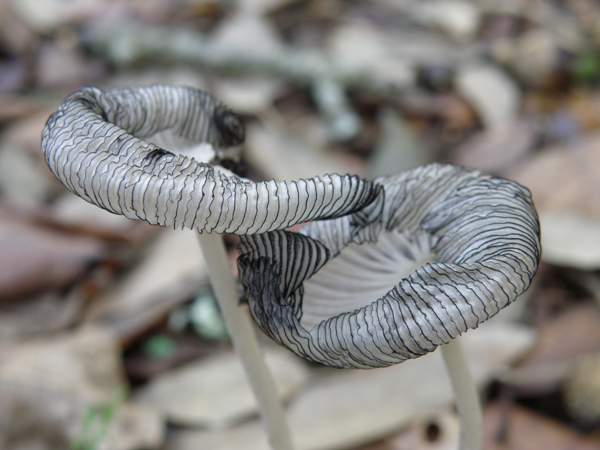
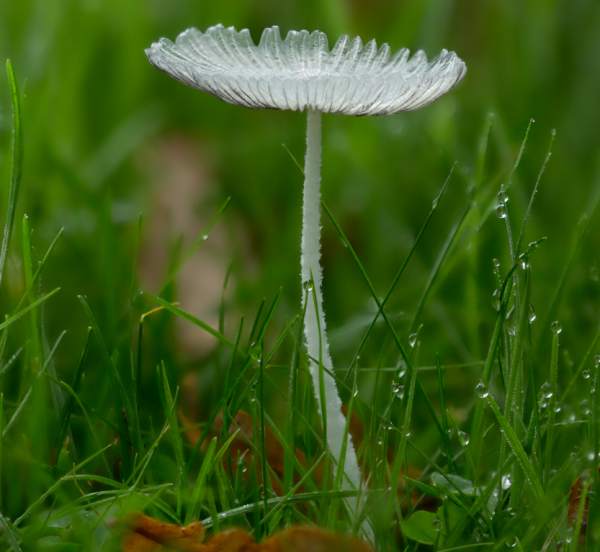
Mature Hare’sfoot Inkcaps look so unlike the immature form that it is hard to believe that the transition between the two does not involve some kind of metamorphosis, as when a caterpillar becomes a butterfly. The furry white coating that initially covers caps and stems disappears as the caps change from egg-shaped to convex and flat, the rim finally turning upwards and shrinking in diameter to produce an inrolled margin that creates a shallow, distinctively black-ribbed translucent bowl.
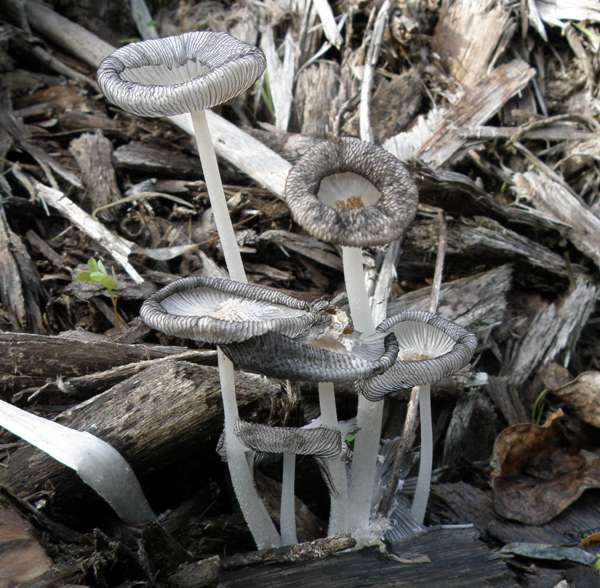
Seen in bright sunlight the intricate beauty of these delicate little inkcaps is quite stunning, but the fruitbodies go through their entire visible lifecycle within 24 hours. Increasingly common on the relatively new urban habitat of woodchip mulch, in the wild this mushroom grows on humus-rich soil and leaf litter, most commonly beside woodland tracks and rides under deciduous trees.
Distribution
Common in most parts of Britain and Ireland, Coprinopsis lagopus occurs throughout mainland Europe and is found also in many other parts of the world including much of Asia and North America.
Note: inkcap is sometimes written as ink-cap or ink cap, and in the USA the terms inky cap or inky-cap are used.
Taxonomic history
The Hare'sfoot Inkcap was described scientifically in 1821 by the great Swedish mycologist Elias Magnus Fries, who named it Agaricus lagopus. (Vast numbers of gilled fungi were dumped into the Agaricus genus in the early days of fungal taxonomy; most have since been moved to other genera leaving in the present-day Agaricus genus a much smaller number of gilled mushrooms that are sometimes referred to as the 'true mushrooms'.) Experts assert that this name encompasses a complex of many similar species.
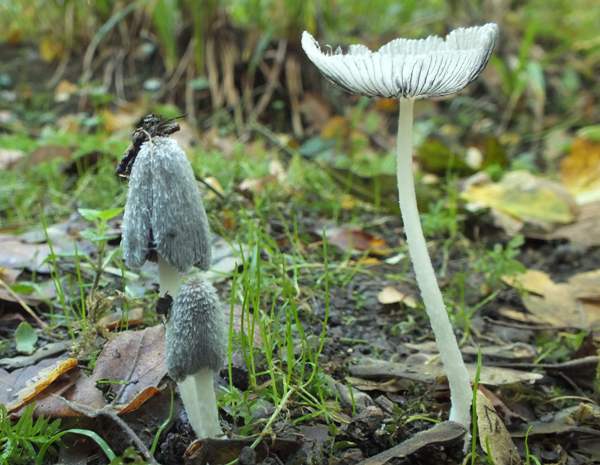
This inkcap was renamed Coprinus lagopus by Fries just 17 years later, and it was referred to by this name by most professional mycologists and virtually all amateurs until 2001. That was when, as a result of molecular (DNA) analysis, the Coprinus genus was shown to contain groups of fungi with only distant relationships to one another, and the earlier Coprinus group was dismantled. The Hare'sfoot Inkcap was moved into the genus Coprinopsis within the family Psathyrellaceae.
Synonyms of Coprinopsis lagopus include Agaricus lagopus Fr., Coprinus lagopus (Fr.) Fr., Coprinus lagopus var. lagopus (Fr.) Fr., and Coprinus lagopus f. macrospermus Romagn.
Etymology
The generic name Coprinopsis indicates that this mushrooms genus is similar to the genus Coprinus, which literally means 'living on dung' - that's true of quite a few of the inkcaps and particularly apt for this species. The specific epithet lagopus comes from ancient Greek words, lagos meaning a hare and pous meaning foot - hence also the common name.
Identification guide
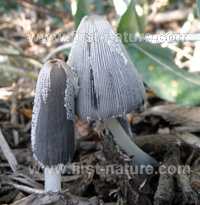 |
CapUsually 1 to 3cm across and initially to 4cm tall; egg-shaped (see left), becoming conical and then flat with a striate margin, the edges turning upwards when old; grey-brown, covered in ephemeral hairy white scales; short lived, deliquescing from the rim within a few hours of becoming fully expanded. |
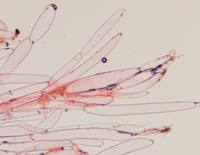 |
PileipellisThe pileipellis is a cutis comprising cylindrical clamped hyphae. Cap structure of Coprinopsis lagopus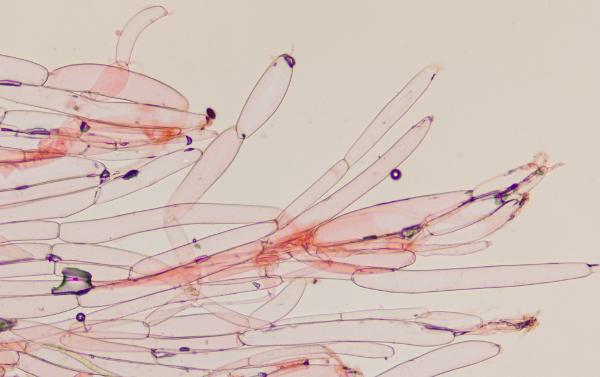 |
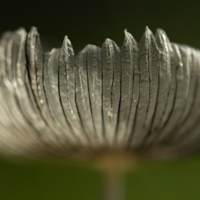 |
GillsAdnexed or free and crowded, the gills of Coprinopsis lagopus are white, turning slightly reddish and then black before deliquescing, together with the cap, starting at the rim. Stem4 to 10cm long and 3 to 6mm dia.; white with ephemeral white scales; no ring. |
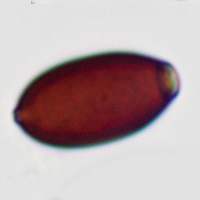 |
SporesEllipsoidal to ovoid, smooth, 11-13 x 6-8µm; nonamyloid. Spores of Coprinopsis lagopus, Hare'sfoot Inkcap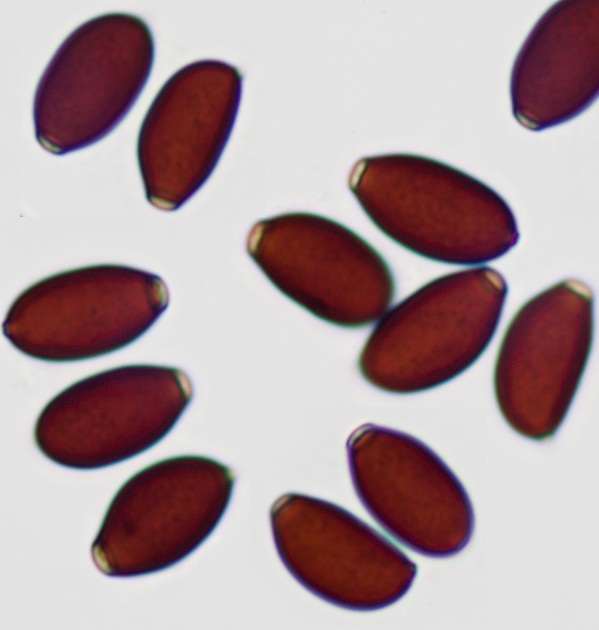 Spore printViolaceous black. |
Odour/taste |
Not distinctive. |
Habitat & Ecological role |
The Hare'sfoot Inkcap grows on humus-rich soil, leaf litter, and increasingly on woodchip mulch. |
Season |
May to November in Britain. |
Similar species |
In the early stages of development, when the caps are 'furry' like the feet of hares, these inkcaps could be confused with Coprinopsis nivea, the Snowy Inkcap, which grows on dung and occasionally on rotting straw. |
Culinary Notes
The Hare'sfoot Inkcap is reported to be inedible, but in any case the caps are so insubstantial that there is no real incentive to give them a try.
Reference Sources
Fascinated by Fungi, 2nd Edition, Pat O'Reilly 2016, reprinted by Coch-y-bonddu Books in 2022.
Orton, P.D. & Watling, R. (1979). British Fungus Flora: Agarics and Boleti. Vol 2. Coprinaceae: Coprinus. Royal Botanic Garden: Edinburgh.
Redhead SA, Vilgalys R, Moncalvo J-M, Johnson J, Hopple JS Jr.; Vilgalys, Rytas; Moncalvo, Jean-Marc; Johnson, Jacqui; Hopple, Jr. John S (2001). 'Coprinus Pers. and the disposition of Coprinus species sensu lato.'. Taxon (International Association for Plant Taxonomy (IAPT)) 50 (1): 203–41.
English Names for fungi; British Mycological Society, 2013.
Dictionary of the Fungi; Paul M. Kirk, Paul F. Cannon, David W. Minter and J. A. Stalpers; CABI, 2008
Taxonomic history and synonym information on these pages is drawn from many sources but in particular from the British Mycological Society's GB Checklist of Fungi.
Acknowledgements
This page includes pictures kindly contributed by Doug Holland and David Kelly.
Fascinated by Fungi. Back by popular demand, Pat O'Reilly's best-selling 450-page hardback book is available now. The latest second edition was republished with a sparkling new cover design in September 2022 by Coch-y-Bonddu Books. Full details and copies are available from the publisher's online bookshop...