Cordyceps militaris (L.) Link - Scarlet Caterpillarclub
Phylum: Ascomycota - Class: Sordariomycetes - Order: Hypocreales - Family: Cordycipitaceae
Distribution - Taxonomic History - Etymology - Identification - Culinary Notes - Reference Sources
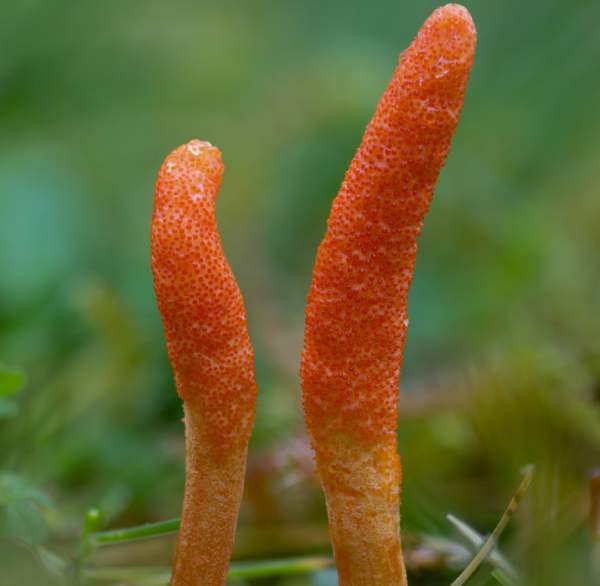
The Scarlet Caterpillarclub is found mainly in grassland and on woodland edges but also occasionally pushing up through bare soil during late summer and autumn. Growing on underground pupae of moths, this ascomycete parasitises its host, turning it into a mushy mess and then pushing up through the turf as a bright orange club. In China related species are highly prized as edible fungi.
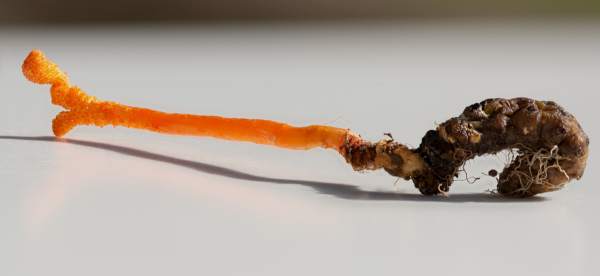
Above: Scarlet Catterpillarclub Cordyceps militaris attached to its host pupa.
Records of Cordyceps fungi in China date from AD620, during the Tang Dynasty, and describe an organism with the ability to transform from animal to plant during summertime and then to change back to an animal for the winter. The former stage seems to be beased on observation (with fungi treated as plants, as they were until very recent times) but the idea of insects being reborn from these fungi is quite fanciful. (The Chinese name for Cordyceps sinensis, which is used extensively as a medicine in China, is Dong chong xia cao, which translates to English as 'winter worm, summer grass'.)

There are several hundred Cordyceps species worldwide. Some attack ants and other kinds of insects, while others parasitise certain kinds of fungi such as puffballs or false truffles. Of at least a dozen Cordyceps species recorded in the British Isles, Cordyceps Militaris, the Scarlet Caterpillarclub, is the most common.
Distribution
An infrequent find in Britain and Ireland, it is quite likely that Cordyceps militaris is more common than it seems. Despite its bright colouring, Scarlet Caterpillarclub is but difficult to spot, because the clubs are usually much shorter than the grass or moss among which they are growing.
Taxonomic history
Carl Linnaeus described the Scarlet Caterpillarclub fungus in 1753, giving it the scientific name Clavaria militaris. Eighty years later, in 1833, German mycologist Johann Heinrich Friedrich Link (1767 - 1850) renamed it Cordyceps militaris, which to the present day remains its generally-accepted scientific name.
Synonyms of Cordyceps militaris include Clavaria militaris L., Sphaeria militaris (L.) Ehrh., andTorrubia militaris (L.) Tul. & C. Tul.
Etymology
The generic name Cordyceps comes from two Latin words: the cord part means a club, and the suffix ceps means head. So club-head fungi they must surely be. Less obviously, perhaps, the specific epithet militaris comes from Latin and may refer to the way this fungus attacks, overpowers and occupies pupae and occasionally larvae of moths.
Identification guide
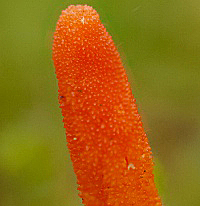 |
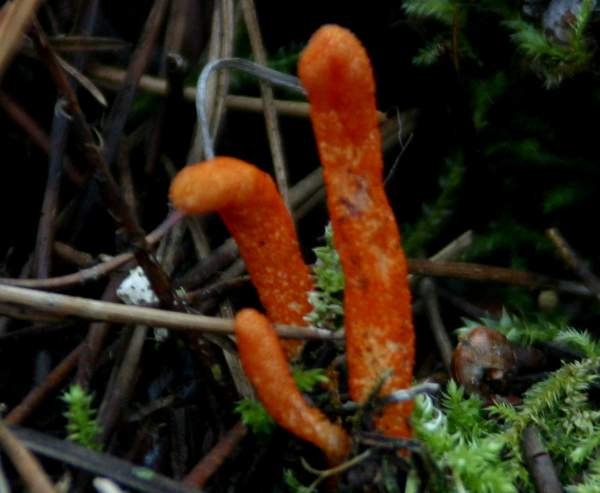
Fruitbody0.5 to 4cm long and 2 to 4mm dia., the fertile head is bright orange or scarlet-orange; club-shaped and slightly swollen; rarely branching; granular, covered in raised pores. The base is attached to a dead insect pupa below the soil surface. The infertile stem is 1 to 3cm long and 1 to 1.5mm dia., usually somewhat wavy; paler orange than the fertile head. |
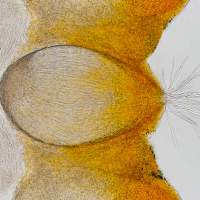 |
Perithecia and asciClose inspection of the surface of a Scarlet Caterpillarclub reveals tiny raised pores at the tops of spherical perithecia (an example, greatly magnified, is shown on the left). The flask-like perithecia are lined with asci 300 - 500µm long x 3.5-5µm diameter. Within each ascus eight ascospores develop.
Perithecia of Cordyceps militaris, Scarlet Catterpilarclub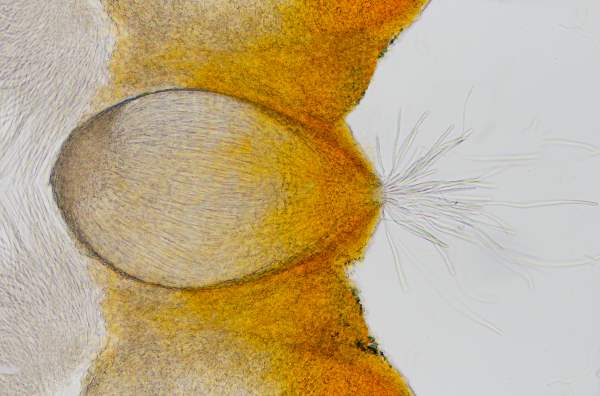 |
SporesMultiseptate (segmented) and filiform (in the form of long threads) eventually breaking into ellipsoidal part-spore segments (rather like a string of sausages), each segment 2-4.5 x 1-1.5µm. Spore printWhite. |
|
Habitat & Ecological role |
In grassland or on mossy woodland edges, always attached to a moth pupa (or exceptionally to a larva) below the ground. |
Season |
Summer and autumn. |
Culinary Notes
Other than for its uses in Chinese medicine, Cordyceps militaris is not generally considered to have any major culinary value. (If it is true that you are what you eat, are you not also what your food eats? Lovely grub!)
Reference Sources
Fascinated by Fungi, 2nd Edition, Pat O'Reilly 2016, reprinted by Coch-y-bonddu Books in 2022.
Dictionary of the Fungi; Paul M. Kirk, Paul F. Cannon, David W. Minter and J. A. Stalpers; CABI, 2008
Taxonomic history and synonym information on these pages is drawn from many sources but in particular from the British Mycological Society's GB Checklist of Fungi.
Acknowledgements
This page includes pictures kindly contributed by David Kelly and by Betty and Tony Rackham.

Fascinated by Fungi. Back by popular demand, Pat O'Reilly's best-selling 450-page hardback book is available now. The latest second edition was republished with a sparkling new cover design in September 2022 by Coch-y-Bonddu Books. Full details and copies are available from the publisher's online bookshop...