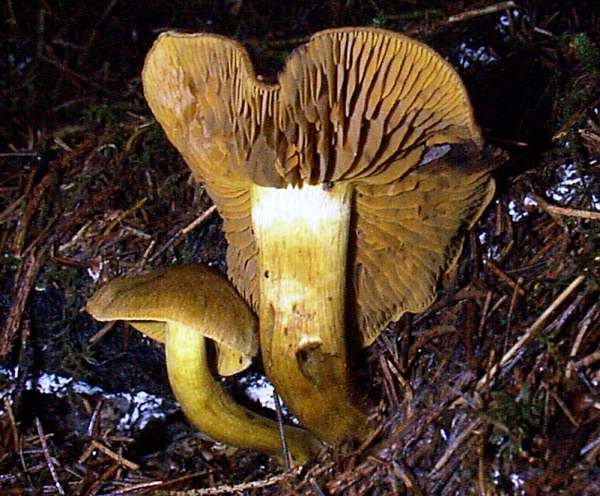
Cortinarius cinnamomeus (L.) Gray - Cinnamon Webcap
Phylum: Basidiomycota - Class: Agaricomycetes - Order: Agaricales - Family: Cortinariaceae
Distribution - Taxonomic History - Etymology - Toxicity - Identification - Reference Sources
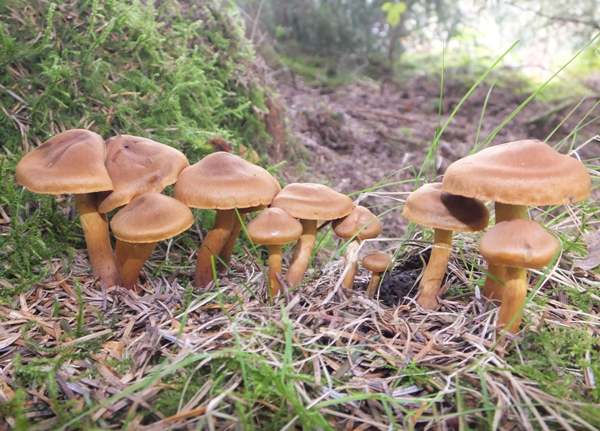
Cortinarius cinnamomeus is a late summer and autumn species that occurs in coniferous woods as well as under birches on heathland. This mycorrhizal woodland mushroom is found mainly in areas of acid soil and often in scattered groups rather than singly.
Few members of the genus Cortinarius are easy to identify, but once you get to know the Cinnamon Webcap it is one of the minority that you should be able to recognise from a distance.
Distribution
An uncommon but quite widespread species in Britain and Ireland, the Cinnamon Webcap is found also throughout most of mainland Europe and in parts of Asia. Cortinarius cinnamomeus is also reported to occur in most parts of North America, where in the west it often fruits in springtime.
Taxonomic history
When Carl Linnaeus described this webcap mushroom in 1753 he gave it the binomial name Agaricus cinnamomeus, which was later ratified by the great Swedish mycologist Elias Magnus Fries. It was British mycologist Samuel Frederick Gray (1766 - 1828) who in 1821 transferred this species to the genus Cortinarius, thereby establishing its currently accepted scientific name as Cortinarius cinnamomeus.
Synonyms of Cortinarius cinnamomeus include Agaricus cinnamomeus L., Dermocybe cinnamomea (L.) Wünsche, Flammula cinnamomea (L.) P. Kumm., and Gomphos cinnamomeus (L.) Kuntze.
You may also come across this species listed in older field guides as Dermocybe cinnamomea (Schaeff.: Fr.) M.M. Moser.
Etymology
The generic name Cortinarius is a reference to the partial veil or cortina (meaning a curtain) that covers the gills when caps are immature. In the genus Cortinarius most species produce partial veils in the form of a fine web of radial fibres connecting the stem to the rim of the cap rather than a solid membrane.
Just as you might expect, the specific epithet cinnamomeus is a reference to the cinnamon colour of this mushroom.
Toxicity
This mushroom is generally regarded as 'suspect' and may contain dangerous toxins; it should not be gathered for eating. Some reddish Cortinarius species with which the Girdled Webcap could be confused contain the toxin orellanine, which if eaten destroys human kidneys and liver.
Identification guide
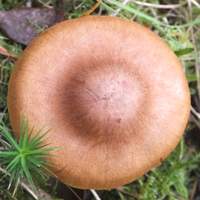 |
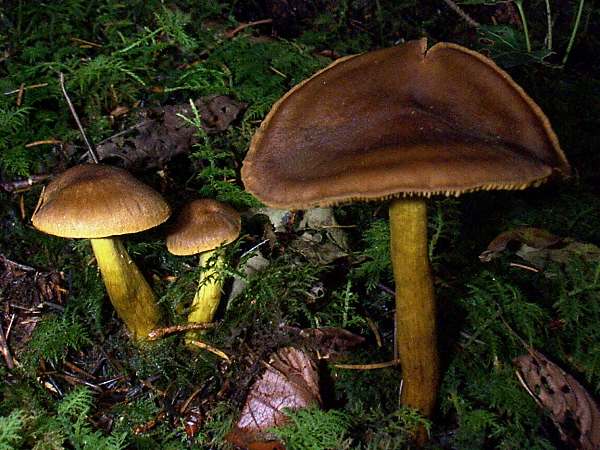
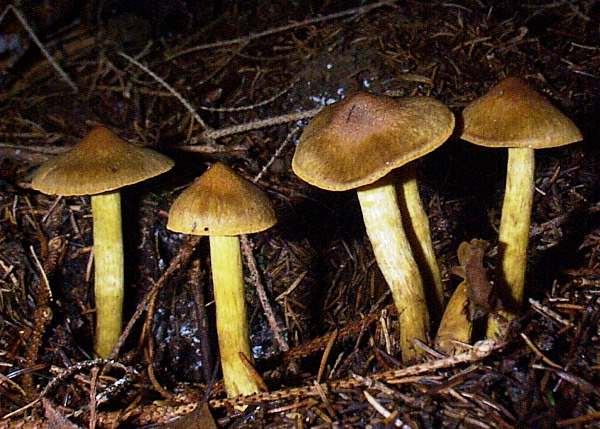
CapYoung caps of Cortinarius cinnamomeus are convex, later flattening but with a moderately broad umbo. The finely fibrilose caps vary in colour from hazel to olive-brown becoming more rust-brown towards the centre.The thin cap flesh is dirty yellow, often with an olive tinge. Caps expand to between 2 and 7cm diameter at maturity. |
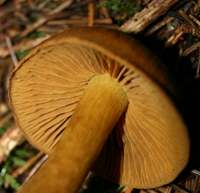 |
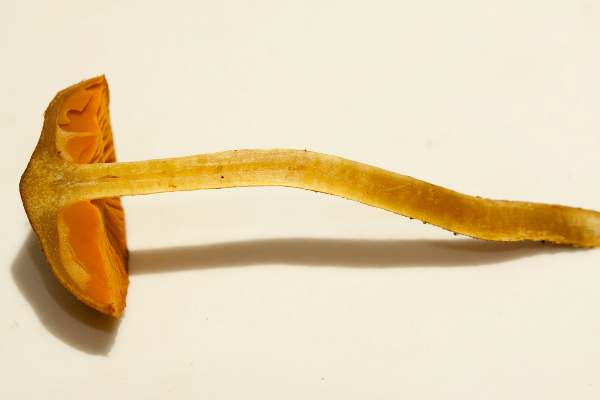
GillsA yellow partial veil covers the gills of young caps. The thin and fairly crowded, adnate gills of the Cinnamon Webcap are at first yellow or ochraceous-orange and later cinnamon. As the spores mature the gills become rather more rust stained. Stem3 to 8mm in diameter, stems of the Cinnamon Webcap range from 3 to 9cm tall. The top of the stipe or stem is pale yellow; the lower part is olive-brown and covered in red-brown fibrils. |
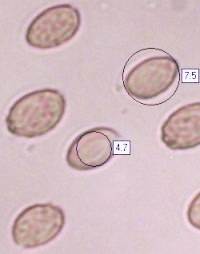 |
SporesEllipsoidal to amygdaliform (almond shaped), 5.5-8.2 x 3.8-5µm; noticeably verrucose. Spore printRusty brown. |
Odour/taste |
Smell faintly of radish; taste bitter. |
Habitat & Ecological role |
In coniferous woodland; less often found on heathland under birch trees. |
Season |
August to December in Britain and Ireland. |
Similar species |
Cortinarius semisanguineus has a similar cap and stem but is readily distinguished by its bright red gills. |
Reference Sources
Fascinated by Fungi, 2nd Edition, Pat O'Reilly 2016, reprinted by Coch-y-bonddu Books in 2022.
Funga Nordica, Henning Knudsen and Jan Vesterholt, 2008.
Fungi of Switzerland Agarics, part 3: Cortinariaceae, Breitenbach, J., Kränzlin, F.
British Mycological Society, English Names for Fungi
Dictionary of the Fungi; Paul M. Kirk, Paul F. Cannon, David W. Minter and J. A. Stalpers; CABI, 2008
Taxonomic history and synonym information on these pages is drawn from many sources but in particular from the British Mycological Society's GB Checklist of Fungi.
Acknowledgements
This page includes pictures kindly contributed by David Kelly.
Fascinated by Fungi. Back by popular demand, Pat O'Reilly's best-selling 450-page hardback book is available now. The latest second edition was republished with a sparkling new cover design in September 2022 by Coch-y-Bonddu Books. Full details and copies are available from the publisher's online bookshop...