Trees Birds Mammals Fish Amphibians Reptiles
Wild Algarve
Bookshop
Cortinarius mucosus (Bull.) J J Kickx - Orange Webcap
Phylum: Basidiomycota - Class: Agaricomycetes - Order: Agaricales - Family: Cortinariaceae
Distribution - Taxonomic History - Etymology - Toxicity - Identification - Reference Sources
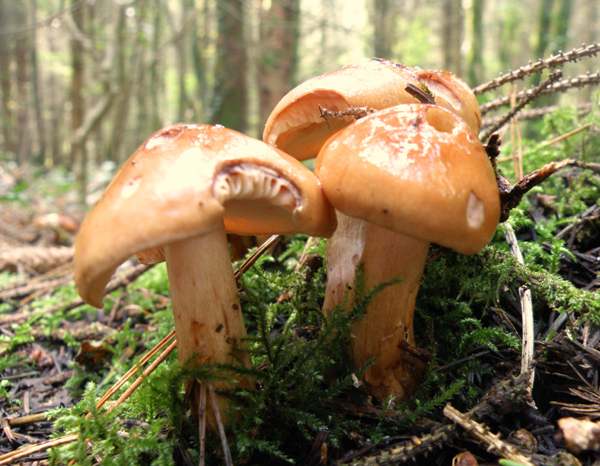
Cortinarius mucosus is an occasional find. It grows on soil, usually in small groups or singly, in birch and conifer forests, nearly always on dryish acidic soil. This species is most often found in association with two-needle pines, with which it forms mycorrhizas.
The caps and veil filaments are very slimy and sticky, even in dry weather - an unusual characteristic that makes this one of the few orange-brown Cortinarius species that can be identified from macroscopic characters alone.
Distribution
An uncommon species in Britain and Ireland, the Orange Webcap is found rather more frequently (in my experience) in central and southern Europe. Look out for this gregarious webcap in mixed woodland containing birches or pines.
Taxonomic history
When French mycologist Jean Baptiste Francois (Pierre) Bulliard described this webcap in 1792 he gave it the binomial scientific name Agaricus mucosus. (Vast numbers of gilled fungi were dumped into the Agaricus genus in the early days of fungal taxonomy; most have since been moved to other genera leaving in the present-day Agaricus genus a much smaller number of gilled mushrooms that are sometimes referred to as the 'true mushrooms'.) It was the Flemish botanist Jean Jacques Kickx (1842 - 1887) who, in 1867, transferred this species to the genus Cortinarius, thus establishing its currently-accepted scientific name Cortinarius mucosus.
Synonyms of Cortinarius mucosus include Agaricus mucosus Bull., Agaricus collinitus ß mucosus (Bull.) Fr., and
Cortinarius collinitus var. mucosus (Bull.) Fr.
Etymology
The generic name Cortinarius is a reference to the partial veil or cortina (meaning a curtain) that covers the gills when caps are immature. In the genus Cortinarius most species produce partial veils in the form of a fine web of radial fibres connecting the stem to the rim of the cap rather than a solid membrane.
Just as you might expect, the specific epithet mucosus refers to the slimy coating that covers the cap and stem of this webcap mushroom.
Toxicity
This mushroom is generally regarded as 'suspect' and may contain dangerous toxins; it should not be gathered for eating. Some reddish Cortinarius species with which the Girdled Webcap could be confused contain the toxin orellanine, which if eaten destroys human kidneys and liver.
Identification guide
 |
Cap
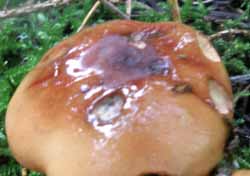
The glossy mid-brown to orange-brown cap, darker towards the centre, is at first convex before flattening at maturity and sometimes developing a slight central depression.
Cap diameter is typically 6 to 9cm when fully expanded. |
 |
Gills
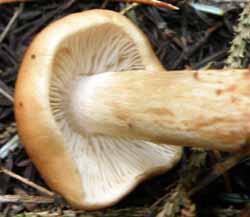
The adnate gills, which are covered by a slimy cortina in young specimens, are pale yellowish at first, becoming rusty brown as the spores mature.
Stem
The stem, which is almost white until the spores mature and begin falling, is typically 10 to 20mm in diameter and 6 to 12
cm tall. |
| |
Spores
Ellipsoidal, 12-14 x 5.5-6.5µm, with a roughened surface.
Spore print
Rusty reddish-brown. |
Odour/taste |
Not distinctive. |
Habitat |
Mycorrhizal, under birch and coniferous trees (especially spruce). |
Season |
August to November in Britain and Ireland. |
Similar species |
Other webcaps within the sub-genus Myxacium are also characterised by their slimy nature, especially in wet weather, and so all macroscopic and microscopic characters must be checked to minimise the risk of misidentification. |
Reference Sources
Fascinated by Fungi, 2nd Edition, Pat O'Reilly 2016, reprinted by Coch-y-bonddu Books in 2022.
Funga Nordica, Henning Knudsen and Jan Vesterholt, 2008.
Fungi of Switzerland Agarics, part 3: Cortinariaceae, Breitenbach, J., Kränzlin, F.
Dictionary of the Fungi; Paul M. Kirk, Paul F. Cannon, David W. Minter and J. A. Stalpers; CABI, 2008
Taxonomic history and synonym information on these pages is drawn from many sources but in particular from the British Mycological Society's GB Checklist of Fungi.
Top of page...
Fascinated by Fungi. Back by popular demand, Pat O'Reilly's best-selling 450-page hardback book is available now. The latest second edition was republished with a sparkling new cover design in September 2022 by Coch-y-Bonddu Books. Full details and copies are available from the publisher's online bookshop...