Crepidotus variabilis (Pers.) P. Kumm. - Variable Oysterling
Phylum: Basidiomycota - Class: Agaricomycetes - Order: Agaricales - Family: Inocybaceae
Distribution - Taxonomic History - Etymology - Culinary Notes - Identification - Reference Sources
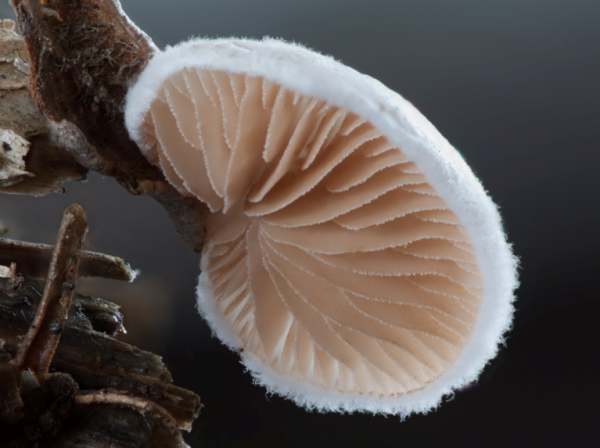
Crepidotus variabilis is a tiny, kidney-shaped fungus that appears on dead twigs of broad-leaved trees in autumn and winter. The attachment is virtually always sessile (having no stem).
Distribution
Common in woodlands throughout Britain and Ireland, this mushroom occurs across mainland Europe and is also recorded in many other parts of the world including North America.
Taxonomic history
The variable oysterling was described in 1799 by Christiaan Hendrik Persoon, who established its basionym when he gave it the binomial scientific name Agaricus variabilis. It was German mycologist Paul Kummer who, in 1871, transferred this species to the genus Crepidotus, whereupon it acquired its currently accepted scientific name Crepidotus variabilis.
Synonyms of Crepidotus variabilis include Agaricus variabilis Pers., Crepidopus variabilis (Pers.) Gray, and Claudopus variabilis (Pers.) Gillet.
Etymology
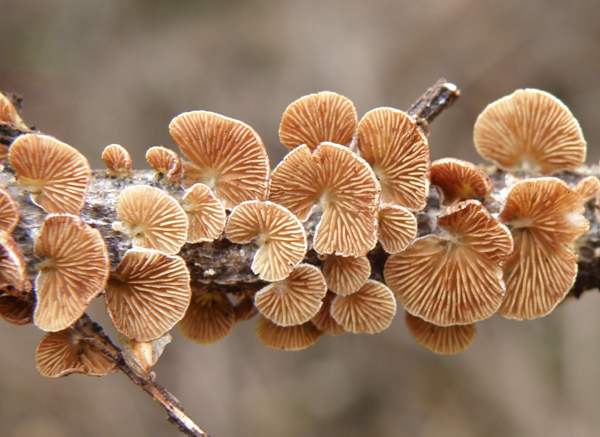
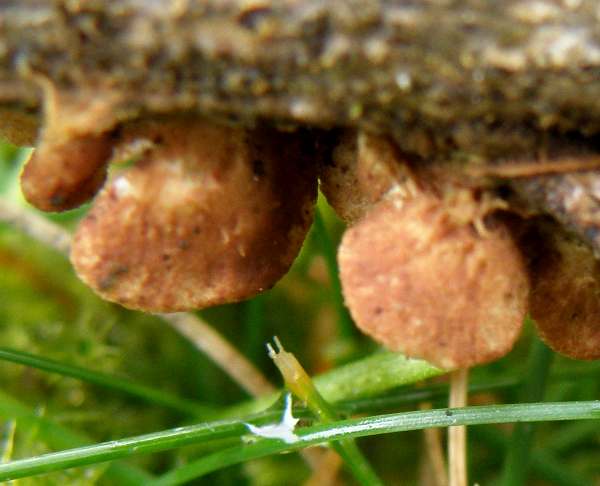
The generic name Crepidotus comes from crepid- meaning a base, such as a shoe or a slipper (although some sources state that it means ;cracked'), and otus, meaning an ear - hence it suggests a 'slipper-like ear'. In the past mushrooms in this genus were sometimes referred to as slipper mushrooms. The specific epithet variabilis means, as you might expect, variable. These little mushrooms are indeed very variable in shape, depending on where they are attached to their substrate; for example they can form neat semicircular brackets on the sides of twigs and branches or almost perfectly circular fans when growing underneath a dead branch.
The picture above shows a twig covered with fruitbodies of the Variable Oysterling at a stage when the bgills have turned pinkish cinnamon because they are covered in mature spores.
Identification guide
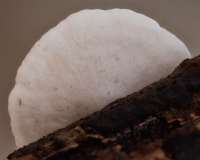 |
CapThe cap is initially white, turning creamy-ochre with age. The fruitbody is nearly always laterally attached to its substrate - usually small twigs - via its cap, rather than with a stipe. Typically 0.5 to 2cm in diameter and often slightly lobed. |
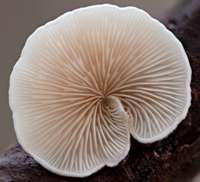 |
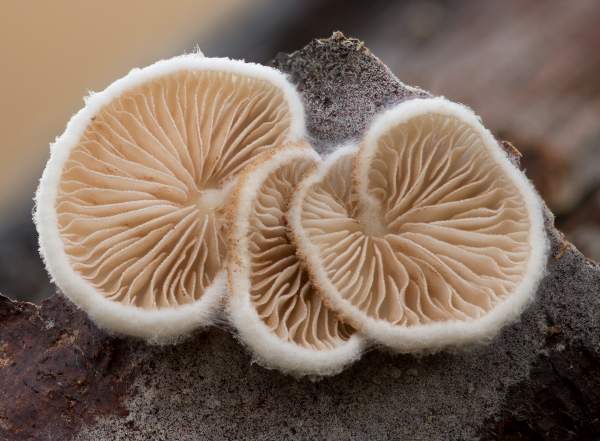
GillsThe gills, which radiate from the point of attachment, are moderately crowded. White at first, they gradually turn yellow-brown or buff. StemAlmost invariably this little woodland mushroom has no stipe (stem) at all. |
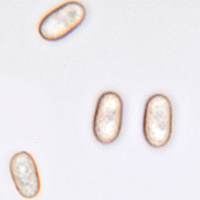 |
SporesEllipsoidal, ornamented with minute spiny warts, 5-7 x 3-3.5um.
Spores of Crepidotus variabilis, Variable Oysterling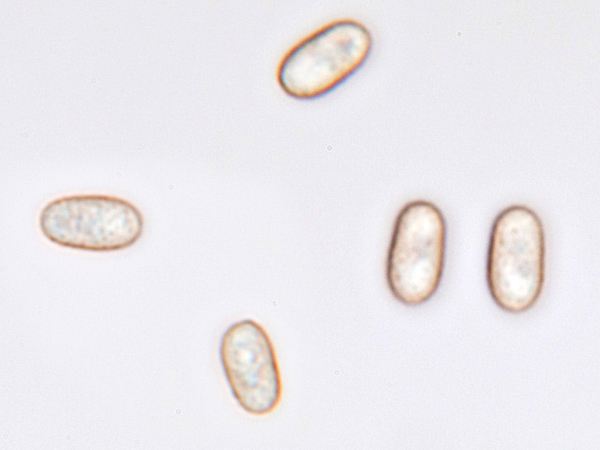 |
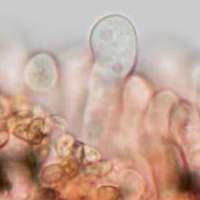 |
CheilocystidiaCheilocystidia (gill edge cystidia) are clavate, sometimes branched, 20-25 x 5-12μm.
Cheilocystidia of Crepidotus variabilis, Variable Oysterling |
Odour/taste |
Not distinctive. |
Habitat & Ecological role |
Saprobic, on twigs in deciduous and mixed woodland and at the bases of hedgerows. |
Season |
August to December in Britain and Ireland. |
Similar species |
Crepidotus cesatti has a scalloped margin and its spores are sub-globose rather than ellipsoidal. Crepidotus mollis is larger and its cap has small scales on an ochre background. |
Culinary Notes
This fairly common summer and autumn species is of dubious edibility and may even be poisonous.
Many authorities give this genus family status as Crepidotaceae, while others include the genus Crepidotus within the family Inocybaceae; this should be a warning that these little fungi are not for eating, as some Inocybe species are deadly poisonous. Care is needed, therefore, when collecting edible Oyster Mushrooms, Pleurotus ostreatus, to avoid accidentally gathering Variable Oysterlings instead.
The pinkish buff spore print of a Variable Oysterling (and in most instances its much smaller size) readily distinguishes it from edible Oyster Mushrooms, whose spore prints are not pinkish buff but white.
Reference Sources
Fascinated by Fungi, 2nd Edition, Pat O'Reilly 2016, reprinted by Coch-y-bonddu Books in 2022.
British Mycological Society. English Names for Fungi.
Dictionary of the Fungi; Paul M. Kirk, Paul F. Cannon, David W. Minter and J. A. Stalpers; CABI, 2008
Taxonomic history and synonym information on these pages is drawn from many sources but in particular from the British Mycological Society's GB Checklist of Fungi.
Acknowledgements
This page includes pictures kindly contributed by David Kelly.

Fascinated by Fungi. Back by popular demand, Pat O'Reilly's best-selling 450-page hardback book is available now. The latest second edition was republished with a sparkling new cover design in September 2022 by Coch-y-Bonddu Books. Full details and copies are available from the publisher's online bookshop...