
Crucibulum laeve (Huds.) Kambly - Common Bird's-nest Fungus
Phylum: Basidiomycota - Class: Agaricomycetes (Gasteromycetes) - Order: Agaricales - Family: Agaricaceae
Distribution - Taxonomic History - Etymology - Culinary Notes - Identification - Reference Sources
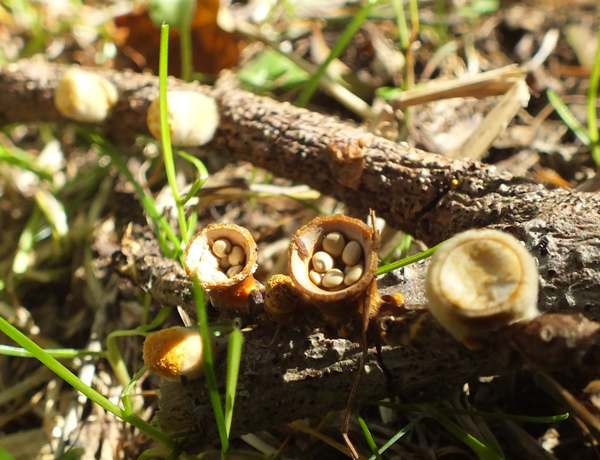
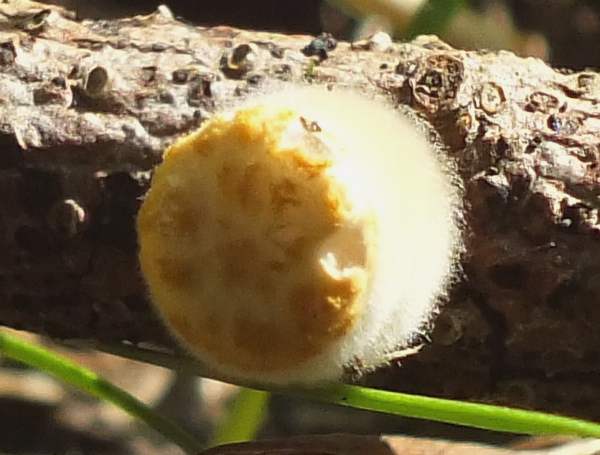
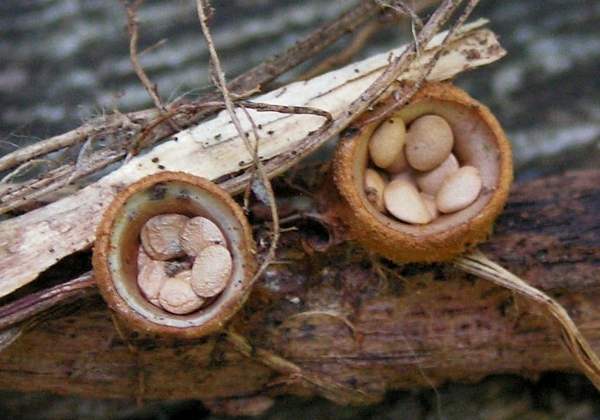
Crucibulum laeve is one of several species of bird's-nest fungi and is among the most common. That's not to say that any of the bird's-nest fungi are easy to find, as they are so tiny and easily overlooked. This remarkable fungus grows on rotting wood (commonly small twigs) and dead stems of other vegetation. Initially a yellow-brown, tapering cup-shaped fruitbody with a yellowish woolly membrane covering the top, once mature the embrane fall away revealing egg-like peridioles that contain the spores of the fungus.
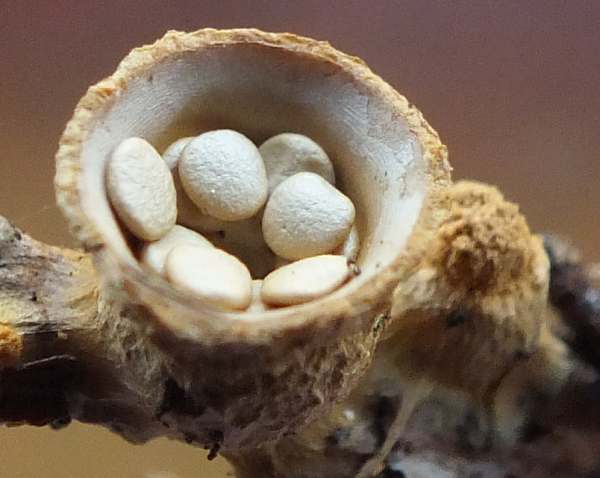
The 'eggs' are attached to the base of the nest by fine threads that break when raindrops knock the eggs from the nest. By this unusual means the spores are dispersed.
Distribution
Probably fairly common and widespread throughout Britain and Ireland but rarely reported because they are so small and inconspicuous and because their most common habitat is dark, damp woodland, Common Bird's Nest fungi are found also throughout other temperate parts of the world including mainland Europe and Asia. This species is known to occur in many parts of North America.
Taxonomic history
This gasteromycete fungus was described in 1778 by the British mycologist William Hudson (1730 - 1793), who gave it the binomial scientific name Peziza laevis.
It was American mycologist P E Kambly who in 1936 transferred this speces to the genus Crucibulum, whereupon it acquired its currently accepted scientific name Crucibulum laeve.
Synonyms of Crucibulum laeve include Peziza crucibuliformis Schaeff., Peziza laevis Huds., Peziza lentifera Huds.,
Cyathus crucibuliformis (Schaeff.) Hoffm., Nidularia laevis (Huds.) Huds., Cyathus scutellaris Roth, Cyathus crucibulum Pers., Nidularia crucibulum Fr., and Crucibulum vulgare Tul. & C. Tul.
Etymology
The generic name Crucibulum means in the form of a crucible, while the specific epithet laeve means smooth - a reference to the smooth inner surfaces of the 'nests'.
Identification guide
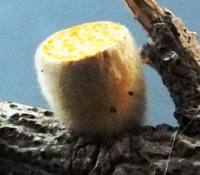 |
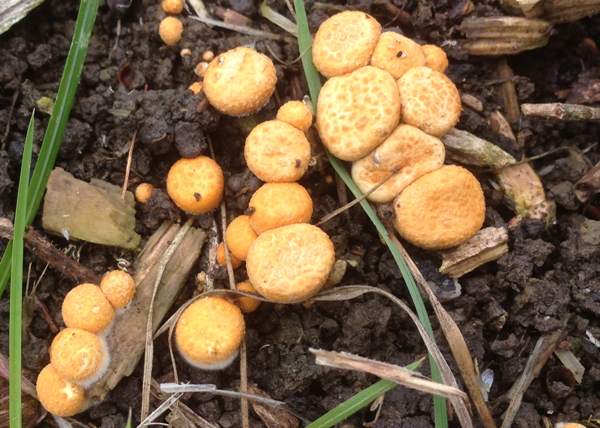
FruitbodyStemless cup-shaped fruitbodies, each 'nest' containing typical five to eight whitish 'eggs' each typically 1.5mm in diameter. A 'nest' is typically 5 to 10mm across and up to 10mm tall. In its immature state each nest or peridium is covered by a yellow-orange membrane, as shown on the left. At maturity the cover ruptures around the rim, and then wind and rain can contact the eggs (peridioles) and disperse them. Often these fungi occur in such densely-packed groups that nests become distorted by the pressure from neighbouring fruitbodies. |
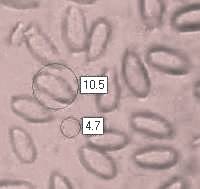 |
SporesEllipsoidal, smooth, 8-11 x 4-6µm; inamyloid. Spore massWhite. |
Odour/taste |
Not significant. |
Habitat & Ecological role
|
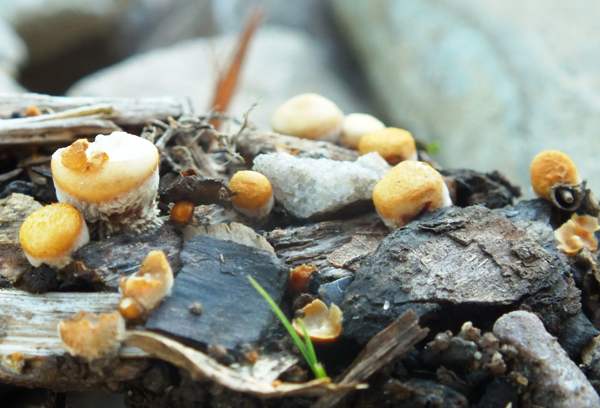
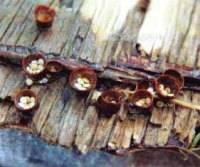
Saprobic, mainly found on fallen dead twigs, old rotting timber (including discarded plywood, as seen on the left) and decaying vegetation. Distribution seems to be very patchy. |
Season |
July to October in Britain and Ireland. |
Similar species |
Several similar species occur throughout Europe. Cyathus striatus (with ribbed nest walls) and Cyathus olla (often on manured soil) are also found occasionally in the British Isles, mainland Europe and further afield. |
Culinary Notes
These fungi are reported to be inedible. My investigations to date have revealed no recipes for cooking these kinds of eggs, and the Common Bird's Nest is not an ingredient of any kind of bird's nest soup... as far as I know!
Reference Sources
Fascinated by Fungi, 2nd Edition, Pat O'Reilly 2016, reprinted by Coch-y-bonddu Books in 2022.
Dictionary of the Fungi; Paul M. Kirk, Paul F. Cannon, David W. Minter and J. A. Stalpers; CABI, 2008
Taxonomic history and synonym information on these pages is drawn from many sources but in particular from the British Mycological Society's GB Checklist of Fungi.
Acknowledgement
This page includes pictures kindly contributed by Simon Harding, Doug Holland and Hilary Rose.
Fascinated by Fungi. Back by popular demand, Pat O'Reilly's best-selling 450-page hardback book is available now. The latest second edition was republished with a sparkling new cover design in September 2022 by Coch-y-Bonddu Books. Full details and copies are available from the publisher's online bookshop...