
Cystoderma amianthinum (Scop.) Fayod - Earthy Powdercap
Phylum: Basidiomycota - Class: Agaricomycetes - Order: Agaricales - Family: Agaricaceae
Distribution - Taxonomic History - Etymology - Identification - Culinary Notes - Reference Sources
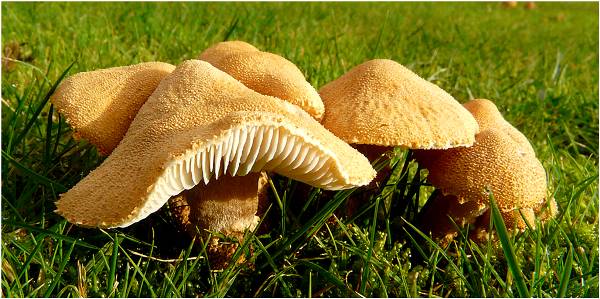
These colourful little mushrooms turn up in all sorts of grassy-mossy places, but they are most common on acid moorland and heathland. (Picture left is shown courtesy John Chester.)
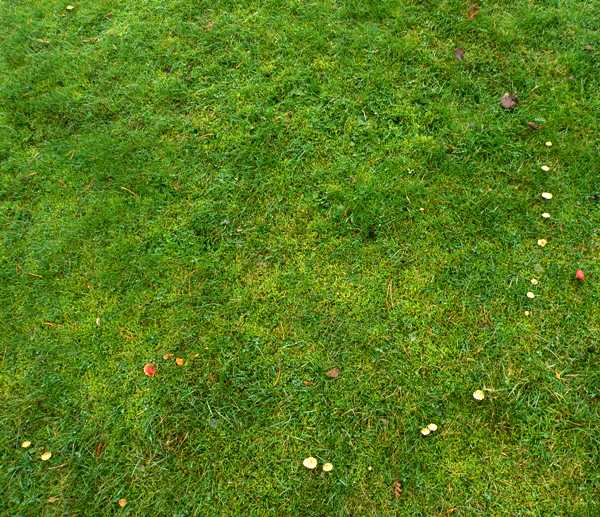
On lawns, Earthy Powdercaps sometimes produce fairy rings several metres in diameter. Above: a ring of Earthy Powdercaps 5m in diameter encloses several other grassland fungi including colourful waxcaps (Hygrocybe species) and pinkgills (Entoloma species).
Distribution
Abundant in all kinds of acid grassland and some woodland habitats in Britain and Ireland, Cystoderma amianthinum occurs also throughout mainland Europe, being most widespread and abundant in cooler northern countries. The Earthy Powdercap is also found in North America.
Cystoderma amianthinum, the Earthy Powdercap, can be found in marshy grassland and peeping up through sphagnum moss on the edges of bogs, but it is intolerant of pollution and therefore an indicator of environmental quality.
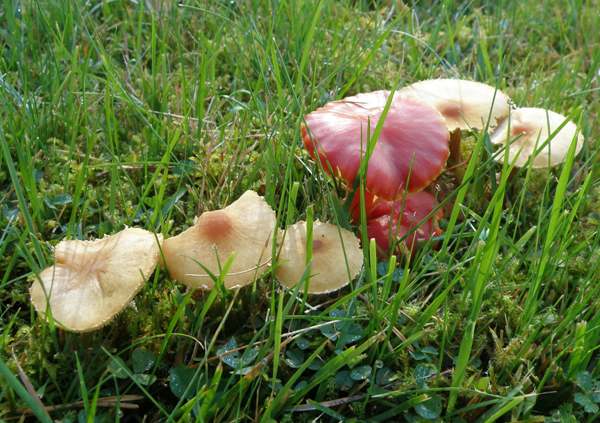
On lawns and in parkland where fertilisers and herbicides have not been used, it is not unusual to see Earthy Powdercaps alongside waxcaps and pinkgills, as was the case on the lawn of an hotel in Aviemore, Scotland, where the photograph shown above was taken. (The waxcaps are Hygrocybe coccinea, the Scarlet Waxcap.)
Taxonomic history
When Giovani Antonio Scopoli described this species in 1772 he gave it the scientific name Agaricus amianthinus. (In the early days of fungal taxonomy most gilled mushrooms were placed in the Agaricus genus, which has since been spread across many genera, leaving in Agaricus only what are commonly called the 'true mushrooms'.) In 1889 the Swiss mycologist Victor Fayod (1860 - 1900) transferred the Earthy Powdercap into the genus Cystoderma, creating its currently accepted scientific name Cystoderma amianthinum.
Synonyms of Cystoderma amianthinum include Agaricus amianthinus Scop., Lepiota granulosa var. amianthina (Scop.) P. Kumm., Lepiota amianthina (Scop.) P. Karst., Lepiota amianthina var. alba Maire, and Cystoderma amianthinum f. rugulosoreticulatum Bon.
A few authorities recognise the form of Earthy Powdercap with a deeply radially wrinkled cap as a separate species which has been given the scientific name Cystoderma rugoso-reticulatum; however, the majority, including the FRDBI, have reduced this form to synomy.
Although a few other Cystoderma species have been recorded in Britain and/or Ireland none of them is common and most are extremely rare.
Etymology
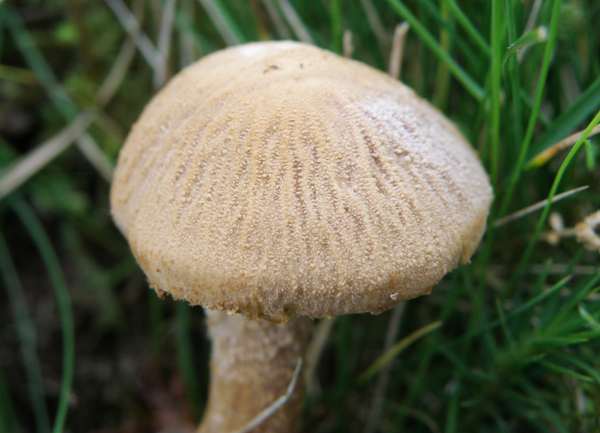
Powdercaps usually do have granular cap surfaces - the generic name Cystoderma means 'blistered skin' - but their most distinctive feature is the marked contrast between the smoothness of the stem above the ring and its scaly surface below. The overall impression is of a mushroom wearing an ill-fitting stocking.
The specific epithet amianthinum means like amiantus (from a Latin origin) or amiantos (from Greek) and means pure or unsullied. (Asbestos is made from bundles of fine silicate fibres each less than 1μm in diameter, and the very finest grade of asbestos fibres is known as 'amianthus', which comes from the same word stem.)
Identification guide
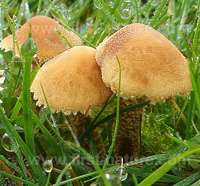 |
Cap2 to 5cm across; initially convex, becoming broadly convex or flat; colour variable from pale ochraceous yellow to reddish brown (centre darker and umbonate in Cystoderma amianthinum var. rugosoreticulatum); surface finely granular, sometimes radially wrinkled. |
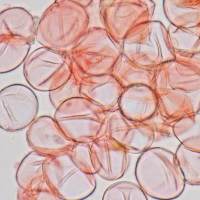 |
The photomicrograph on the left shows sphaerocysts (globose hyphal cell structures) in the cap of Cystoderma amianthinum. Sphaerocysts in the cap of Cystoderma amianthinum |
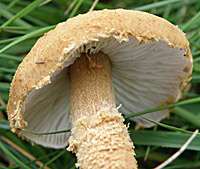 |
GillsAdnate or adnexed; crowded; white at first, becoming cream. Stem3 to 5cm long and 4 to 8mm diameter; colour as cap or darker, but paler above ring; smooth or very finely granular above ring, scaly below; cylindrical; small tan coloured, collar-like stem ring is sometimes short-lived but usually at least some fragments of the ring are persistent. |
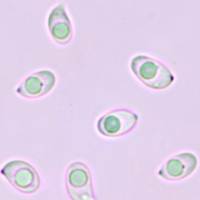 |
SporesEllipsoidal to oblong, smooth, 5-7.5 x 3-4μm; amyloid. Spores of Cystoderma amianthinum, Earthy Powdercap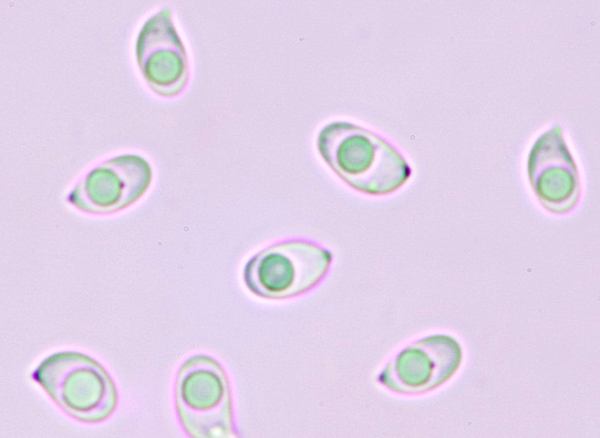 Spore printWhite or pale cream. |
Odour/taste |
Musty or earthy odour; taste not significant. |
Habitat & Ecological role |
Saprobic in grassland and woodland edges; on heathland and even on mossy edges of bogs. |
Season |
Summer and autumn. |
Related species |
Squamanita paradoxa, the Powdercap Strangler, is a rare grassland mushroom that attacks the Earthy Powdercap, Cystoderma amianthinum, apparently growing up through its stem and producing a voilet cap in place of the orange cap of the Earthy Powdercap. The lower part of the stem remains identical to that of the host mushroom, giving a very strange two-tone effect. |
Culinary Notes
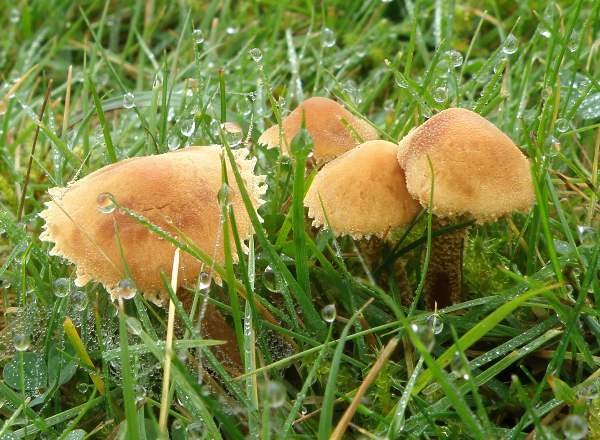
Some authorities say that the Earthy Powdercap is an edible mushroom, but many more now categorise it as inedible. Eating bright orange mushrooms is generally a bad idea, as some deadly poisonous Cortinarius species (webcaps) are orange, as also are some of the poisonous dapperlings (Lepiota species) - although the southern European species Amanita caesarea, commonly known as Caesar's Mushroom, is a notable exception to this rule. We are quite sure that Cystoderma amianthinum would not be a good substitute for Caesar's Mushroom!
Reference Sources
Pat O'Reilly; Fascinated by Fungi, 2016.
Dictionary of the Fungi; Paul M. Kirk, Paul F. Cannon, David W. Minter and J. A. Stalpers; CABI, 2008
British Mycological Society (2010). English Names for Fungi
Taxonomic history and synonym information on these pages is drawn from many sources but in particular from the British Mycological Society's GB Checklist of Fungi.
Fascinated by Fungi. Back by popular demand, Pat O'Reilly's best-selling 450-page hardback book is available now. The latest second edition was republished with a sparkling new cover design in September 2022 by Coch-y-Bonddu Books. Full details and copies are available from the publisher's online bookshop...