
Exidia thuretiana (Lév.) Fr. - White Brain Fungus
Phylum: Basidiomycota - Class: Tremellomycetes - Order: Auriculariales - Family: Auriculariaceae
Distribution - Taxonomic History - Etymology - Identification - Culinary Notes - Reference Sources
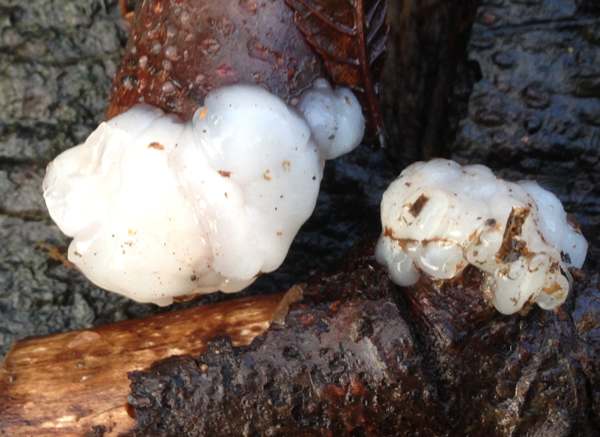
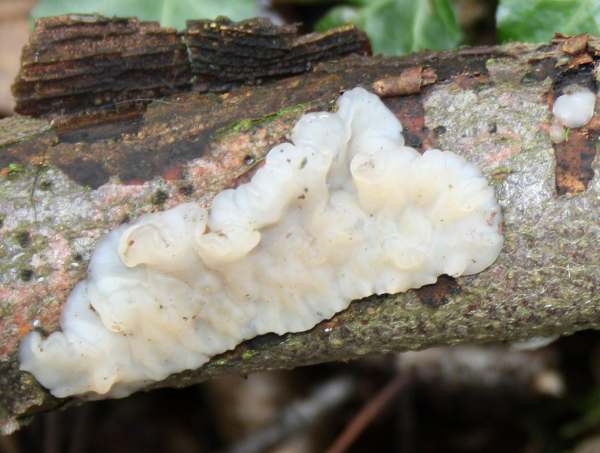
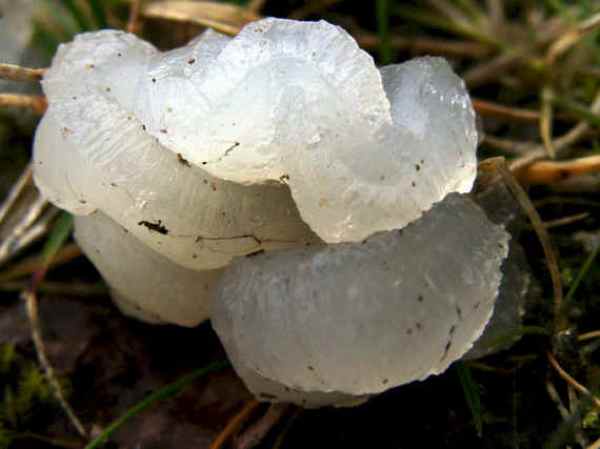
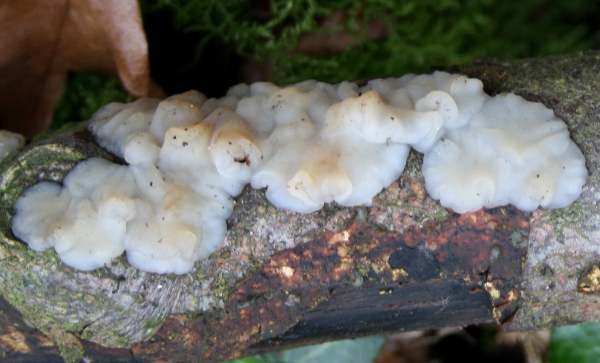
Exidia thuretiana appears on rotting hardwood, and particularly beech. In dry weather this fungus shrinks and becomes quite hard. You will need wet weather to find this fungus: during dry spells it shrivels up almost completely to leave just a transparent rubbery patch on the host wood.
Autumn and winter are the best times to look for this species.
Distribution
Exidia thuretiana occurs throughout Britain and Ireland, but in most areas it is rather an uncommon find. This jelly fungus can be seen also in many countries on mainland Europe and in northern Africa.
Taxonomic history
The basionym of this species was established in 1848 by the French physician and mycologist Joseph-Henri Léveillé (1796 - 1870), who described this jelly fungus and gave it the binomial scientific name Tremella thuretiana. Then in 1874 Swedish mycologist Elias Magnus Fries transferred this species to the genus Exidia, and so its scientific name became Exidia thuretiana, which remains its generally-accepted name today. (It was also Fries who, in 1822, separated out the genus Exidia from what had previously been a much larger genus Tremella.)
Synonyms of Exidia thuretiana include Tremella thuretiana Lév., but this jelly fungus has also been described by various authors under a number of other binomials including Exidia albida, Tremella albida, Tremella cerebrina, and Tremella hyalina.
Etymology
Exidia, the generic name, means exuding or staining, and both seem appropriate because these jelly fungi do look like exudations when moist and like dark stains on wood when they dry out.
The specific epithet thuretiana honours Gustave Adolphe Thuret (1817 - 1875), a noted French botanist and founder of the Jardin botanique de la Villa Thuret. M. Thuret was also the owner of the Château de Rentilly, in the grounds whereof Exidia thuretiana was first collected.
Identification guide
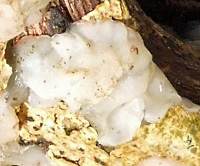 |
FruitbodyPure white when wet, drying to almost invisible, the fruiting bodies are cushion shaped, becoming contorted with age and fusing with neighbouring fruiting bodies to form a large mass several cm across. Individual fruit bodies grow to between 0.2 and 1cm across. (Picture: Paul Machin) |
SporesCylindrical to allantoid (sausage-shaped), smooth, 13-18 x 5.5-7µm; inamyloid. Spore printWhite. |
|
Odour/taste |
Not distinctive. |
Habitat & Ecological role |
Mainly on dead and decaying hardwood, particularly Beech and Ash. |
Season |
Late autumn and early winter in Britain and Ireland. |
Similar species |
Tremella mesenterica is usually yellow and has a brain-like structure, but it does also have a (rare) white form. |
Culinary Notes
This jelly fungus is of dubious edibility, and in any case it is too insubstantial to be worth collecting for food. We therefore - Class it as being of no culinary value.
Reference Sources
Fascinated by Fungi, 2nd Edition, Pat O'Reilly 2016, reprinted by Coch-y-bonddu Books in 2022.
British Mycological Society (2010). English Names for Fungi
Dictionary of the Fungi; Paul M. Kirk, Paul F. Cannon, David W. Minter and J. A. Stalpers; CABI, 2008
Taxonomic history and synonym information on these pages is drawn from many sources but in particular from the British Mycological Society's GB Checklist of Fungi.
Acknowledgements
This page includes pictures kindly contributed by Simon Harding.
Fascinated by Fungi. Back by popular demand, Pat O'Reilly's best-selling 450-page hardback book is available now. The latest second edition was republished with a sparkling new cover design in September 2022 by Coch-y-Bonddu Books. Full details and copies are available from the publisher's online bookshop...