
Ganoderma lucidum (Curtis) P. Karst. - Lacquered Bracket
Phylum: Basidiomycota - Class: Agaricomycetes - Order: Polyporales - Family: Ganodermataceae
Distribution - Taxonomic History - Etymology - Identification - Culinary Notes - Reference Sources
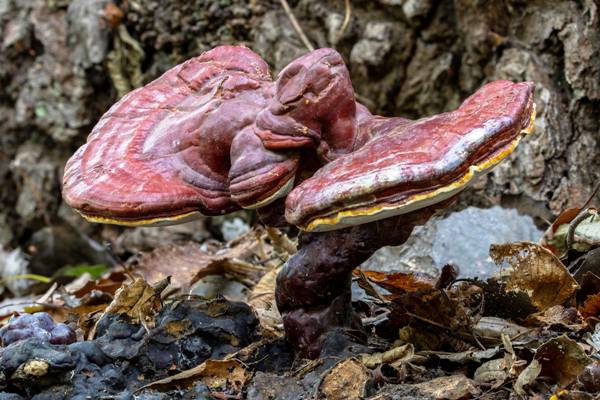
Ganoderma species are notoriously difficult to identify with confidence because of their variability, and Ganoderma lucidum is no exception.
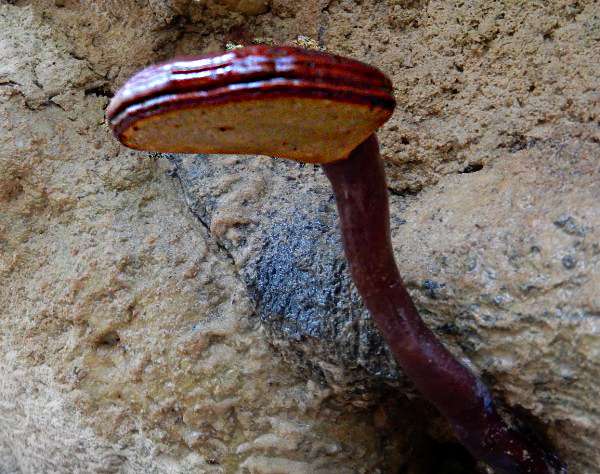
Before it matures and begins releasing clouds of brown spores, which attach themselves to the upper surface of the cap (and the bark of the tree to which it is attached) thereby masking its lacquered appearance, this is one of the most beautiful of large bracket fungi. Unfortunately it is not a common sight in Britain and Ireland.
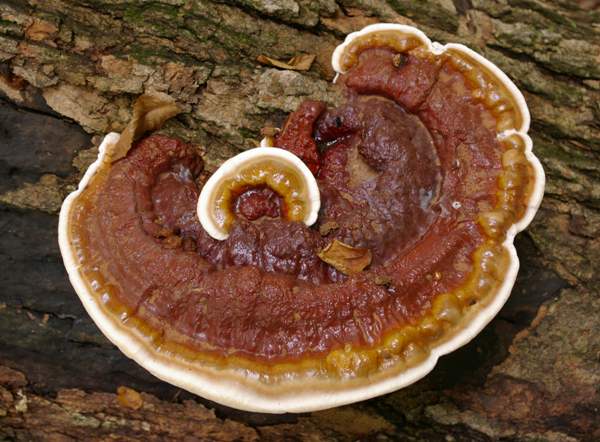
Occasionally this polypore grows on the flat top of a stump or on the uppermost surface of a felled trunk, in which circumstances it can sometimes form a beautiful rosette rather than a bracket.
The superb sessile (stemless) specimen shown above was photographed in the USA. In North America this sessile form is quite common, although short-stemmed brackets do also occur there. Long-stemmed forms of this remarkable polypore are found most frequently in the tropics, but I have seen them in Britain, France and Portugal.
In oriental medicine, dried and powdered Ganoderna lucidum is highly valued; it is known as the Reishi Mushroom in Japan, Lingzhi in China and Youngzhi in Korea. (These common names also encompass another species, Ganoderma tsugae.) In the Far East these fungi have been used medicinally for at least 2000 years.
During summer and early autumn, when Ganoderma lucidum releases spores in their billions, the upper surface of these brackets can get covered with a dense coating of reddish-brown spores.
Distribution
An uncommon find in Britain and Ireland, Ganoderma lucidum occurs throughout mainland Europe as well as in many parts of Asia and North America.
Taxonomic history
The species was described in 1781 by British mycologist William Curtis (1746 - 1799), who gave it the scientific name Boletus lucidus. From the opposite hemisphere, it was the famous Finnish mycologist Peter Karsten (1834 - 1917) who transferred this polypore to its present genus in 1881, renaming it Ganoderma lucidum.
Synonyms of Ganoderma lucidum are plentiful and include include Boletus lucidus Curtis, Boletus laccatus Timm, Grifola lucida (Curtis) Gray, Polyporus lucidus (Curtis) Fr., Polyporus laccatus (Timm) Pers., Fomes lucidus (Curtis) Fr., and Ganoderma laccatum (Timm) Pat.
Ganoderma lucidum is the type species of the Ganoderma genus.
Etymology
The specific epithet lucidum means 'shining', which seems almost superfluous because the genus name Ganoderma comes from the Greek words Ganos and derma and translates to 'shining skin'. Compared with many other members of this genus, however, Ganoderma lucidum is particularly bright and shiny.
Identification guide
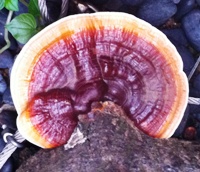 |
CapUp to 25cm across; to 4cm thick, sometimes sessile but more often with a stalk; fan-shaped or kidney-shaped, most often laterally attached but occasionally almost centrally attached when in sessile form, concentrically grooved yellow, orange, red and purplish zones shading to ochre towards the margin and with a whitish growing edge; eventually turning purple-brown all over the upper surface, finally blackening (The picture on the left is shown by courtesy of Farhan Rasheed.) |
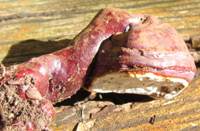 |
StemStems may be rudimentary or quite substantial; they are eccentrically attached to the caps and are broad near the point of attachment and usually narrower towards the stem base. Stems can be up to 20cm in length, although 5 to 15cm is more typical. The red-brown stem and upper cap surface have a varnished gloss, becoming dull and matt when covered in spores. |
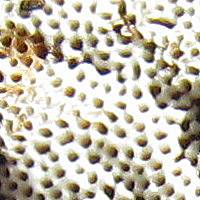 |
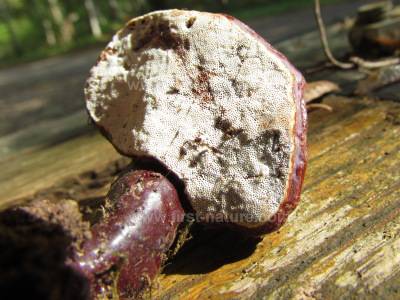
Tubes and PoresThe tubes are white at first, later becoming ochraceous; 5 to 20mm deep and typically spaced at 4 to 6 pores per mm. The small roundish pores are just perceptible to the naked eye; they are white when the fruiting body is young, turning brown with age or when bruised. |
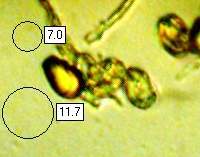 |
SporesEllipsoidal to ovoid with one end flattened, twin walled, 7-12 x 6-8µm; ornamented with a few fine warts. Spore printReddish-brown. |
Odour/taste |
Odour not significant; taste rather bitter. |
Habitat & Ecological role |
In Britain and Ireland the Lacquered Bracket is parasitic mainly at or near the bases of old oak and maple trees or saprobic on the stumps of these and occasionally other recently felled broadleaf trees. |
Season |
This annual bracket fungus releases spores in summer and autumn, but the tough fruitbodies persist for several months. |
Similar species |
Ganoderma resinaceum is stemless; it has larger spores and smaller pores and a more rounded margin than Ganoderma lucidum. Ganoderma applanatum, the Artist's Fungus, is ochre brown, stemless, and broadly attached to its substrate. |
Culinary Notes
The medicinal claims for Ganoderma lucidum, known as 'Reishi' in Japan and 'Ling Zhi' in China, make it one of the most sought after fungi used in oriental medicine. Extracts are made from the bracket itself and from its spores. The only specimens I have found have either been immature with spongy flesh or fully grown and almost rock hard except for the growing edge. Anti-cancer, anti-bacterial and antiviral effects are among the many claims for potions produced from the Lacquered Bracket. We have no recipes for soups or other mushroom dishes based on this bracket fungus.
Reference Sources
, Pat O'Reilly, 2016
Mattheck, C., and Weber, K. Manual of Wood Decays in Trees. Arboricultural Association 2003.
Dictionary of the Fungi; Paul M. Kirk, Paul F. Cannon, David W. Minter and J. A. Stalpers; CABI, 2008
Taxonomic history and synonym information on these pages is drawn from many sources but in particular from the British Mycological Society's GB Checklist of Fungi.
Acknowledgements
This page includes pictures kindly contributed by Wayne Hicks, Doug Holland, Harold Seelig and Farhan Rasheed.
Fascinated by Fungi. Back by popular demand, Pat O'Reilly's best-selling 450-page hardback book is available now. The latest second edition was republished with a sparkling new cover design in September 2022 by Coch-y-Bonddu Books. Full details and copies are available from the publisher's online bookshop...