Gymnosporangium clavariiforme
Phylum: Basidiomycota - Class: Pucciniomycetes - Order: Pucciniales - Family: Pucciniaceae
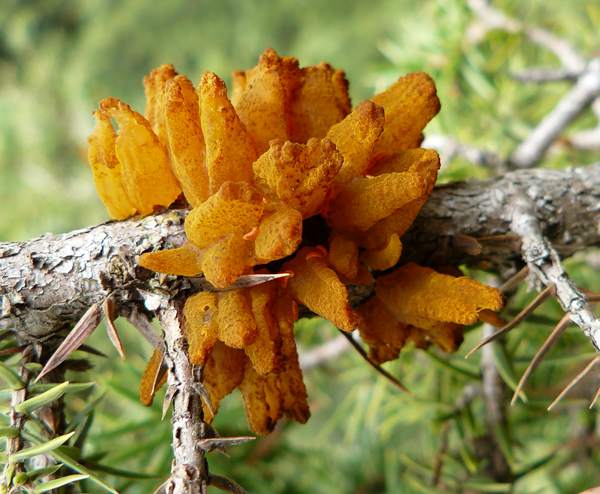
Rust fungi have complex lifecycles, and some of them even switch host part-way through their development. Gymnosporangium calvariiforme is one such example.
If you notice this strange fungus it will almost certainly be at the stage where it is producing orange fruitbodies on Junipers. Later the fungus produces yellow depressions on the leaves of its secondary host - Hawthorn in the case of this particular fungus.
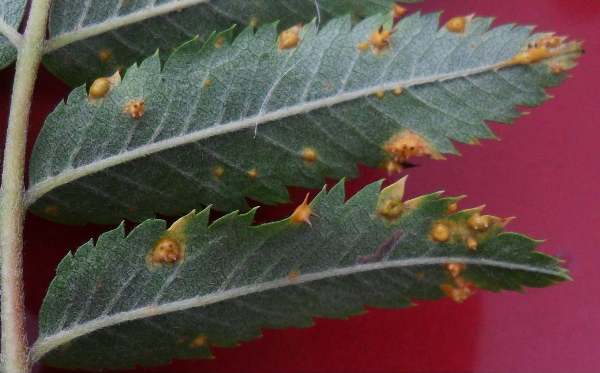
We don't have a picture of this rust fungus on its secondary host (Hawthorn), but below is the closely-related Gymnosporangium cornutum, whose secondary hosts are members of the family Rosaceae.
Identification Guide
Description |
On its primary host, Juniper, this fungus produces rusty horns with a rubbery texture; each horn is typically 1cm across and up to 3cm long; they are clustered around stem, usually in the form of a ball. Juniper trees do not seem to be damaged by this rust fungus, but its alternate host, Hawthorn, is more seriously affected, not only by yellow spots on its leaves but also via the haws (fruits of the Hawthorn), which sprout small white tubes that eventually produce spores. The spores released from the fungus on a hawthorn must contact a Juniper, of course, in order to continue the process. |
Spore Print |
White. |
Habitat & Ecological role |
On Junipers as primary host and Hawthorn as alternate host. |
Season |
The orange rusty horns appear on Junipers in springtime. |
Occurrence |
Fairly common where there are Junipers. |
Similar species |
Many other rust fungi produce orange spots on the leaves of particular plants; others produce yellow, red, purple or black spots. The colour of the fruitbody and the host species infected are aids to identification. Few people study this fascinating branch of mycology, for which a good microscope is essential. |
Reference Sources
Fascinated by Fungi, 2nd Edition, Pat O'Reilly 2016, reprinted by Coch-y-bonddu Books in 2022.
Dictionary of the Fungi; Paul M. Kirk, Paul F. Cannon, David W. Minter and J. A. Stalpers; CABI, 2008
Taxonomic history and synonym information on these pages is drawn from many sources but in particular from the British Mycological Society's GB Checklist of Fungi.
Acknowledgements
This page includes pictures kindly contributed by Arnor Gullanger and Penny Turner.
Fascinated by Fungi. Back by popular demand, Pat O'Reilly's best-selling 450-page hardback book is available now. The latest second edition was republished with a sparkling new cover design in September 2022 by Coch-y-Bonddu Books. Full details and copies are available from the publisher's online bookshop...