
Hebeloma mesophaeum (Pers.) Quél. - Veiled Poisonpie
Phylum: Basidiomycota - Class: Agaricomycetes - Order: Agaricales - Family: Strophariaceae
Distribution - Taxonomic History - Etymology - Toxicity - Identification - Reference Sources
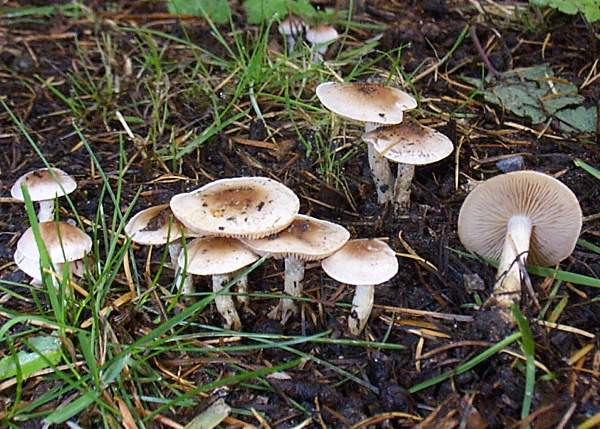
Nearly always associated with conifers on sandy acidic soil, Hebeloma mesophaeum is a relatively small and very common mushroom; it is yet another of the many woodland fungui that give off a radish-like odour when cut or crushed.
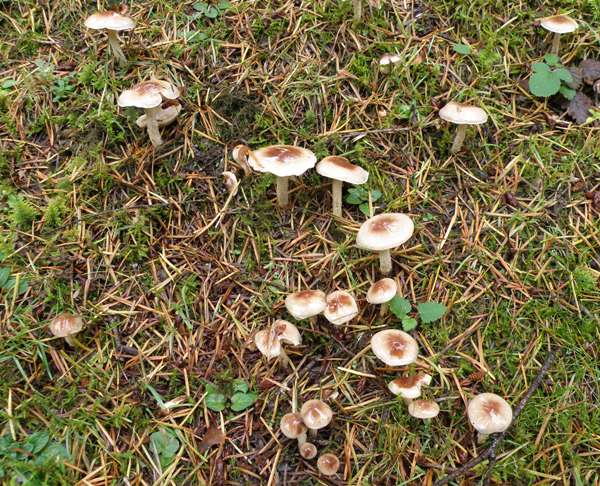
Hebeloma mesophaeum occurs most often under pine trees in late summer and autumn, where it sometimes grows in very large groups. This infrequently encountered mycorrhizal species is very slimy and sticky in wet weather.
Distribution
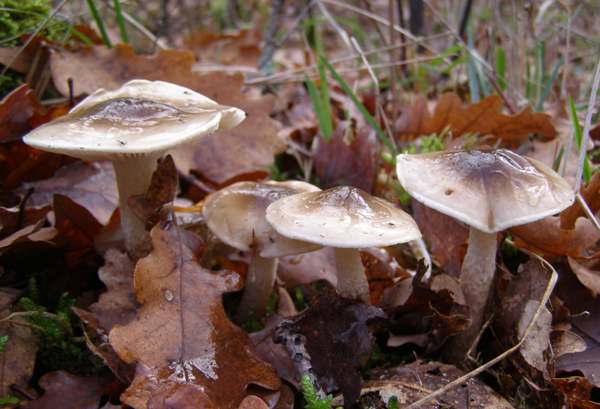
Common in pine and birch woodlands on acid soils throughout Britain and Ireland, where it fruits usually in groups (sometimes in great numbers), this distinctive mushroom is found also in many countries on mainland Europe. Veiled Poisonpie is common and widespread in North America.
Taxonomic history
This mushroom was described in 1828 by Christiaan Hendrik Persoon, who gave it the scientific binomial name Agaricus fastibilis var. mesophaeus and, ten years later, the name Agaricus mesophaeus. (Vast numbers of gilled fungi were dumped into the Agaricus genus in the early days of fungal taxonomy; most have since been moved to other genera leaving in the present-day Agaricus genus a much smaller number of gilled mushrooms that are sometimes referred to as the 'true mushrooms'.)
It was French mucologist Lucien Quélet who, in 1872, transferred this species to the genus Hebeloma, whereupon the Veiled Poisonpie mushroom acquired its currently-accepted scientific name of Hebeloma mesophaeum.
Synonyms of Hebeloma mesophaeum include Agaricus fastibilis var. mesophaeus Pers., Agaricus mesophaeus (Pers.) Fr., Agaricus strophosus Fr., Hebeloma mesophaeum var. mesophaeum (Pers.) Quél., Agaricus mesophaeus var. minor Cooke, Hebeloma strophosum (Fr.) Sacc., Hebeloma mesophaeum var. minor (Cooke) Massee, Hebeloma flammuloides Romagn., and Hebeloma mesophaeum var. strophosum (Fr.) Quadr.
Etymology
The generic name Hebeloma comes from two Ancient Greek words: hebe- means youth, and the suffix -loma means a veil. Thus mushrooms of this genus have a veil (the partial veil that covers the gills) only in the early stages of fruitbody development - when they are youthful. We come across that suffix -loma in several other fungi genera including Entoloma, and Tricholoma.
The specific epithet mesophaeum means with a dusky middle - well, the centre of the cap is darker than the rest!
Toxicity
Just the common name Veiled Poisonpie should be enough to warn anyone from gathering these mushrooms for food. This is quite likely to be a toxic toadstool, as it is certainly known that several other species in the genus Hebeloma are seriously poisonous; we therefore treat this species as inedible and probably pioisonous.
Identification guide
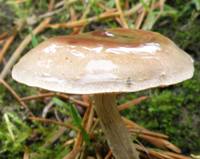 |
CapYoung caps are conical and then convex, later becoming almost flat. The centre is date brown, while the outer area is pale buff with an almost white margin. The surface is viscid in wet weather, and the flesh of the cap is white. Cap diameter varies from 2.5 to 4.5cm at maturity. |
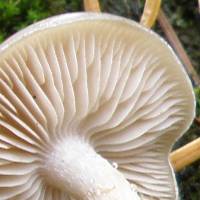 |
GillsYoung specimens have pale clay-brown gills; they are adnexed with a decurrent tooth; they are moderately crowded. As the spores mature, the gills turn darker brown. Stem3 to 4mm in diameter and 4 to 7cm tall, the fibrous stems are pale buff, gradually becoming tinged with brown as the fruiting body ages. The stem flesh is also buff. There is no distinct ring but just a zone-like region. |
SporesEllipsoidal, 8-10 x 5-6µm; finely warty. Spore printBrown. |
|
Odour/taste |
Odour of radish; bitter taste. |
Habitat & Ecological role |
Mycorrhizal, mainly under pines in damp places. |
Season |
August to November in Britain and Ireland. |
Reference Sources
Fascinated by Fungi, 2nd Edition, Pat O'Reilly 2016, reprinted by Coch-y-bonddu Books in 2022.
Dictionary of the Fungi; Paul M. Kirk, Paul F. Cannon, David W. Minter and J. A. Stalpers; CABI, 2008
Taxonomic history and synonym information on these pages is drawn from many sources but in particular from the British Mycological Society's GB Checklist of Fungi.
Fascinated by Fungi. Back by popular demand, Pat O'Reilly's best-selling 450-page hardback book is available now. The latest second edition was republished with a sparkling new cover design in September 2022 by Coch-y-Bonddu Books. Full details and copies are available from the publisher's online bookshop...