
Hygrocybe reidii Kühner - Honey Waxcap
Phylum: Basidiomycota - Class: Agaricomycetes - Order: Agaricales - Family: Hygrophoraceae
Distribution - Taxonomic History - Etymology - Identification - Culinary Notes - Reference Sources
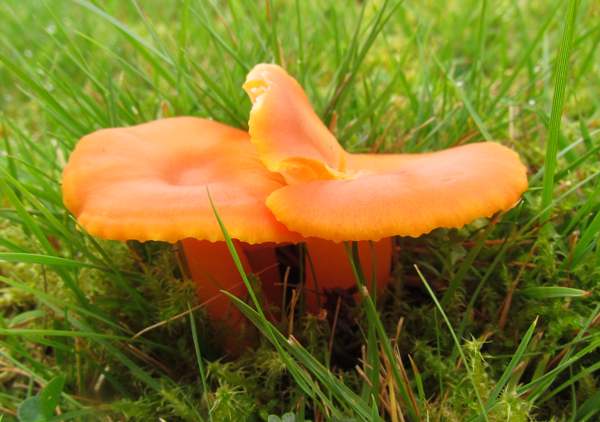
The Honey Waxcap is one of the dry, scurfy-capped members of its genus, many of which are either greasy or slimy with smooth cap surfaces. At maturity it is not uncommon for the caps to distort and split radially.
Cap colour is a poor guide to identification of orange and red waxcaps in particular, and so it is essential to check the texture of both the cap and the stem as well as gill spacing and the form of the gill attachment.
The common name is not a reference to the colour of this lovely grassland fungus, which in most instances is a deeper orange than any honey that we know of, but to its odour, which is strongest in the freshly cut or bruised flesh of the lower part of the stem. If you do not have a particularly good sense of smell but would nevertheless like to check this out, scratch the surface of a stem base and then place it into a sealed box or polythene bag and leave it there for a few minutes; sniff it immediately after opening the container.
Distribution
Widespread and (for a waxcap) fairly common in Britain and Ireland, particularly in upland areas on acidic soil, the Honey Waxcap usually forms small densely-packed groups rather than appearing as singletons. Hygrocybe reidii is also found across most of central and northern mainland Europe where grassland of high enough quality (low in nutrients and in particular not treated with artificial fertilisers) occurs. There are reports of Hygrocybe reidii occurring in the Great Smoky Mountain National Park, near Gatlinburg, Tennessee, USA, and in Quebec, Canada.
Taxonomic history
Many of the currently recognised Hygrocybe species have a relatively short taxonomic history because they were either hidden within a complex of taxa under a single specific name or they were consistently misidentified. The annals of Hygrocybe reidii do not stretch back far, its currently accepted name stemming from a 1996 publication by German mycologist Robert Kühner (1903 - 1996). It is synonymous with Hygrophorus reidii (Kühner) and with a 1960 description by R W G Dennis, P. D. Orton & F B Hora that was (invalidly) given the name Hygrocybe marchii. The Honey Waxcap is very similar to a much rarer waxcap that is now generally accepted as Hygrocybe marchii and was described by German-born mycologist Rolf Singer (1906 - 1994) almost a decade earlier, in 1951.
Etymology
The genus Hygrocybe is so named because fungi in this group are always very moist. Hygrocybe means 'watery head'. A few fungi have been named in honour of a great botanist or mycologist of the past, and the Honey Waxcap's specific epithet reidii honours British mycologist Derek Agutter Reid (1927 - 2006), who for many years held the post of the head of mycology at the Royal Botanic Gardens, Kew. (In all six fungal species have been named in honour of Dr Reid.)
Identification guide
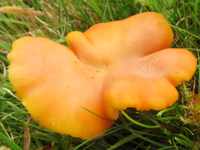 |
Cap2 to 5cm in diameter; bright orange or orange-red but fading to dingy orange or orange-yellow with age, often paler at the margin, the conical caps are convex, flattening and often becoming centrally depressed; the surface is dry and scurfy except in very wet weather; marginal striations are rarely evident. When very dry the margins of mature caps tend to crack. |
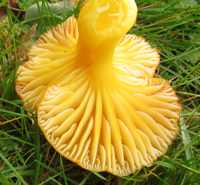 |
GillsThe broadly adnate gills have a slightly decurrent tooth; they are widely spaced and they are coloured as the caps but somewhat paler. |
Stem |
Cylindrical or laterally compressed, often with irregular grooves, the stem is 2.5 to 6mm in diameter and 2 to 6cm tall; it has no ring and is dry rather than viscous. |
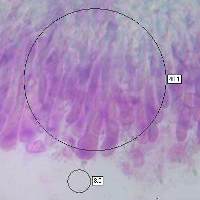 |
BasidiaUnusually long for a waxcap: 45-65 x 7.5-10μm. Basidia of Hygrocybe reidii, Honey Waxcap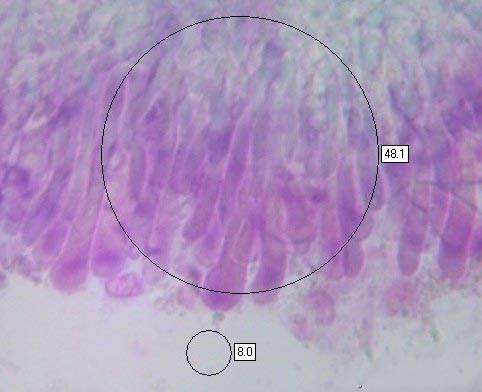 |
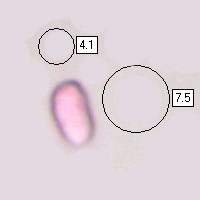 |
SporesEllipsoidal, smooth, 6.5-8.5 x 4-6μm; inamyloid. Spores of Hygrocybe reidii, Honey Waxcap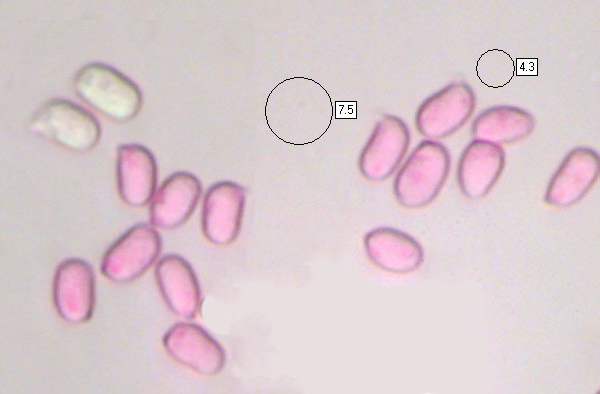 Spore printWhite. |
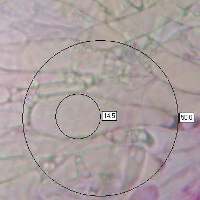 |
Gill tramaSubregular hyphal elements, mostly inflated, typically 8 to 16μm in diameter and 30 to 60μm (exceptionally up to 100μm) long. Gill trama of Hygrocybe reidii, Honey Waxcap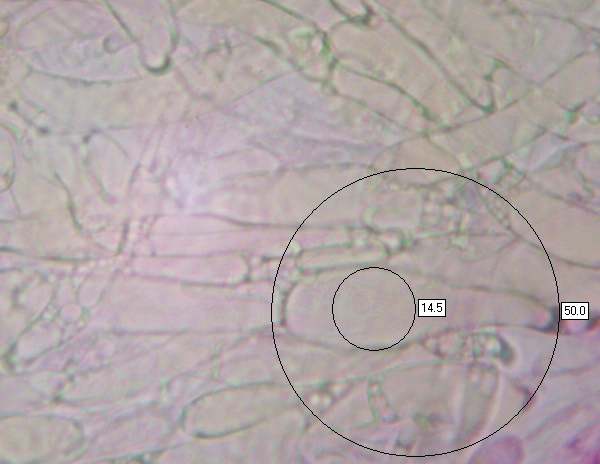 |
 |
PileipellisSubregular hyphal elements, mostly inflated, typically 8 to 16μm in diameter and 30 to 60μm (exceptionally up to 100μm) long. Pileipellis of Hygrocybe reidii, Honey Waxcap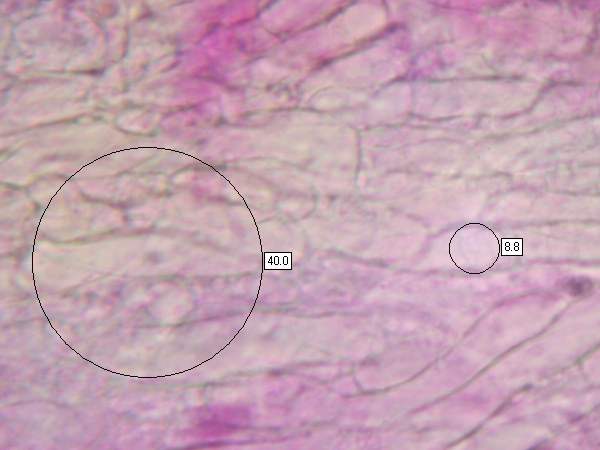 |
Odour/taste |
Odour of honey; taste not distinctive. |
Habitat & Ecological role |
On lawns, in churchyards, on fixed sand dunes, and on meadows and other areas of closely cropped or mown grassland where artificial fertilisers are not spread. Waxcaps have long been considered to be saprobic on the dead roots of grasses and other grassland plants, but it is now considered likely that there is some kind of mutual relationship between waxcaps and mosses. |
Season |
August to November in Britain and Ireland. |
Similar species |
Gliophorus laetus has an orange cap but its gills have a grey tinge; when crushed it smells of burnt rubber. |
Culinary Notes
The Honey Waxcap is reputed to be edible but of poor quality. There are no authenticated reports of serious poisoning by waxcaps in Britain or Ireland, but it is important to note that some individuals can have serious adverse reactions to mushroom species that most people can eat and find delicious. For this reason we caution against experimenting with fungi that are of unknown edibility and stress the crucial importance of not eating any species that has not been identified with absolute certainty.
Reference Sources
Fascinated by Fungi, 2nd Edition, Pat O'Reilly 2016, reprinted by Coch-y-bonddu Books in 2022.
Fungi of Northern Europe, Volume 1 - The Genus Hygrocybe, David Boertmann, 2010.
Dictionary of the Fungi; Paul M. Kirk, Paul F. Cannon, David W. Minter and J. A. Stalpers; CABI, 2008.
Fascinated by Fungi. Back by popular demand, Pat O'Reilly's best-selling 450-page hardback book is available now. The latest second edition was republished with a sparkling new cover design in September 2022 by Coch-y-Bonddu Books. Full details and copies are available from the publisher's online bookshop...