Hypholoma capnoides (Fr.) P. Kumm. - Conifer Tuft
Phylum: Basidiomycota - Class: Agaricomycetes - Order: Agaricales - Family: Strophariaceae
Distribution - Taxonomic History - Etymology - Culinary Notes - Identification - Reference Sources
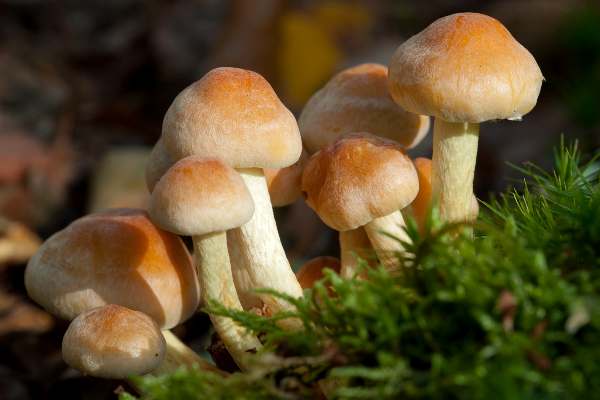
The pale grey gills (never green) of Hypholoma capnoides, the Conifer Tuft, help distinguish it from its poisonous close relative the Sulphur Tuft Hypholoma fasciculare.
Distribution
in Britain and Ireland the Conifer Tuft is a fairly frequent find but nowhere near as common as the Sulphur Tuft. Hypholoma capnoides occurs also throughout most of mainland Europe and in many other parts of the world including North America.
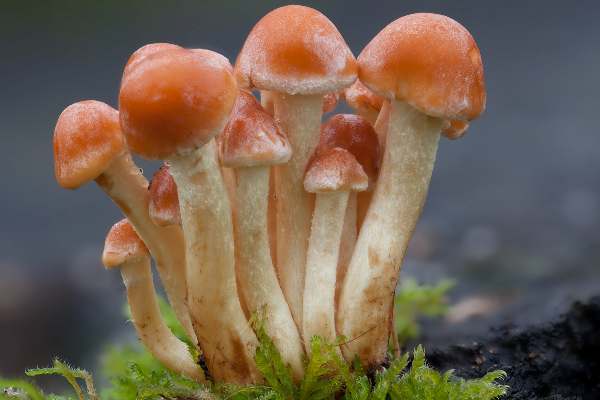
Seen from above, Conifer Tufts are very similar to the Common Rustgill Gymnopilus penetrans, but the spores of the latter are rusty rather than purple brown. Other wood rotters that could be confused with Hypholoma capnoides include certain Galerina and Pholiota species, whose spores are mid brown.
Taxonomic history
When in 1821 the great Swedish mycologist Elias Magnus Fries described this mushroom scientifically, he gave it the name Agaricus capnoides. (Most gilled mushrooms were initially placed in the genus Agaricus in the early days on fungal taxonomy.)
It was German mycologist Paul Kummer who, in 1871, established the currently accepted scientific name of this species when he transferred it to the genus Hypholoma.
Synonyms of Hypholoma capnoides include Agaricus capnoides Fr., and Naematoloma capnoides (Fr.) P. Karst.
Etymology
Hypholoma, the genus name, means 'mushrooms with threads'. It may be a reference to the thread-like partial veil that connects the cap rim to the stem of young fruitbodies, although some authorities suggest that it is a reference to the thread-like rhizomorphs (root-like bundles of mycelial hyphae) that radiate from the stem base.
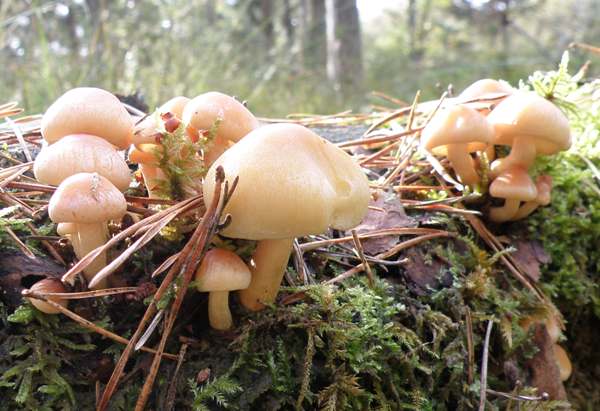
The specific epithet capnoides means 'looking like smoke'; it is a reference to the smoky grey colour of the gills which differentiate the Conifer Tuft from other similar members of the genus Hypholoma. (In particular this feature distinguishes Conifer Tuft fungi from Sulphur Tufts Hypholoma fasciculare, whose gills have a greenish tinge.)
Identification guide
 |
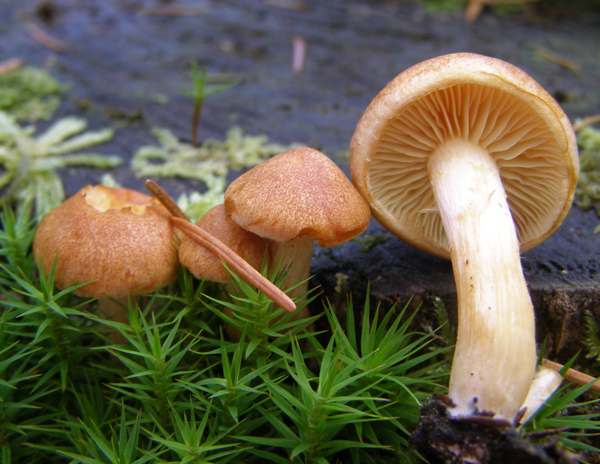
CapPale veil remnants are visible at the edge of the rounded hygrophanous caps, which are greasy with bright orange centres in wet weather and dry out to become pale orange-brown. 3 to 7cm in diameter, with pale yellow flesh. |
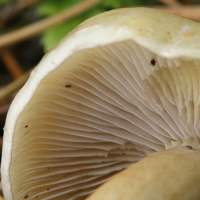 |
GillsThe grey adnate gills turn grey-brown as the fruitbody matures. Stem5 to 10mm in diameter and 5 to 8cm tall; pale yellow at the top and rusty brown towards the base. Unlike Sulphur Tuft and Brick Tuft, this wood-rotting mushroom does not have a persistent stem ring. |
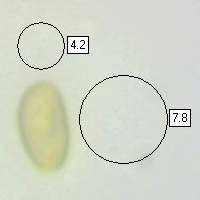 |
SporesEllipsoidal, smooth, 6-7.8 x 3.5-4.5µm; with a small germ pore.
Spores of Hypholoma capnoides, Conifer Tuft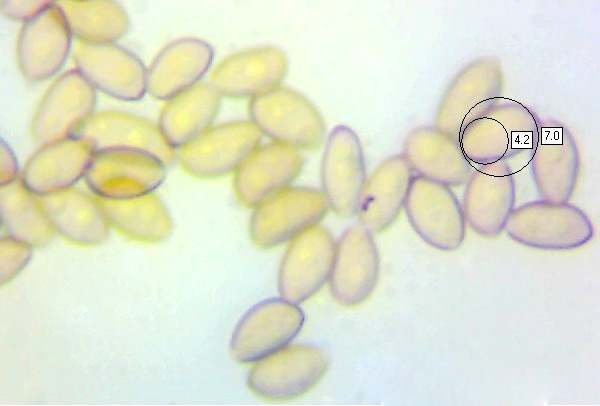 Spore printDark wine-brown. |
Odour/taste |
No significant odour; the taste is mild. |
Habitat & Ecological role |
Saprobic, in small tufts or singly on conifer stumps and on buried or exposed roots of dead conifers. |
Season |
August to October in Britain and Ireland. |
Similar species |
Hypholoma lateritium, commonly referred to as Brick Tuft, is a larger species with a brick-red central zone and paler margin; it has creamy-yellow gills when young. |
Culinary Notes
Generally considered edible, this woodland mushroom is easily confused with other fungi (for example Sulphur Tufts) from the same genus that are inedible or even poisonous as well as Galerina marginata, commonly referred to as the Funeral Bell, which is deadly poisonous. If you need a further disincentive the small size and infrequent occurrence of Conifer Tuft surely make it a mushroom that is not worth collecting to eat.
Reference Sources
Fascinated by Fungi, 2nd Edition, Pat O'Reilly 2016, reprinted by Coch-y-bonddu Books in 2022.
Funga Nordica: 2nd edition 2012. Edited by Knudsen, H. & Vesterholt, J. ISBN 9788798396130
BMS List of English Names for Fungi
Dictionary of the Fungi; Paul M. Kirk, Paul F. Cannon, David W. Minter and J. A. Stalpers; CABI, 2008
Taxonomic history and synonym information on these pages is drawn from many sources but in particular from the British Mycological Society's GB Checklist of Fungi.
Acknowledgements
This page includes pictures kindly contributed by David Kelly.

Fascinated by Fungi. Back by popular demand, Pat O'Reilly's best-selling 450-page hardback book is available now. The latest second edition was republished with a sparkling new cover design in September 2022 by Coch-y-Bonddu Books. Full details and copies are available from the publisher's online bookshop...