
Inocybe geophylla (Fr.) P. Kumm. - White Fibrecap
Phylum: Basidiomycota - Class: Agaricomycetes - Order: Agaricales - Family: Inocybaceae
Distribution - Taxonomic History - Etymology - Identification - Toxicity - Reference Sources
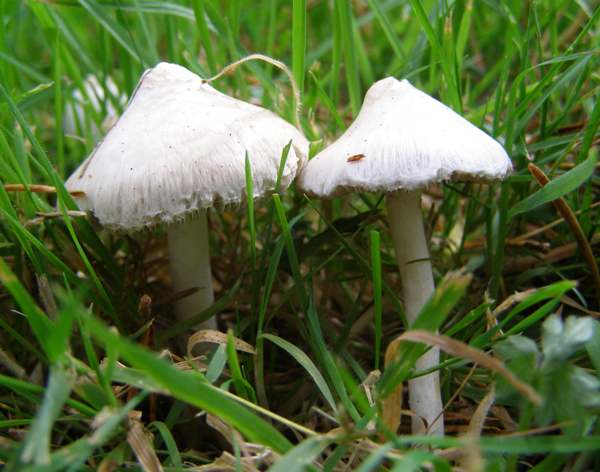
Inocybe geophylla is a very common species and is sometimes mistaken for small field mushrooms (Agaricus campestris) with disastrous results: it is extremely poisonous and its consumption can even be fatal.
Although they are known to be mycorrhizal with deciduous broadleaf trees and with conifers, these little white mushrooms are also a very common find on mud rich in leaf litter beside tree-lined roads.
Distribution
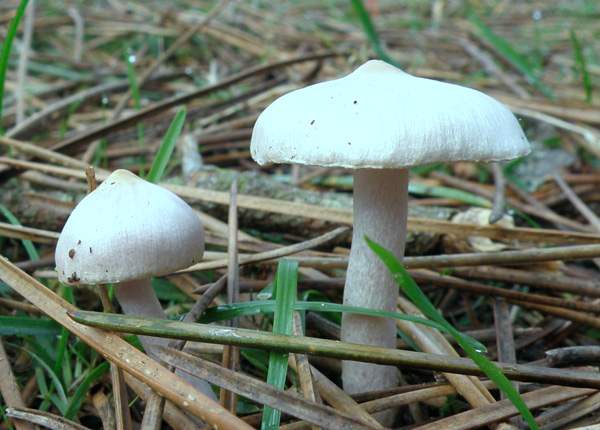
Inocybe geophylla is a common and widespread woodland species throughout Britain and Ireland. These toxic little toadstools are found in most parts of mainland Europe, and they are also recorded as common in North America.
Taxonomic History
The White Fibrecap was desribed scientifically in 1821 by Elias Magnus Fries, who gave it the binomial name Agaricus geophyllus. (At that time most gilled fungi were initially placed in a gigantic Agaricus genus, which has since been slimmed down with most of its contents being transferred to other newer genera.)
In 1871 German mycologist Paul Kummer transferred this species to the genus Inocybe, establishing its currently-accepted scientific name as Inocybe geophylla.
Synonyms of Inocybe geophylla include Agaricus geophyllus Fr., Agaricus clarkii Berk. & Broome, Inocybe clarkii (Berk. & Broome) Sacc., and Inocybe geophylla var. alba Hruby.
There are two common varieties of this species: the White Fibrecap, Inocybe geophylla, and a variety commonly referred to as the Lilac Fibrecap, Inocybe geophylla var. lilacina.
To differentiate it from the Lilac Fibrecap, Inocybe geophylla var. lilacina the White Fibrecap is recorded formally as Inocybe geophylla var. geophylla.
Etymology
Inocybe, the genus name, means 'fibrous head', while the specific epithet geophylla is derived from the Ancient Greek words geo- meaning earth, and phyllon which means leaf.
Toxicity
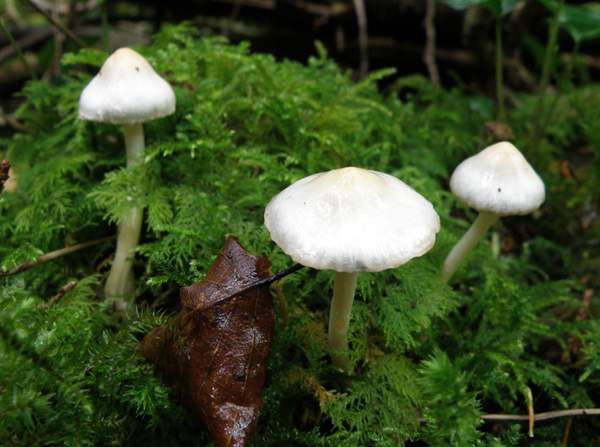
Inocybe geophylla is a deadly poisonous and fairly common species that grows in habitats where people expect to find edible mushrooms. That makes it very dangerous indeed.
The symptoms of poisoning by this and several similar Inocybe species are those associated with muscarine poisoning. Excessive salivation and sweating set in within half an hour of eating these fungi. Depending on the amount consumed, victims may also suffer abdominal pains, sickness and diarrhoea, together with blurred vision and laboured breathing. Deaths of otherwise healthy people from eating these fungi are not reported. Anyone with a weakened heart or with respiratory problems is much more at risk.
Identification guide
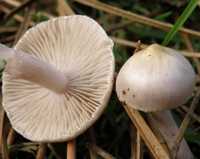 |
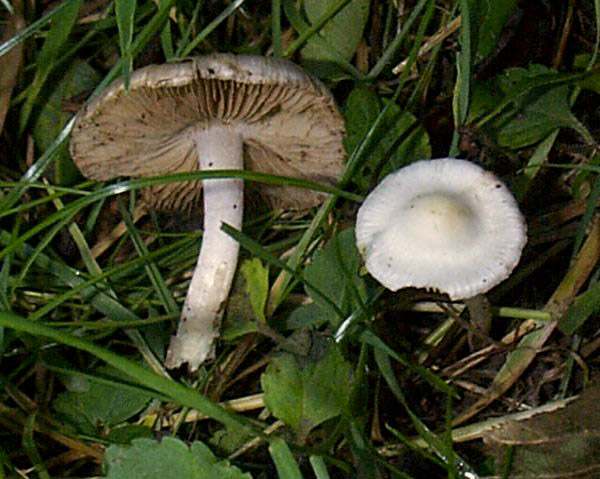
CapThe smooth, silky cap has a diameter of 1.5 to 3.5cm; initially conical, it flattens as it matures, usually retaining a pointed umbo and streaky radial fibres that in dry weather tend to tear into strips towards the edge of the cap. Both the white and lilac varieties fade to ochre-brown from the centre as the fruitbody ages. |
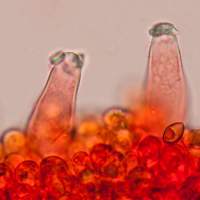 |
CheilocystidiaAbundant thick-walled cheilocystidia (standing out from the gill edges) of the White Fibrecap are fusiform and their tips are encrusted with crystals. The pleurocystidia are similar. Cheilocystidia of Inocybe geophylla, White Fibrecap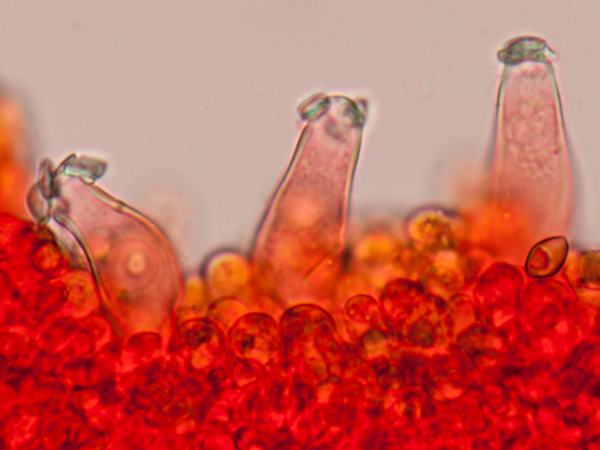 |
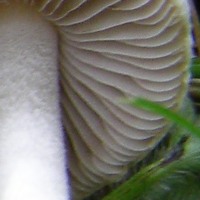 |
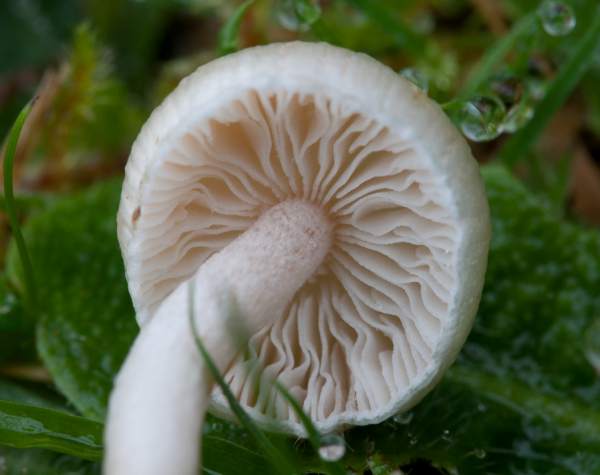
GillsThe crowded gills, which are notched or adnexed, start off creamy-grey and later turn clay-brown as the spores mature. Stem3 to 6mm in diameter and up to 6cm tall, the stipe is smooth and silky, sometimes slightly fibrillose towards the base, and the same colour as the cap. The stipe also gradually turns clay-brown with age. |
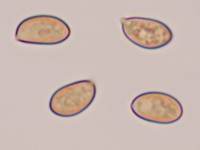 |
SporesEllipsoidal, smooth, 7.5-10 x 4.5-5.5μm Spores of Inocybe geophylla, White Fibrecap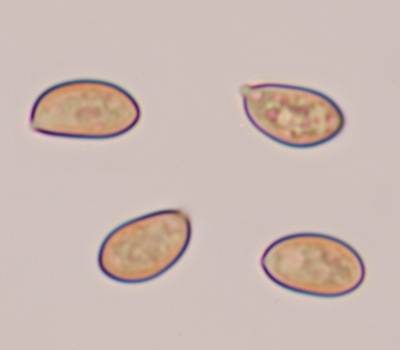 Spore printDull brown. |
Odour/taste |
Slightly earthy or mealy smell. Reported to have a mild taste (but please be aware that this is a deadly poisonous fungus and so tasting any part of it is not advisable). |
Habitat & Ecological role |
Mycorrhizal; found beside paths and on roadside verges beneath deciduous trees and in mixed woodland; less frequently under conifers. |
Season |
Summer and autumn in Britain and Ireland. |
Similar species |
The White Fibrecap Inocybe geophylla could be confused with Agaricus campestris, which is usually much larger, has a stem ring and does not have a silky cap. |
Reference Sources
Fascinated by Fungi, 2nd Edition, Pat O'Reilly 2016, reprinted by Coch-y-bonddu Books in 2022.
Alan Outen and Penny Cullington (2009), Keys to the British Species of Inocybe.
Funga Nordica: 2nd edition 2012. Edited by Knudsen, H. & Vesterholt, J. ISBN 9788798396130
BMS List of English Names for Fungi
Dictionary of the Fungi; Paul M. Kirk, Paul F. Cannon, David W. Minter and J. A. Stalpers; CABI, 2008
Taxonomic history and synonym information on these pages is drawn from many sources but in particular from the British Mycological Society's GB Checklist of Fungi.
Acknowledgements
This page includes pictures kindly contributed by David Kelly.
Fascinated by Fungi. Back by popular demand, Pat O'Reilly's best-selling 450-page hardback book is available now. The latest second edition was republished with a sparkling new cover design in September 2022 by Coch-y-Bonddu Books. Full details and copies are available from the publisher's online bookshop...