
Microglossum olivaceum (Pers.) Gillet - Olive Earthtongue
Phylum: Ascomycota - Class: Leotiomycetes - Order: Leotiales - Family: Leotiaceae
Distribution - Taxonomic History - Etymology - Identification - Culinary Notes - Reference Sources
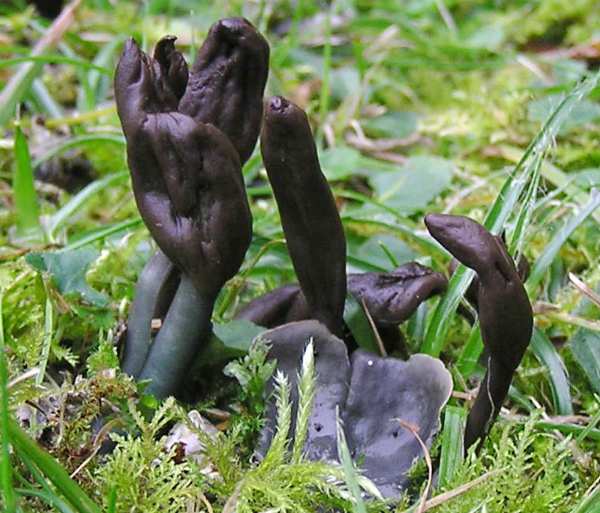
These tiny greenish or brownish earthtongues are not only rare by very small and well camouflaged against the background of mosses and plant leaves in the kinds of unimproved grasslands in which they occur.
Distribution
The Olive Earthtongue is a Biodiversity Action Plan (BAP) species in Britain. This very rare earthtongue fungus has been officially recorded in England, Wales, Scotland and Ireland, where it occurs in mossy woodlands and sometimes in high quality (low nutrient) unimproved grassland. Microglossum olivaceum is found also in locations throughout northern Europe, but there is concern that this fungus (now considered to be a complex of species) may be declining in many of its known sites.
Taxonomic history
In 1796 when Christiaan Hendrik Persoon described the Olive Earthtongue he gave it the binomial scientific name Geoglossum olivaceum. It was the French mycologist Claude-Casimir Gillet (1806 - 1896) who in 1879 transferred this species to the genus Microglossum - a new genus circumscribed by Gillet in that same year - whereupon it acquired the scientific name Microglossum olivaceum by which it is generally known today.
Synonyms of Microglossum olivaceum include Geoglossum olivaceum Pers., Leptoglossum olivaceum (Pers.) W. Phillips, Mitrula olivacea (Pers.) Sacc., and Microglossum fuscorubens Boud.
Etymology
Microglossum, the genus name, means small tongue, while the specific epitet olivaceum refers to the olive tinge to most of the fruitbodies (but note that the colour is very variable with some being much browner than others).
Identification guide
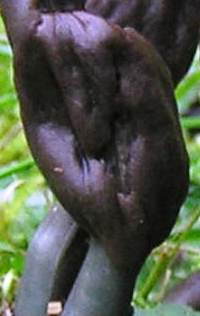 |
FruitbodyLike other earthtongues, this very rare species comprises a narrow stem supporting a wider, usually flattened head that does indeed look like a wrinkled tongue protruding from the earth. The colours of the Olive Earthtongue are very variable and should not be used as the sole means of identification. The fertile tongue section may be reddish or brown, medium olive-brown or dark greenish-olive, and can vary from 0.8 to 2cm long and up to 1cm wide. The infertile stem is 2 to 6mm in diameter and 1 to 3cm long, smooth and varying in colour from bottle green through various shades of olive or occasionally brown. |
SporesFusiform, smooth, 13-17 x 3.5-5µm. Spore printWhite. |
|
Odour/taste |
No significant taste or odour. |
Habitat & Ecological role |
Saprobic, in mossy woodlands and unimproved grassland. |
Season |
Summer and autumn. |
Similar species |
Microglossum viride, a woodland species, is usually much greener and has a scaly stem. The two species can be separated with certainty by microscopic examination: the asci of Microglossum olivaceum are shorter than 100µm whereas the asci of Microglossum viride are longer than 110µm and can be up to 150µm. (As a further check, the spores of the Green Earthtongue are significantly larger than those of the Olive Earthtongue.) |
Culinary Notes
These are very rare fungi and they should definitely not be collected for food. They are considered by some authorities to be of unknown edibility or suspect and so they might possibly be poisonous.
Reference Sources
Kucera, V., Lizon, P. & Tomsovsky. M. (2017). Taxonomic divergence of the green naked-stipe members of the genus Microglossum (Helotiales) Mycologia 109.
Fascinated by Fungi, 2nd Edition, Pat O'Reilly 2016, reprinted by Coch-y-bonddu Books in 2022.
Dennis, R.W.G. (1981). British Ascomycetes; Lubrecht & Cramer; ISBN: 3768205525.
Breitenbach, J. & Kränzlin, F. (1984). Fungi of Switzerland. Volume 1: Ascomycetes. Verlag Mykologia: Luzern, Switzerland.
Medardi, G. (2006). Ascomiceti d'Italia. Centro Studi Micologici: Trento.
British Mycological Society (2010). English Names for Fungi
Dictionary of the Fungi; Paul M. Kirk, Paul F. Cannon, David W. Minter and J. A. Stalpers; CABI, 2008
Taxonomic history and synonym information on these pages is drawn from many sources but in particular from the British Mycological Society's GB Checklist of Fungi.
Acknowledgements
This page includes pictures kindly contributed by David Harries.
Fascinated by Fungi. Back by popular demand, Pat O'Reilly's best-selling 450-page hardback book is available now. The latest second edition was republished with a sparkling new cover design in September 2022 by Coch-y-Bonddu Books. Full details and copies are available from the publisher's online bookshop...