
Otidea bufonia (Pers.) Boud - Toad's Ear
Phylum: Ascomycota - Class: Pezizomycetes - Order: Pezizales - Family: Pyronemataceae
Distribution - Taxonomic History - Etymology - Identification - Culinary Notes - Reference Sources
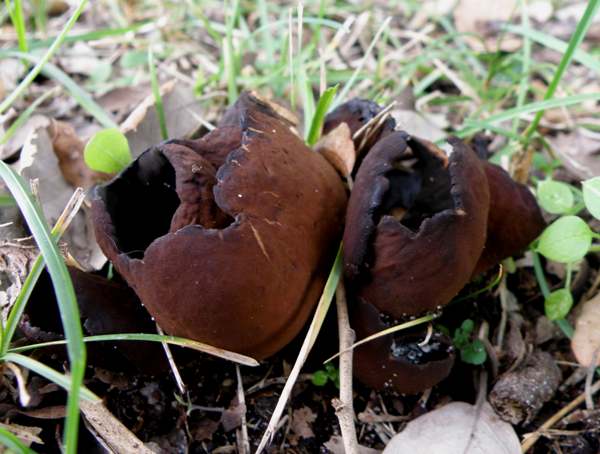
An infrequent and easily overlooked species, Toad’s Ear is most often found on forestry roads and paths, where all too often it blends in with bark chippings or dark humus-rich soil.
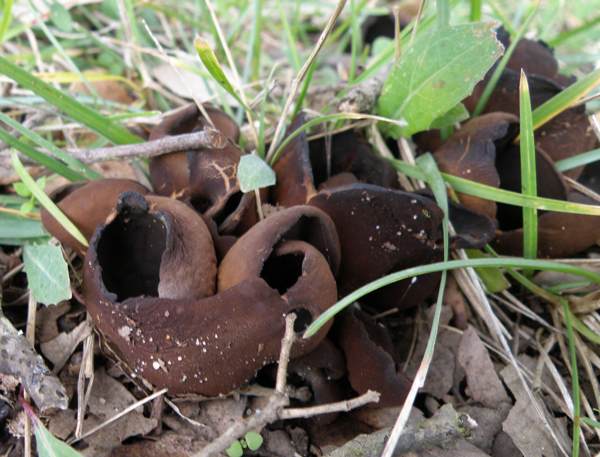
There is something special about footpaths through woods that suits these and other ear- and cup-like fungi - perhaps it is the disturbance, or maybe the change in soil density due to compaction, that causes them to fruit most often right on the edges of such well-trodden tracks.
Distribution
Widespread but an uncommon to rare find in Britain and Ireland, this rather brittle cup fungus occurs in all kinds of woodlands and beside tracks and lanes. Otidea bufonia is found throughout much of mainland Europe. (I have not been able to find any reference to the Toad's Ear fungus occurring in North America.)
Taxonomic history
In 1822 when Christiaan Hendrik Persoon described this ascomycete fungus he gave it the binomial scientific name Peziza bufonia. It was the French mycologist Jean Louis Emile Boudier (1828 - 1920) who in 1907 transferred this species to the genus Otidea, renaming it Otidea bufonia, its currently accepted scientific name.
Peziza bufonia Pers. is as synonym of Otidea bufonia.
Etymology
The genus name Otidea is a reference to the ear-like form of fungi in this group, while the specific epithet bufonia means 'like a toad'. (The scientific name for a Common Toad is Bufo bufo.)
Identification guide
 |
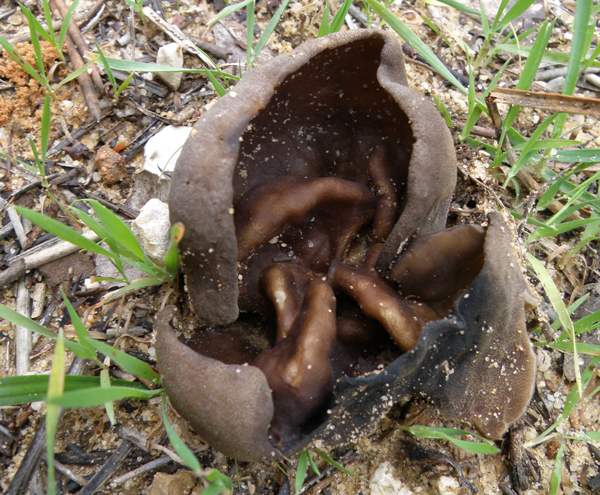
Fruitbody (apothecium)Elongated cup with a split down the shorter side and edges overlapping rather than merely abutting; inner surface smooth, dark brown; outer surface mid brown and scurfy; 3 to 6cm tall and 1.5 to 4cm across; thick brown stem up to 1cm long. |
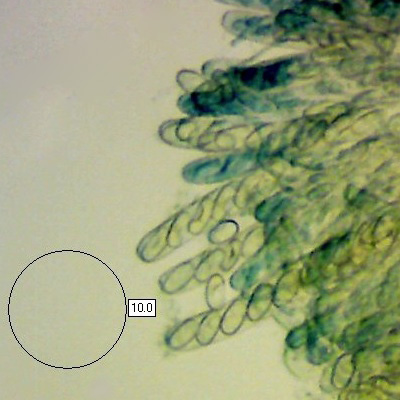
AsciEight spores per ascus. Asci are typically 180 x 11µm, and they are interspersed with paraphyses that are long and narrow with sharply-curved tips. Show larger imageAsci of Otidea bufonia, Toad's Ear fungus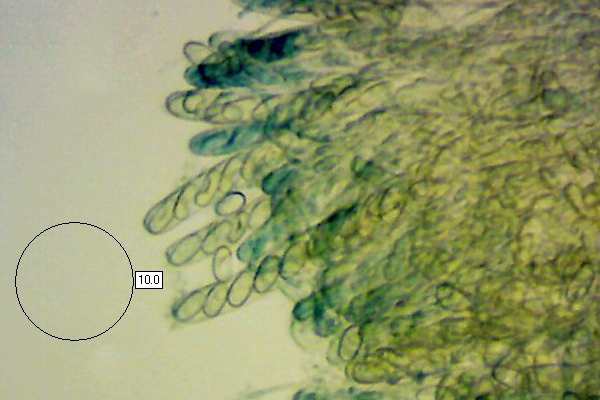 |
|
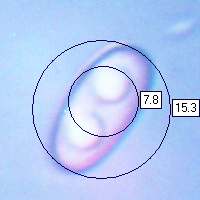 |
SporesEllipsoidal, smooth, 13-15 x 6.5-7µm, each generally containing two oil drops. Show larger imageSpores of Otidea bufonia, Toad's Ear fungus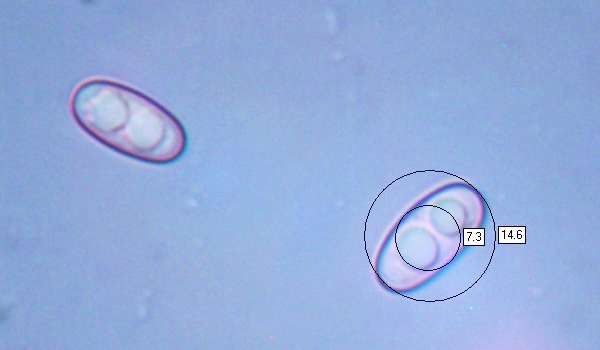 Spore printWhite. |
Odour/taste |
Not distinctive. |
Habitat & Ecological role |
Saprobic, in mossy woodlands and woodland edges; often beside and sometimes on forestry tracks. |
Season |
June to early November in Britain and Ireland. |
Similar species |
Otidea onotica is a much paler orange-brown ear fungus and usually produces smaller cups. The Bay Cup Peziza badia is smaller and does not have a slit down the side with overlaps; its spores are much larger than those of Otidea bufonia. |
Culinary Notes
Otidea bufonia is generally regarded as inedible.
Reference Sources
Fascinated by Fungi, 2nd Edition, Pat O'Reilly 2016, reprinted by Coch-y-bonddu Books in 2022.
Dennis, R.W.G. (1981). British Ascomycetes; Lubrecht & Cramer; ISBN: 3768205525.
Breitenbach, J. & Kränzlin, F. (1984). Fungi of Switzerland. Volume 1: Ascomycetes. Verlag Mykologia: Luzern, Switzerland.
Medardi, G. (2006). Ascomiceti d'Italia. Centro Studi Micologici: Trento.
British Mycological Society (2010). English Names for Fungi
Dictionary of the Fungi; Paul M. Kirk, Paul F. Cannon, David W. Minter and J. A. Stalpers; CABI, 2008
Taxonomic history and synonym information on these pages is drawn from many sources but in particular from the British Mycological Society's GB Checklist of Fungi.

Fascinated by Fungi. Back by popular demand, Pat O'Reilly's best-selling 450-page hardback book is available now. The latest second edition was republished with a sparkling new cover design in September 2022 by Coch-y-Bonddu Books. Full details and copies are available from the publisher's online bookshop...