
Phellinus igniarius (L.) Quél. - Willow Bracket
Phylum: Basidiomycota - Class: Agaricomycetes - Order: Polyporales - Family: Hymenochaetaceae
Distribution - Taxonomic History - Etymology - Identification - Culinary Notes - Reference Sources
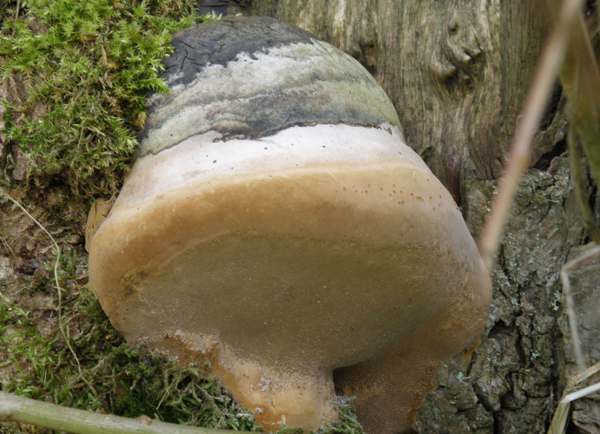
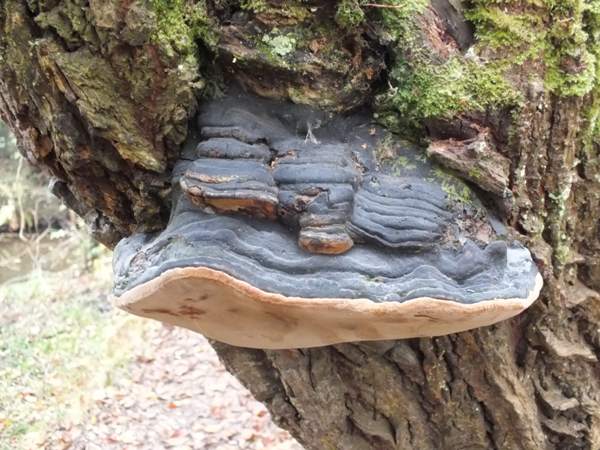
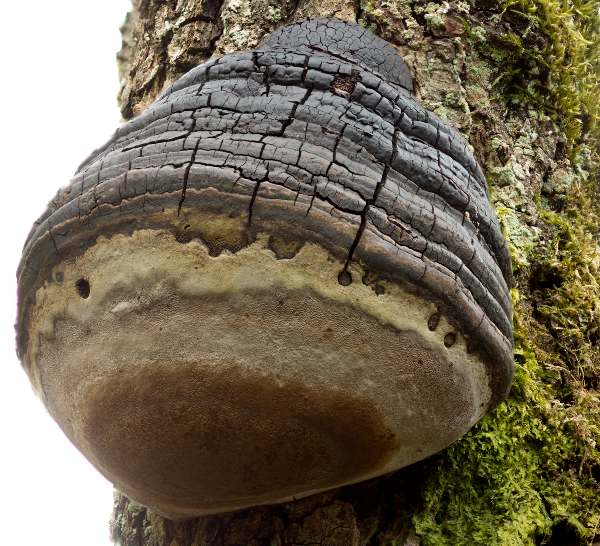
You are most likely to come across old, blackened, gnarled and cracked fruitbodies of this bracket (which experts believe is probably a ‘complex’ of several species rather than a single species). That’s because fruitbodies can continue growing for many years, feeding on the remains of the host tree long after it has died. (The picture below, taken in France, shows an aged bracket on a willow stump.) Willows are the preferred victims of this very tough bracket fungus, which looks quite similar to Hoof Fungus Fomes fomentarius.
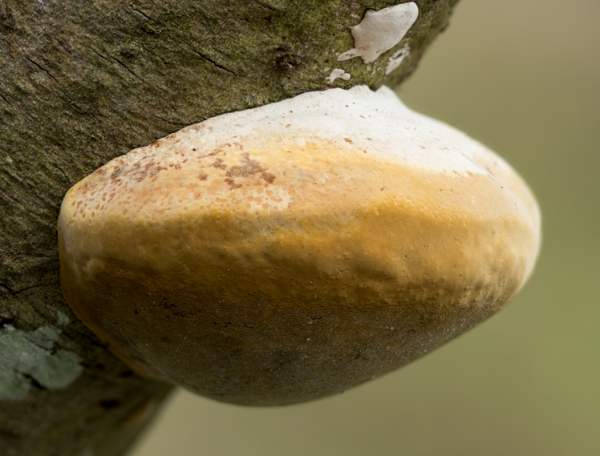
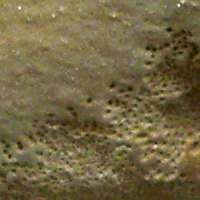
As with nearly all bracket fungi, young fruitbodies are pale and rather undistinguished - see below.
Distribution
Phellinus igniarius is an uncommon find in Britain and Ireland and rather variable in appearance depending on the age of the brackets and the type of host tree. (This kind of bracket occasionally attacks other kinds of hardwood trees, although the various types of large willows are the favoured food source for these white-rot inducing fungi.) Willow Bracket occurs in many countries on mainland Europe,and this species is also recorded in North America.
Taxonomic history
In 1776 Carl Linnaeus described this species, giving it the name Boletus igniarius. It was the French mycologist Lucien Quélet who, in 1886, transferred the Willow Bracket fungus to the genus Phellinus, renaming it as Phellinus igniarius, the scientific name by which it is generally recognised nowadays.
Common synonyms of Phellinus igniarius include Boletus igniarius L., Polyporus igniarius (L.) Fr., Fomes igniarius (L.) Cooke, Fomes trivialis Bres., and Phellinus trivialis (Bres.) Kreisel.
Etymology
In 1886 the genus Phellinus was circumscribed by French mycologist Lucien Quélet; the generic name comes from phell- meaning cork, while the suffix -inus denotes a superlative. The implication, therefore, is that fungi in the genus Phellinus are the most cork-like (the toughest) of them all. The specific epithet igniarius means of or relating to fire (as in ignited). Hence the Willow Bracket's scientific name tells us that it is a very tough, cork-like fungus that looks as though it has been in a fire. Spot on, particularly for older specimens that look as blackened, cracked and charred as... er, charcoal.
Identification guide
 |
FruitbodyUpper surface grey on young fruitbodies (see left), turning black and often developing vertical cracks when older; outer margin remaining brown and velvety even on very old fruitbodies; up to 40cm across and as much as 20cm thick; hoof-like and concentrically ridged in annual layers. The flesh inside these brackets is reddish brown. |
 |
Tubes and PoresThe tubes are brown, 3 to 5mm deep and spaced at 4 to 6 per mm; they terminate in grey-brown to red-brown pores, sometimes having a purple tinge. |
SporesSubspherical, smooth, 5.5-7 x 4.5-6μm; inamyloid. Spore printWhite. |
|
Odour/taste |
Not significant. |
Habitat & Ecological role |
Parasitic and eventually saprobic, restricted to broadleaf (hardwood) trees and most commonly willows (Salix species). |
Season |
Perennial, releasing spores throughout summer and autumn. |
Similar species |
Fomes fomentarius is similarly hoof shaped with an overall grey appearance; it attacks mainly birches in Britain and Ireland. |
Culinary Notes
Phellinus igniarius is a tough inedible fungus - even removing one of these brackets from a tree requires a saw and would consume far more calories that would be obtained if you managed to chew and swallow it. It is unlikely that Willow Bracket contains deadly toxins, because according to Tom Volk for hundreds of years it has been mixed in powder form with tobacco and smoked by Native Indians of north America. We know of no recipes for this rather uncommon bracket fungus.
Reference Sources
Fascinated by Fungi, 2nd Edition, Pat O'Reilly 2016, reprinted by Coch-y-bonddu Books in 2022.
British Mycological Society (2010). English Names for Fungi
Dictionary of the Fungi; Paul M. Kirk, Paul F. Cannon, David W. Minter and J. A. Stalpers; CABI, 2008
Taxonomic history and synonym information on these pages is drawn from many sources but in particular from the British Mycological Society's GB Checklist of Fungi.
Acknowledgements
This page includes pictures kindly contributed by David Kelly.
Fascinated by Fungi. Back by popular demand, Pat O'Reilly's best-selling 450-page hardback book is available now. The latest second edition was republished with a sparkling new cover design in September 2022 by Coch-y-Bonddu Books. Full details and copies are available from the publisher's online bookshop...