
Pholiota aurivella (Batsch) P. Kumm. - Golden Scalycap
Phylum: Basidiomycota - Class: Agaricomycetes - Order: Agaricales - Family: Strophariaceae
Distribution - Taxonomic History - Etymology - Identification - Culinary Notes - Reference Sources
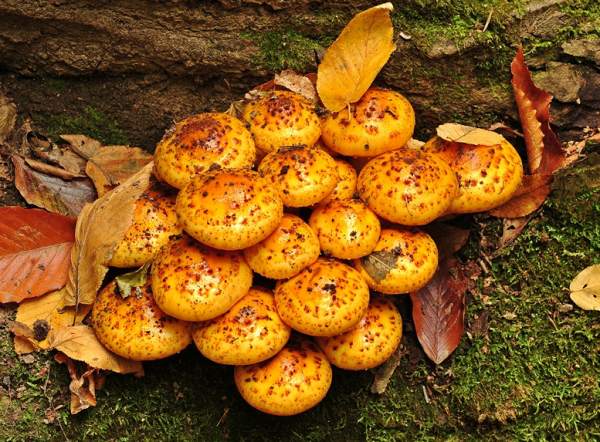
Pholiota aurivella is an infrequent species in many parts of Britain and Ireland but more common in the south-east of England and of Wales where mature Beech trees are more abundant. Easily confused with other greasy-capped members of the genus Pholiota (the so-called scalycaps), such as Pholiota alnicola which grows on alders and Pholiota gummosa which is often seen growing in grass beside sick or dead deciduous trees, the Golden Scalycap is one of the largest mushrooms in this group.
Distribution
An uncommon but far from rare species in Britain and Ireland, Pholiota aurivella is also found in northern and central mainland Europe as well as in Asia and parts of North America.
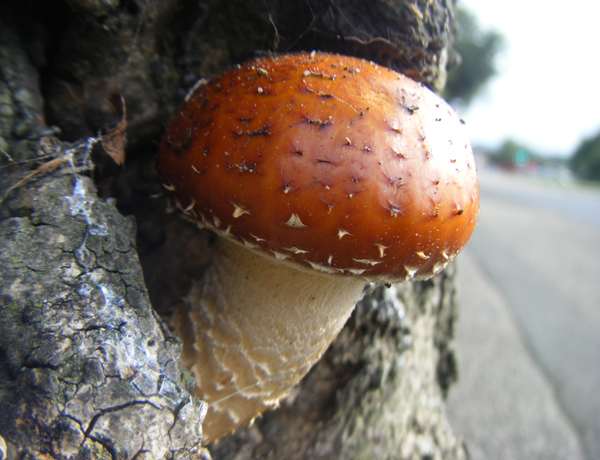
Darker forms of the Golden Scalycap also occur. Shown on the left is a beautiful specimen photographed on a roadside tree near Leeds, in northern England.
Taxonomic history
The Golden Scalycap was described in 1786 by German naturalist August Johann Georg Karl Batsch (1761 - 1802), who gave it the binomial scientific name Agaricus aurivellus. (In the early days of fungal taxonomy most gilled mushrooms were placed in the genus Agaricus, which was later broken up into the many other genera that we use today.) It was another German mycologist, Paul Kummer, who transferred this species to the new genus Pholiota in 1888, thereby establishing its currently-accepted scientific name as Pholiota aurivella.
Synonyms of Pholiota aurivella may include Pholiota cerifera, Pholiota adiposa and Pholiota squarrosa-adiposa; however, note the use of the word 'may' because there is still much debate about just how many species are contained in the grouping that most of us are content to call Golden Scalycaps (although some of these lovely but inedible mushrooms are much too brown to justify being called golden!).
Etymology
The generic name Pholiota means scaly, and the specific epithet aurivella means golden fleece - whenever you see -vell in a scientific name, look for the fleecy characteristic to which this prefix refers.
Identification guide
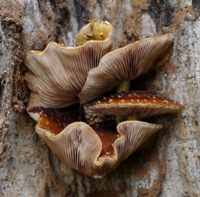 |
Cap5 to 15cm in diameter, bright golden yellow to rusty brown and with a slimy or greasy surface covered in darker-brown scales that sometimes wash off in wet weather. The lovely specimens shown on the left are particularly dark. |
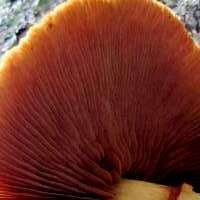 |
GillsThe crowded adnate gills are cream when young, turning reddish-brown as the spores develop. Stem6 to 12mm in diameter and 3 to 9cm tall; lemon-yellow becoming browner with age; smooth above a pale cottony ring (persistent fragments of the partial veil) and having darker brown scales below the ring. The stem is solid with fibrous yellowish flesh. |
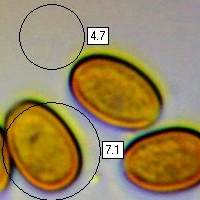 |
SporesEllipsoidal, smooth, 6.5-10 x 4-6μm; with a distinct germ pore. Show larger imageSpores of Pholiota aurivella, Golden Scalycap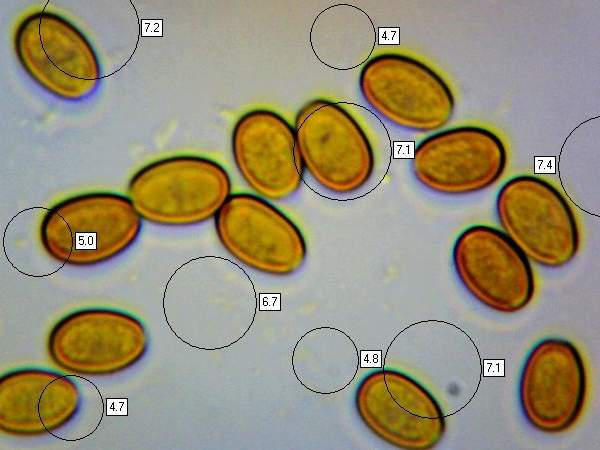 Spore printReddish-brown. |
Odour/taste |
No distinctive odour; taste is rather bitter. |
Habitat & Ecological role |
On stumps, large fallen branches and dead trunks of deciduous hardwood trees, most commonly Beeches. |
Season |
September to December in Britain and Ireland. |
Similar species |
Pholiota alnicola is smaller and rarely has many cap scales. |
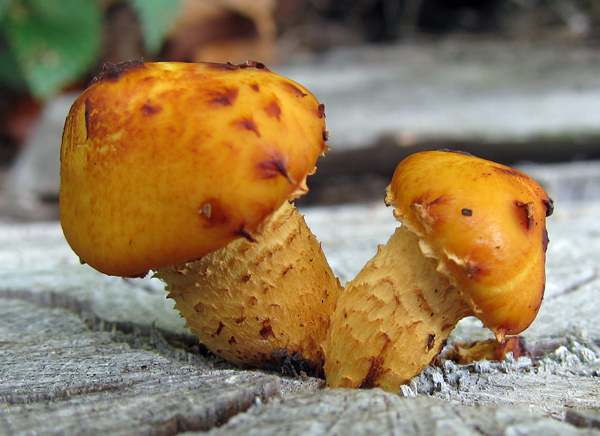
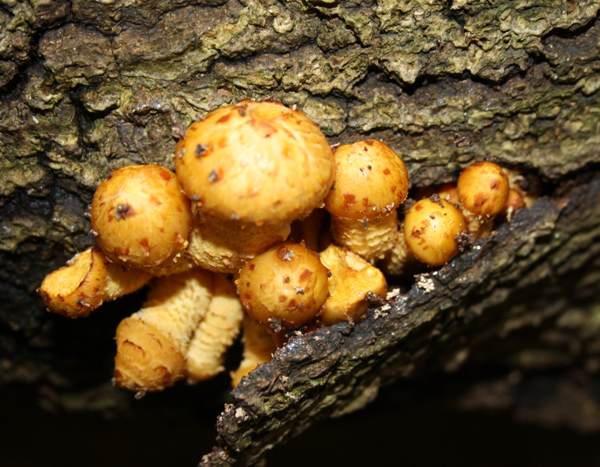
Above: young fruitbodies of Pholiota aurivella.
Culinary Notes
Despite their attractive appearance, these and other scalycaps (Pholiota species) are definitely not edible mushrooms, although in the past some members of this genus were considered to be so.
Reference Sources
Fascinated by Fungi, 2nd Edition, Pat O'Reilly 2016, reprinted by Coch-y-bonddu Books in 2022.
British Mycological Society (2016). English Names for Fungi
Funga Nordica, Henning Knudsen and Jan Vesterholt, 2008.
Dictionary of the Fungi; Paul M. Kirk, Paul F. Cannon, David W. Minter and J. A. Stalpers; CABI, 2008
Taxonomic history and synonym information on these pages is drawn from many sources but in particular from the British Mycological Society's GB Checklist of Fungi.
Acknowledgements
This page includes pictures kindly contributed by Simon Harding, Anthony Harding, Nigel P Kent, Varsha Patel and John Wilson.
Fascinated by Fungi. Back by popular demand, Pat O'Reilly's best-selling 450-page hardback book is available now. The latest second edition was republished with a sparkling new cover design in September 2022 by Coch-y-Bonddu Books. Full details and copies are available from the publisher's online bookshop...