
Pleurotus dryinus (Pers.) P. Kumm. - Veiled Oyster
Phylum: Basidiomycota - Class: Agaricomycetes - Order: Agaricales - Family: Pleurotaceae
Distribution - Taxonomic History - Etymology - Identification - Culinary Notes - Reference Sources
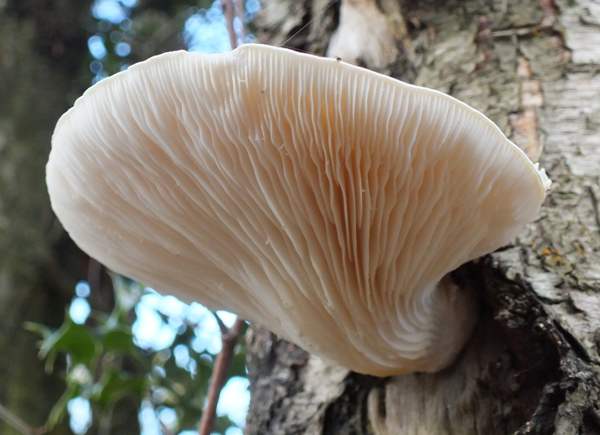
Among the oyster mushrooms (so called because the cap is shaped likean oyster shell) are some truly photogenic fungi, and the Veiled Oyster is certainly one of the finest. The fruitbodies can be found on living or dead hardwood trees, notably oak trees and Beech, and very occasionally on conifers.
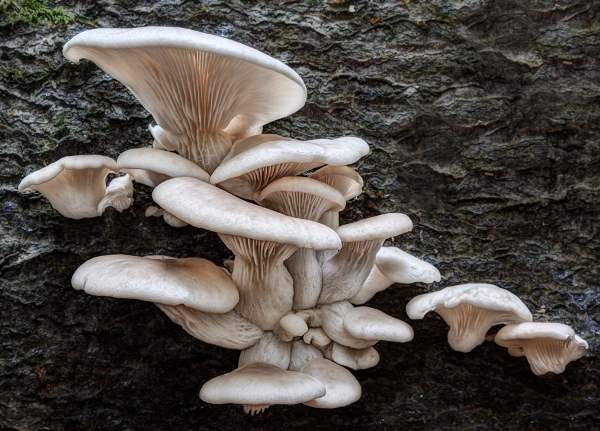
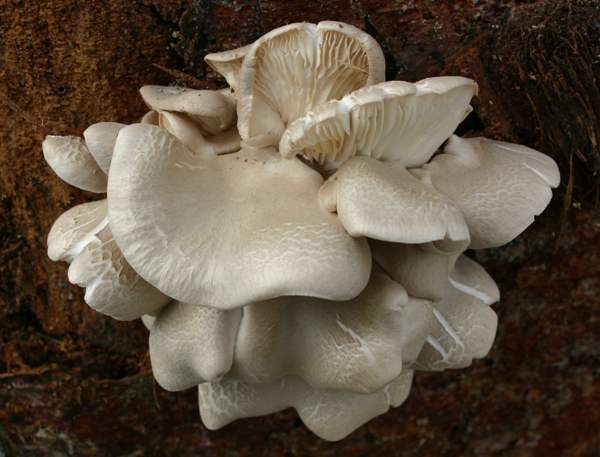
Sometimes occurring singly, these large oyster mushrooms are most spectacular when fruiting in groups, as shown on the left.
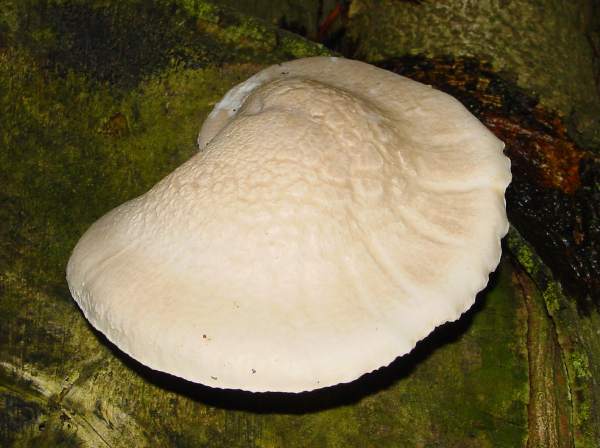
The Veiled Oyster shown below is fruiting from decaying hardwood on a living tree. It has emerged from a wound where a large branch has been sawn from an old Horse Chestnut tree.
Distribution
Pleurotus dryinus, the Veiled Oyster mushroom, occurs throughout Britain and Ireland as well as in most parts of mainland Europe. It is also widely distributed throughout much of Asia, including Japan, and is present in many parts of North America. However, several similar species within the Pleurotus genus are often confused, and so distribution data for individual species in this complex group are subject to some uncertainty.
Taxonomic history
The basionym of the Veiled Oyster Mushroom was established in 1801 when this species was described scientifically by Christiaan Hendrik Persoon, who named it Agaricus dryinus. (Most gilled fungi were initially placed in a giant Agaricus genus, but the majority have since been redistributed to other genera leaving the 'true mushrooms' in Agaricus.)
The currently-accepted scientific name Pleurotus dryinus dates from 1871, when German mycologist Paul Kummer transferred the Veiled Oyster into the Pleurotus genus.
Synonyms of Pleurotus dryinus are many and include Agaricus dryinus Pers., Agaricus corticatus Fr., Agaricus albertinii Fr., Agaricus spongiosus Fr., Agaricus acerinus Fr., Pleurotus corticatus (Fr.) P. Kumm., Pleurotus tephrotrichus Fr., Pleurotus corticatus var. tephrotrichus (Fr.) Gillet, Pleurotus acerinus (Fr.) Sacc., Pleurotus albertinii (Fr.) Sacc., Pleurotus spongiosus (Fr.) Sacc., and Pleurotus corticatus var. albertinii (Fr.) Rea.
Etymology
Pleurotus, the generic name, is Latin for ‘side ear ’ and refers to the lateral attachment of the stem. The specific epithet dryinus means 'of oak trees'.
Oaks of various kinds are among the main hosts of the Veiled Oyster Mushroom, although in Britain and Ireland this mushroom is probably rather more likely to be seen on Beech or Ash trees.
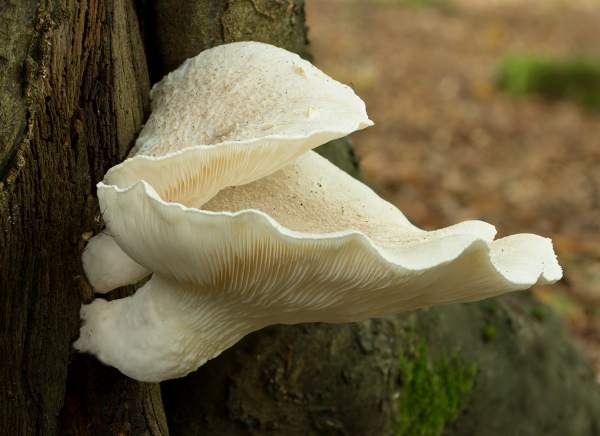
It is the partial veil (rather than a universal veil of the kind that leaves a volva at the stem base of Amanita and Volvariella species) from which this edible mushroom gets its common name. Fragments of the partial veil can often be seen hanging from the inrolled cap margins of young fruitbodies of the Veiled Oyster, as seen in Sean Goodwin's picture at the top of this page.
Identification guide
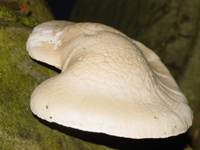 |
CapWhite or cream; convex and usually bracket-like with either radial or eccentric stem; convex, gradually flattening but often retaining a broad umbo; surface is felt-like, often breaking into large scale-like patches; 5 to 15cm across. |
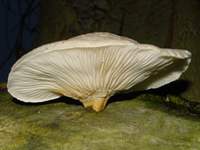 |
GillsWhite, decurrent. |
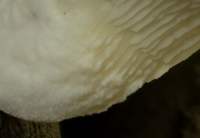 |
StemWhite or cream; up to 3cm long and 1 to 2cm dia.; tapering towards base; with a short-lived white or cream ring. |
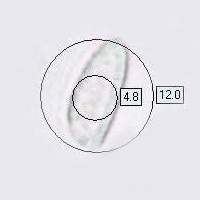 |
SporesElongated ellipsoidal to cylindrical, smooth, 10-14 x 3.5-5µm; inamyloid. Spores of Pleurotus dryinus, Veiled Oyster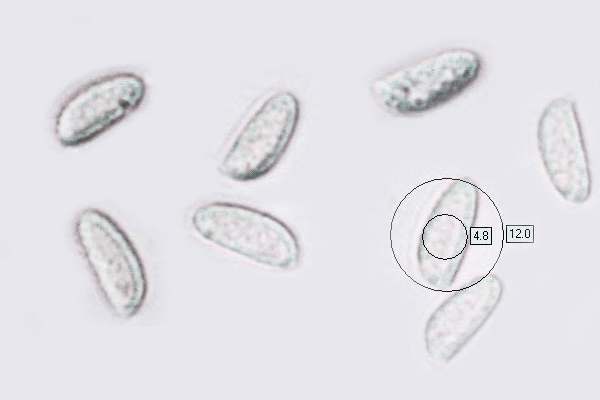 Spore printWhite. |
Odour/taste |
Not significant. |
Habitat & Ecological role |
Saprobic, on wood of dead deciduous broadleaf trees, particularly Beech, oaks and Horse Chestnut; also quite commonly on dead-wood parts of living trees, such as where a branch has been removed.. |
Season |
Late summer and autumn in Britain and Ireland. |
Similar species |
The frosted appearance of the cap distinguishes this oyster mushroom from other common members of the Pleurotus genus. |
Culinary Notes
Like its more plentiful relative the Oyster Mushroom Pleurotus ostreatus, the Veiled Oyster is a good edible mushroom. Unfortunately its scarcity over much of its range means that these kinds of oysters are rarely on the menu. We have not tried them, but we find other kinds of oyster mushrooms excellent in mixed mushroom meals, whereas on their own the texture is rather limp and not one of our favourites. We rate the Veiled Oyster as a two-star (out of five) mushroom for texture and three-star for flavour.
Reference Sources
Fascinated by Fungi, 2nd Edition, Pat O'Reilly 2016, reprinted by Coch-y-bonddu Books in 2022.
British Mycological Society, English Names for Fungi
Dictionary of the Fungi; Paul M. Kirk, Paul F. Cannon, David W. Minter and J. A. Stalpers; CABI, 2008
Taxonomic history and synonym information on these pages is drawn from many sources but in particular from the British Mycological Society's GB Checklist of Fungi.
Acknowledegements
This page includes pictures kindly contributed by Rob Evans, Sean Goodwin and David Kelly.
Fascinated by Fungi. Back by popular demand, Pat O'Reilly's best-selling 450-page hardback book is available now. The latest second edition was republished with a sparkling new cover design in September 2022 by Coch-y-Bonddu Books. Full details and copies are available from the publisher's online bookshop...