
Polyporus tuberaster (Jacq.) Fr. - Tuberous Polypore
Phylum: Basidiomycota - Class: Agaricomycetes - Order: Polyporales - Family: Polyporaceae
Distribution - Taxonomic History - Etymology - Identification - Culinary Notes - Reference Sources
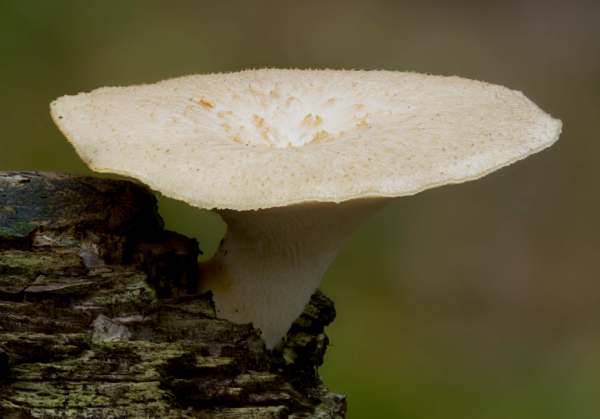
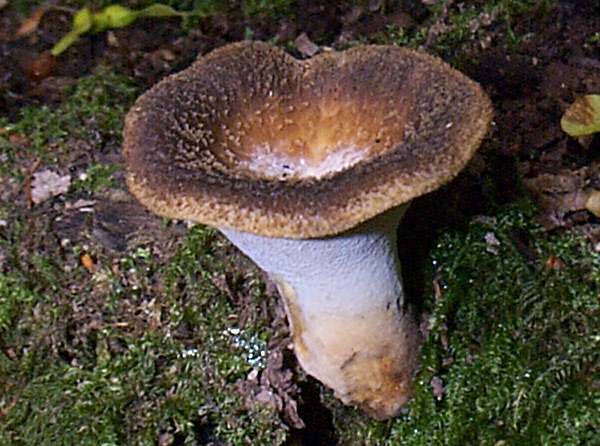
An uncommon find, the Tuberous Polypore grows on fallen branches of deciduous hardwood trees. It is reported that sometimes these funnel-shaped polypores grow from a sclerotium-like tuber (a hard mass of mycelium that stores food reserves, enabling the fruitbody to survive harsh environmental conditions).
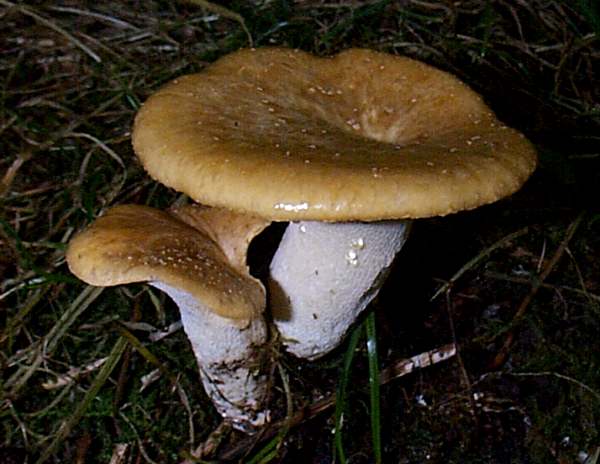
These woodland fungi are easily overlooked, as often the caps are darker than those on the left and blend in with a background of dead leaves.
Distribution
Polyporus tuberaster is seen only infrequently in Britain and Ireland. It occurs also across most of mainland Europe and in many parts of Asia.
Taxonomic history
The Tuberous Polypore was described in 1796 by Dutch naturalist Nicolaus Joseph von Jacquin (1727 - 1817), who gave it the binomial scientific name Boletus tuberaster. It was the Swedish mycologist Elias Magnus Fries who, in 1821, redescribed this species and transferred it to the genus Polyporus, thus establishing its currently-accepted scientific name Polyporus tuberaster.
Synonyms of Polyporus tuberaster include Boletus tuberaster Jacq., Favolus boucheanus Klotzsch, Polyporus lentus Berk., Polyporus coronatus Rostk., Polyporus floccipes Rostk., Polyporus boucheanus (Klotzsch) Fr., and Polyporus forquignonii Quél.
Etymology
The generic name Polyporus means 'having many pores', and fungi in this genus do indeed have tubes terminating in pores (usually very small and a lot of them) rather than gills or any other kind of hymenial surface.
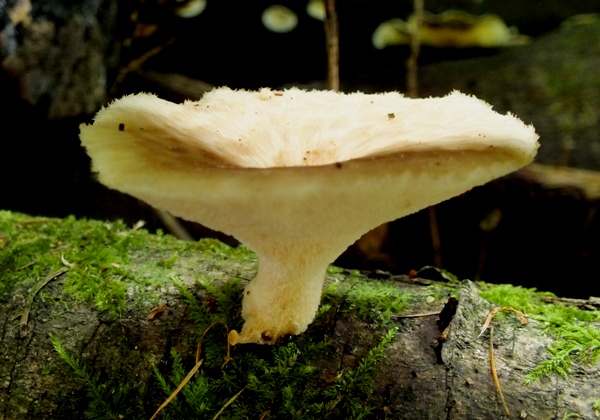
The specific epithet tuberaster means 'with tubers', and in the case of the Tuberous Polypore this is a reference to tuber-like lumps of hyphae from which these funnel-shaped fungi emerge.
The tubers are reputed to store essential food substances necessary for the fungi to survive in harsh environments. (In Britain's temperate climate Polyporus tuberaster may not need such an insurance policy, but perhaps evolution has equipped it to cope with extremes of climate change yet to come) Round, oval or irregular in shape, the tubers are ochraceous and fleshy when fresh, shrinking considerably if they dry out.
Other polypores that either mainly or at least sometimes have central (or nearly central) stems include Albatrellus ovinus, Albatrellus subrubescens, Polyporus brumalis, and Phaeolus schweinitzii as well as some of the bracket fungi - particularly in the genera Trametes, Bjerkandera and Meripilus.
Identification guide
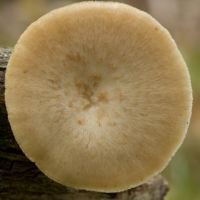 |
Cap5 to 10cm across; round rather than bracket shaped; slightly or deeply funneled; light brown to dark orange-brown and covered in small scales, sometimes concentrically zoned; the thin margin is often downturned or inrolled. StemRudimentary, pale; reported to be attached to a sclerotium in some instances (but certainly not generally so in Britain and Ireland); hairy near the base. |
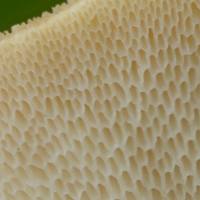 |
Tubes and poresTubes are creamy-white, 1-4mm deep, terminating in white or cream angular pores spaced at 1-3 per mm, decurrent and so leaving very little bare stem. |
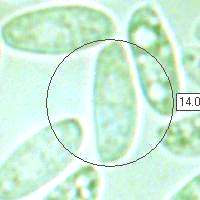 |
SporesCylindrical, smooth, 12-16 x 4-6µm; inamyloid. Spores of Polyporus tuberaster, Tuberous Polypore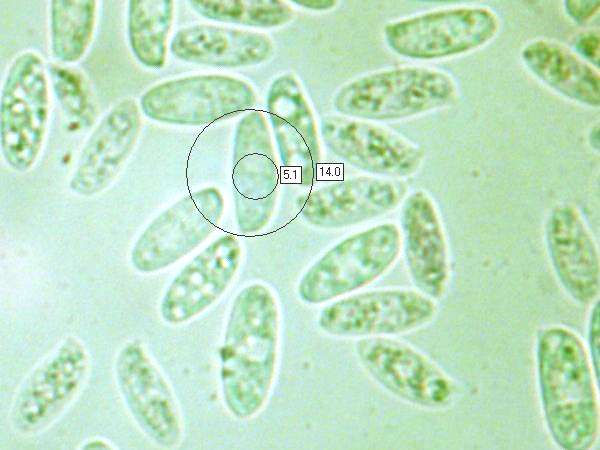 Spore printWhite. |
Odour/taste |
Odour slightly mushroomy; taste mild but not distinctive. |
Habitat & Ecological role |
Saprobic, most often found growing on buried rotten hardwoods, particularly Beech. |
Season |
Summer and autumn. |
Similar species |
Dryad's Saddle, Polyporus squamosus, occasionally forms trumpet-shaped fruitbodies arising from roots under the leaf litter; however, it has a black stem base and larger cap scales than the Tuberous Polypore. |
Culinary Notes
When young the fruitbodies of the Tuberous Polypore are said to be edible and quite good, but we have no first-hand experience of eating these fungi and we know of no recipes specifically devised for them.
Reference Sources
Mattheck, C., and Weber, K. (2003). Manual of Wood Decays in Trees. Arboricultural Association
Ellis, J. B.; Ellis, Martin B. (1990). Fungi without gills (hymenomycetes and gasteromycetes): an identification handbook. London: Chapman and Hall. ISBN 0-412-36970-2
Pat O'Reilly (2016). Fascinated by Fungi, First Nature Publishing
BMS List of English Names for Fungi
Paul M. Kirk, Paul F. Cannon, David W. Minter and J. A. Stalpers. (2008). Dictionary of the Fungi; CABI.
Taxonomic history and synonym information on these pages is drawn from many sources but in particular from the British Mycological Society's GB Checklist of Fungi.
Acknowledgements
This page includes pictures kindly contributed by David Kelly.
Fascinated by Fungi. Back by popular demand, Pat O'Reilly's best-selling 450-page hardback book is available now. The latest second edition was republished with a sparkling new cover design in September 2022 by Coch-y-Bonddu Books. Full details and copies are available from the publisher's online bookshop...