Postia caesia (Schrad.) P. Karst. - Conifer Blueing Bracket
Phylum: Basidiomycota - Class: Agaricomycetes - Order: Polyporales - Family: Fomitopsidaceae
Distribution - Taxonomic History - Etymology - Identification - Culinary Notes - Reference Sources
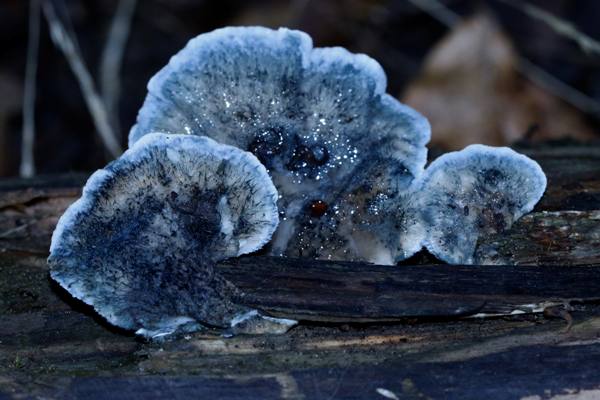
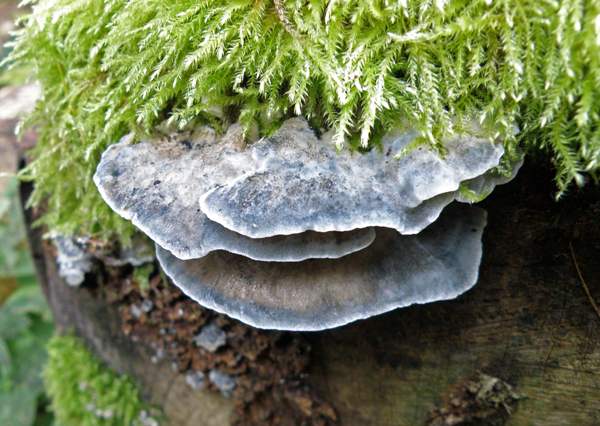
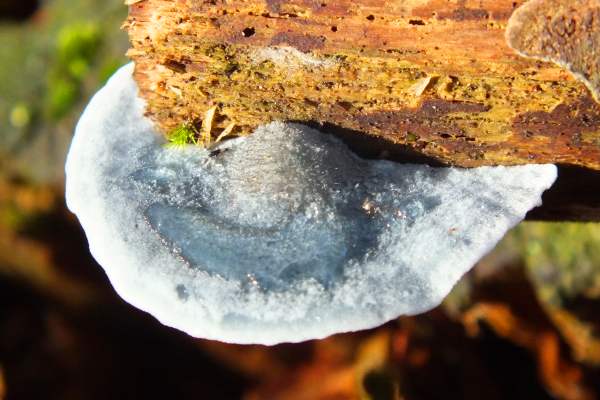
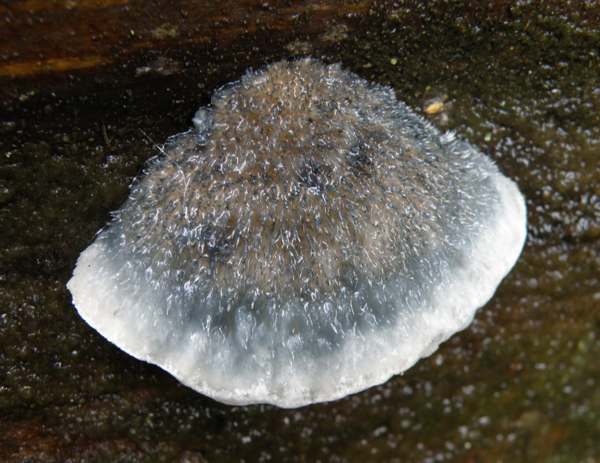
Pale all over at first, this unusual but hardly pretty annual bracket fungus, which can appear singly or in rows or tiers, turns a distinctive blue colour on its upper surface as it ages.
Pine wood is the usual host (staple diet!) of this wood-rotting fungus, although very occasionally you may also find these hairy blue brackets on dead and decaying hardwoods such as beech or oak logs - almost invariably a long after the tree has died and its bark fallen away.
Distribution
Widespread and fairly common in Britain and Ireland, Postia caesia is found throughout most of mainland Europe and is most common in central and northern Europe. (The group shown here was found in central France.) The Conifer Blueing Bracket is also recorded in parts of Asia and is reported from North America.
Taxonomic history
This bracket fungus was described scientifically in 1794 by German botanist and mycologist Heinrich Adolph Schrader (1767 - 1836), who established its basionym when he gave it the binomial name Boletus caesia.
The Conifer Blueing Bracket was transferred to its present genus in 1881 by the Finnish mycologist Petter Adolf Karsten (1834 - 1917), at which point its scientific name became Postia caesia.
Synonyms of Postia caesia include Boletus caesius Schrad., Polyporus caesius (Schrad.) Fr., Leptoporus caesius (Schrad.) Quél., Tyromyces caesius (Schrad.) Murrill, and Oligoporus caesius (Schrad.) Gilb. & Ryvarden.
Etymology
Postia, the genus name, was established by Elias Magnus Fries in honour of the Swedish naturalist Hampus von Post (1822 - 1911). The specific epithet caesia means sky blue and is a reference to the blue-grey colour of the upper (infertile) surface of mature specimens of this bracket fungus.
Identification Guide
 |
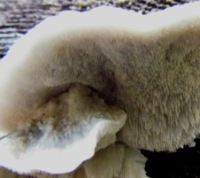
CapThe fruitbodies are typically 1 to 5cm across and up to 1cm thick, and the upper surface is covered in fine hairs and radial wrinkles that create a slightly wavy margin. The upper surface is white initially but develops a blue-grey tinge as it matures, and it also blues fairly soon after being handled. |
 |
Tubes and PoresThe pores are white and spaced 4 to 6 per mm. |
SporesSausage-shaped, smooth, 4-5 x 0.7-1.0µm; amyloid. Spore printVery pale blue. |
|
Odour/taste |
Mild odour; very little taste. |
Habitat & Ecological role |
In Britain and Ireland the Conifer Blueing Bracket is saprobic mainly on the well rotted dead wood of coniferous trees, and most often seen on decaying felled spruce trunks. In contrast, in North America (where this rubbery shelf or bracket fungus is commonly referred to as the Blue Cheese Polypore) this species is often recorded as occurring on standing or fallen trunks or on the snapped-off decaying branches of broadleaf trees. The Conifer Blueing Bracket is a fungus of damp, shaded places, and so it is much more often found in mature mixed woodland, conifer forests and plantations than on dead timber in more open parkland. |
Season |
Brackets are visible throughout most of the year, but they release their spores in late autumn. |
Similar species |
Because of its unusual colour and spongy texture, Postia caesia is unlikely to be confused with any other common bracket fungus on conier timber. Cyanosporus subcaesius (syn. Postia subcaesia) and Postia alni, both more often associated with broadleaf trees rather than conifers, have rather different blueing characteristics and produce narrower spores; however, even after academics and other professional mycologists have compared molecular sequences for samples from several countries, the question of whether these are genuinely different species is still the subject of ongoing debate. |
Culinary Notes
These bracket fungi are generally considered to be edible.
Reference Sources
Mattheck, C., and Weber, K. Manual of Wood Decays in Trees. Arboricultural Association 2003.
Fascinated by Fungi, 2nd Edition, Pat O'Reilly 2016, reprinted by Coch-y-bonddu Books in 2022.
BMS List of English Names for Fungi
Dictionary of the Fungi; Paul M. Kirk, Paul F. Cannon, David W. Minter and J. A. Stalpers; CABI, 2008
Taxonomic history and synonym information on these pages is drawn from many sources but in particular from the British Mycological Society's GB Checklist of Fungi.
Acknowledgements
This page includes pictures kindly contributed by David Kelly and James Wainscoat.

Fascinated by Fungi. Back by popular demand, Pat O'Reilly's best-selling 450-page hardback book is available now. The latest second edition was republished with a sparkling new cover design in September 2022 by Coch-y-Bonddu Books. Full details and copies are available from the publisher's online bookshop...