Schizophyllum commune Fr. - Split Gill
Phylum: Basidiomycota - Class: Agaricomycetes - Order: Agaricales - Family: Schizophyllaceae
Distribution - Taxonomic History - Etymology - Identification - Culinary Notes - Reference Sources
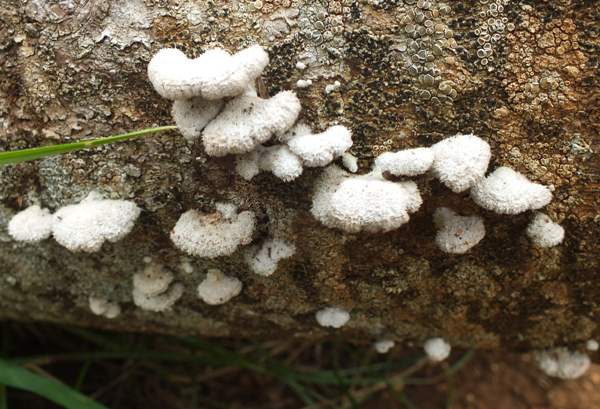
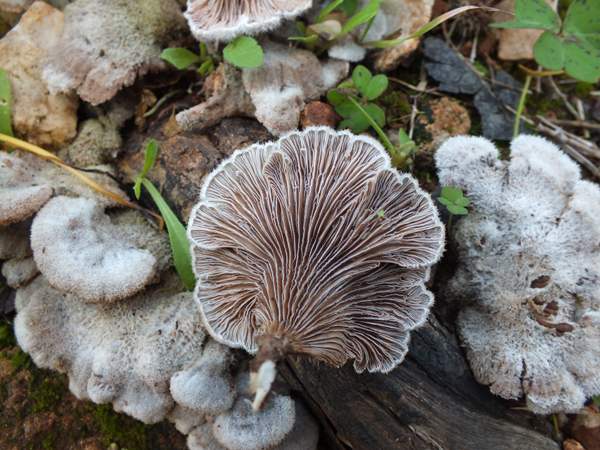
Often seen on sickly hardwood trees, but equally common on dead wood including cut timber, the Split Gill fungus usually grows as a sessile bracket. On the undersides of branches, however, it more often forms centrally-attached circular fans, as shown below.
Seen from above, this is just another small white bracket-like fungus, but beneath the cap are radial gill-like folds, each of which is centrally split - hence the common name Split Gill. These splits are a clever adaptation to changing environments.
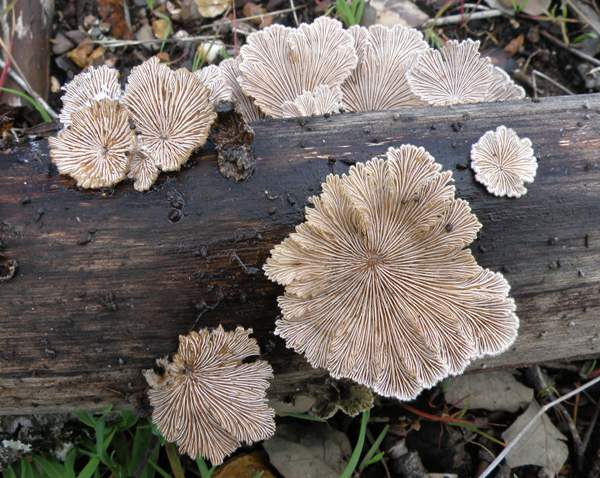
The splits in the gills of Schizophyllum commune close over the fertile surfaces as the fruitbody shrivels during prolonged dry weather, rehydrating when moistened by rain; then the splits reopen, the spore-producing surfaces are exposed to the air, and spores are released.
Split Gills can survive several such cycles of dehydration and rehydration, a facility that enables these fungi to live on every continent on earth with (as far as anyone knows) the (exception of Antarctica.
Often when fungi appear to be similar but occur on widely separated continents, DNA analysis shows that their genetic separation is so great that they should be - Classified as distinct species. Thanks to the work of John Raper and colleagues at Harvard University over two decades from the 1950s to the 1970s we know that Schizophyllum commune is one species worldwide.
Roper and his colleagues collected Split Gill mushrooms from all over the world, and from germinated spores they grew mycelia and showed that as two strains were of different mating types they were able to mate with one another. They also discovered that Schizophyllum commune has more than 28,000 sexes, an adaptation that minimises the risk of siblings mating, and therefore maximises the genetic diversity by achieving nearly 100% outbreeding with new genetic stock.
Distribution
Common in the west but much less so in the north and east (see note below), Split Gill is found in most parts of Britain and Ireland. These tough little fungi occur throughout the world and can be seen on a wide range of timbers and many other plant-based substrates virtually anywhere in Europe, Asia, Africa, the Americas and Australasia.
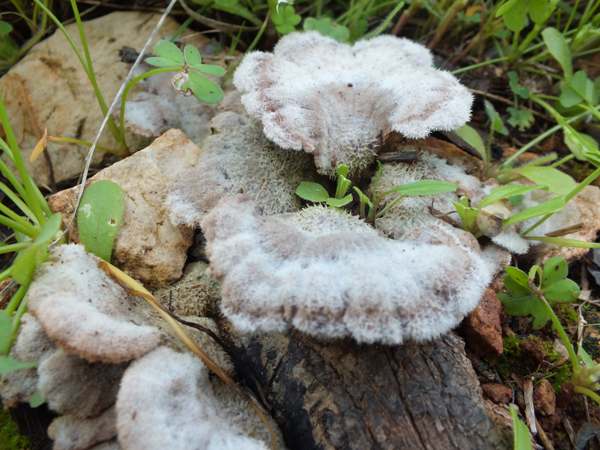
I am grateful to Neil Mahler, County Fungus Recorder, Suffolk, who in January 2015 advised me that he had recently received only the fifth record of Split Gill in the county, and he was confident that sightings in Norfolk are also very scarce.
Often only the tiniest strip of white shows along the edge of a crack in a dry old timber infected with Schyzophyllum commune, and so Split Gill can easily be overlooked, particularly in dry areas.
Taxonomic history
The great Swedish mycologist Elias Magnus Fries gave the Split Gill mushroom its current scientific name in 1815.
Synonyms of Schizophyllum commune include Agaricus alneus L., Agaricus multifidus Batsch, and Apus alneus (L.) Gray.
Schizophyllum commune is the type species of its genus, which is very small with only half a dozen separate species identified to date. Schizophyllum amplum (Lév.) Nakasone is the only other member of this genus currently recorded in Britain.
Etymology
It's not hard to work out that the generic name Schizophyllum simply means split leaves (split gills, in this instance), while the specific epithet commune is also as plain as it appears, having the same basis as common or communal - meaning shared, and implying that this species is shared all over the world. (Another common name sometimes used when referring to Schizophyllum commune is Common Porecrust - a quite inappropriate term, of course because, as I hope the pictures and notes on this page make clear, this fungus does not have a pored fertile surface.)
Identification guide
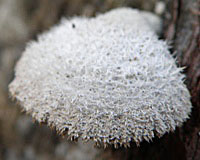 |
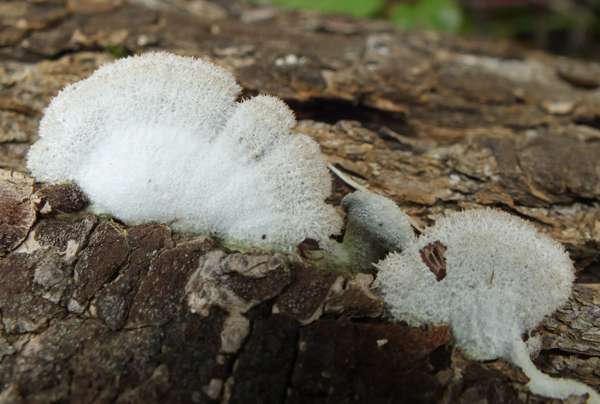
CapWhite and hairy, sometimes tinged purple; the individual caps of Schizophyllum commune are typically 1 to 3cm across and 0.3 to 1cm thick; frequently fused into the edges of adjacent caps. |
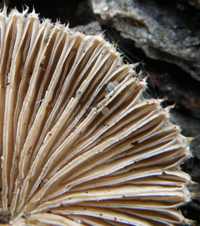 |
GillsPinkish grey, radiating from the attachment point (whether lateral or central), the 'gills' of Schizophyllum commune are split lengthways and they curl back to protect the fertile surfaces (hymenium) during dry weather. (In fact these gill-like structures are simply folds in thefertile undersurface of the cap, and so despite its appearance this is not strictly an agaricoid fungus.) StemThe rudimentary stems of the Split Gill fungus are very short and often not visible above the substrate surface; indeed, when underneath dead wood the fruitbodies are attached centrally via the infertile surface and without any stem. |
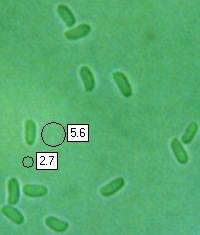 |
SporesCylindrical to ellipsoidal; smooth, 4-6 x 1.5-2.5µm. Spore printWhite. |
Odour/taste |
Not distinctive. |
Habitat & Ecological role
|
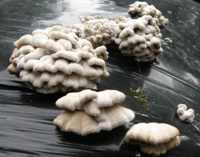
More often than not many tiers of Split Gill fruitbodies will cover damaged areas of bark on a sickly tree’s trunk or on dead or dying branches. Primarily a saprobic wood-rotting fungus, Schizophyllum commune causes white rot (it consumes mainly the lignin within timber, leaving the much softer white cellulose largely unscathed). In recent years this remarkable saprobic fungus has taken a liking to silage; it is frequently seen with tiers of fruitbodies emerging from cracks in plastic-wrapped round bales that are left piled beside field hedges or in barns. |
Season |
The long-lived fruitbodies of Schizophyllum commune can be seen throughout the year. |
Culinary Notes
These bracket-like fungi are often tougher than the timber from which they sprout, and so they are of no culinary interest.
Reference Sources
Fascinated by Fungi, 2nd Edition, Pat O'Reilly 2016, reprinted by Coch-y-bonddu Books in 2022.
British Mycological Society (2010). English Names for Fungi
Cooke, W B, 1961. The Genus Schizophyllum; Mycologia 53(6), pp575-599.
Dictionary of the Fungi; Paul M. Kirk, Paul F. Cannon, David W. Minter and J. A. Stalpers; CABI, 2008
Taxonomic history and synonym information on these pages is drawn from many sources but in particular from the British Mycological Society's GB Checklist of Fungi.

Fascinated by Fungi. Back by popular demand, Pat O'Reilly's best-selling 450-page hardback book is available now. The latest second edition was republished with a sparkling new cover design in September 2022 by Coch-y-Bonddu Books. Full details and copies are available from the publisher's online bookshop...