
Scleroderma citrinum Pers. - Common Earthball
Phylum: Basidiomycota - Class: Agaricomycetes - Order: Boletales - Family: Sclerodermataceae
Distribution - Taxonomic History - Etymology - Identification - Toxicity - Reference Sources
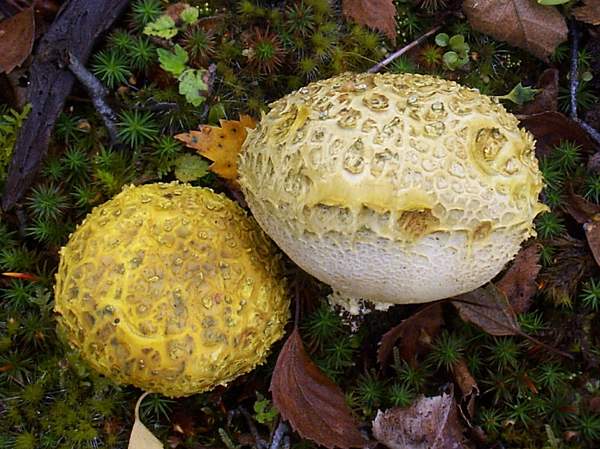
Scleroderma citrinum, the Common Earthball, is similar in appearance to a warty potato. Acid soils, especially on the compacted paths in forests, are its main habitat. The colour of these probably poisonous members of the (artificial rather than taxonomically-related) group of fungi known as gasteromycetes or stomach fungi varies from light ochre to mid brown, but usually there is a lemon-yellow tinge, especially to the upper surface. For this reason another of its common names is Citrine Earthball.
Distribution
The Common Earthball Scleroderma citrinum is very common and widespread throughout of Britain and Ireland. These poisonous fungi are found also throughout mainland Europe and in North America.
Taxonomic history
This fungus was first described in scientific literature by Christian Hendrik Persoon in 1801. (Persoon's Synopsis Methodica Fungorum, published in 1801, marked the starting point for taxonomy of gasteromycete fungi.)
The gasteromycetes are not close relatives but simply a group of fungi sharing the characteristic of producing spores within a sealed spherical, oval or pear-shaped casing. It turns out that Scleroderma fungi such as the Common Earthball are in fact close relatives of the boletes, and in particular boletes of the genus Gyroporus.
Etymology
The generic name Scleroderma comes from the Greek words scler- meaning hard, and -derma meaning skin. Earthballs certainly do have hard (and thick) skins. The specific epithet citrinum refers to the citrine (lemon-yellow) colour of the skins of most Common Earthballs.
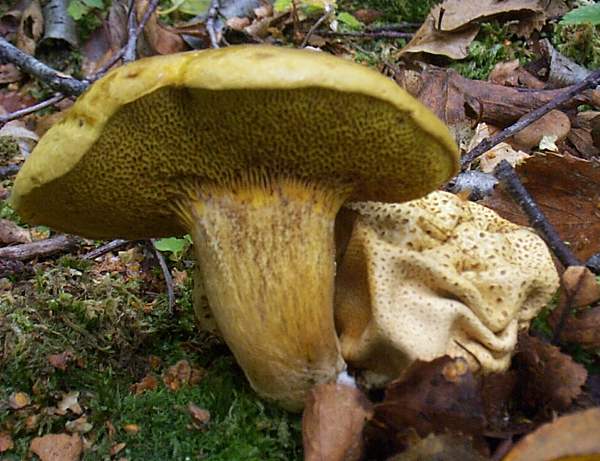
Earthballs are closely related to boletes, and in particular to those is the genus Gyropus. It is rather surprising, therefore, to discover that Scleroderma citrinum is sometimes parasitised (although the nature of the relationship between these fungi is questioned by some authorities) by the Parasitic Bolete Pseudoboletus parasiticus (pictured on the left) which cannot live without being attached to a Common Earthball. (The converse is not true: Common Earthballs are very common indeed whereas Parasitic Boletes are relatively rare finds, although they are sometimes abundant in sites where they do occur.)
Toxicity
There are conflicting reports as to whether Scleroderma citrinum is seriously poisonous; however, it is generally considered as at best inedible and suspect and at worst poisonous. I am influenced by the fact that one of its common names in the USA is Pigskin Poison Puffball, and so I treat this as a toxic species just for looking not for cooking.
Identification guide
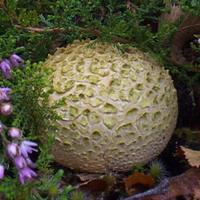 |
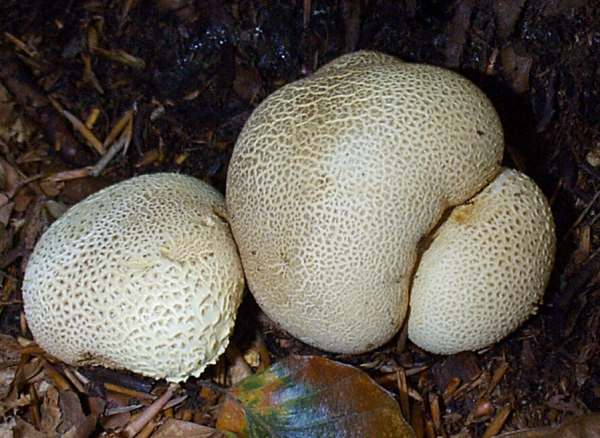
FruitbodyTypically 4 to 10cm across and 3 to 6cm tall, the rounded fruitbody is stemless and attached to the ground by white mycelial threads, visible in the picture on the left. The tough thick skin of this earthball is initially white, cream or yellow and may turn ochre-brown or green as it ages; it is covered by a network of coarse scales of irregular shapes and variable size.
|
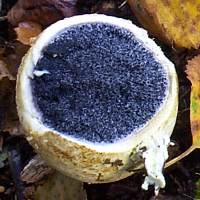 |
GlebaInside the earthball the spore mass is almost white at first but soon turns brown with white marbling before becoming purple-brown throughout.
|
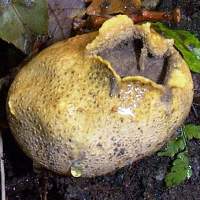 |
At maturity the skin ruptures leaving a large, irregular opening via which the wind and rain disperse the spores. Empty earthball cases can persist for many months in sheltered woodland hollows. |
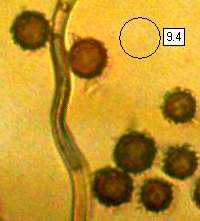 |
SporesSpherical, spiny, 8-13µm diameter when fully mature; surface reticulate, with ribs linking many of the spines to form an incomplete network. Spore massDark brown. |
Odour/taste |
Unpleasant odour of gas; taste not distinctive. |
Habitat |
Mycorrhizal, found growing on well drained, sandy soil, forest tracks and shaded banks; particularly common on the sides or forest drainage ditches. |
Season |
July to early December in Britain and Ireland. |
Similar species |
Earthballs are much less spongy than the various puffballs with which they are sometimes confused. Lycoperdon perlatum, the common puffball, has pearly, pointed scales and is very spongy to the touch. It is club-like in shape has a rudimentary infertile stipe. Lycoperdon mammiforme, another of the many puffball species, is white at first before its surface breaks up into large cream scales rather than warts; it, too, is more spongy and is more pear shaped, comprising a fertile ball on a spongy infertile stipe. |
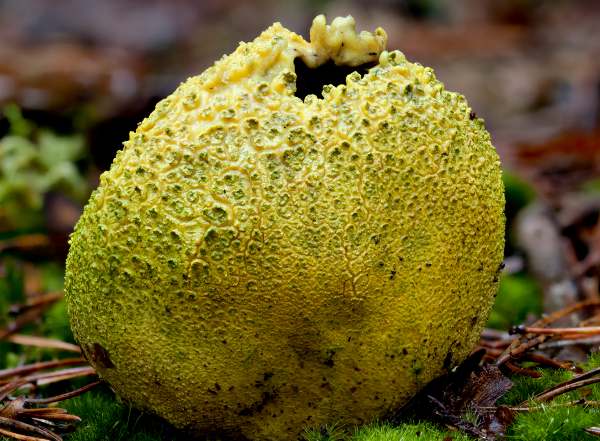
Above: the outer skin of this Common Earthball has fractured, allowing the spores to be washed out by rain during wet weather or blown out by the wind in dry spells.
Reference Sources
Fascinated by Fungi, 2nd Edition, Pat O'Reilly 2016, reprinted by Coch-y-bonddu Books in 2022.
Pegler, D.N., Laessoe, T. & Spooner, B.M (1995). British Puffballs, Earthstars and Stinkhorns. Royal Botanic Gardens, Kew.
Dictionary of the Fungi; Paul M. Kirk, Paul F. Cannon, David W. Minter and J. A. Stalpers; CABI, 2008
Taxonomic history and synonym information on these pages is drawn from many sources but in particular from the British Mycological Society's GB Checklist of Fungi.
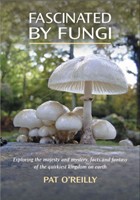
Fascinated by Fungi. Back by popular demand, Pat O'Reilly's best-selling 450-page hardback book is available now. The latest second edition was republished with a sparkling new cover design in September 2022 by Coch-y-Bonddu Books. Full details and copies are available from the publisher's online bookshop...