
Sparassis crispa (Wulfen) Fr. - Wood Cauliflower
Phylum: Basidiomycota - Class: Agaricomycetes - Order: Polyporales - Family: Sparassidaceae
Distribution - Taxonomic History - Etymology - Identification - Culinary Notes - Reference Sources
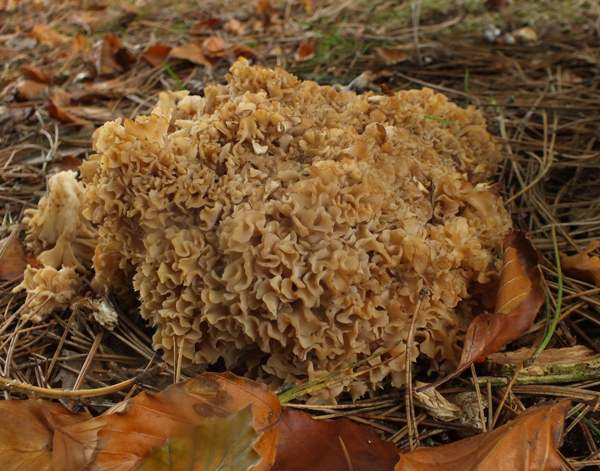
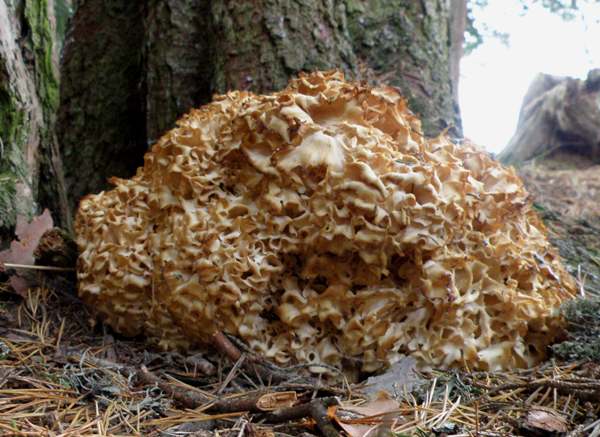
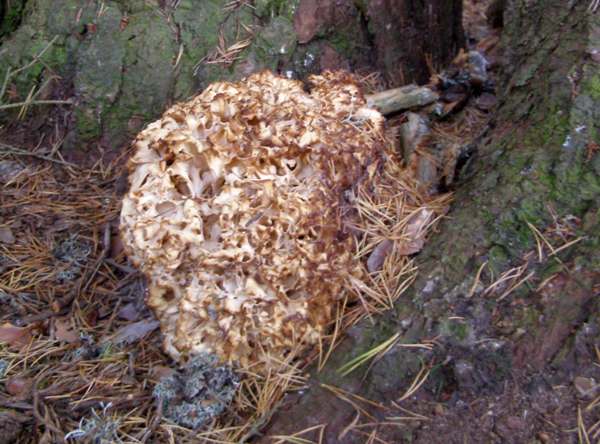
This massive fungus, sometimes several attaining a weight of several kg, grows at the bases of pine trees and occasionally other softwoods in summer and autumn. Commonly referred to as the Wood Cauliflower, this really is an impressive fungus.
Although in the wild these fungi are parasitic on the roots of coniferous trees, where squirrels often nibble them before anyone gets a chance to make them into a tasty mushroom soup, Wood Cauliflowers can be grown in cultivation. (There are reports of its culture on softwood sawdust heaps.)
Sparassis crispa is only a weak parasite and not a deadly killer. Trees can live for many years supporting new Wood Cauliflower fruitbodies annually. (In Mycelium Running, Paul Stamets shows an old-growth Douglas Fir in North America that has been the host of cauliflower mushrooms for at least two decades.)
Distribution
The Wood Cauliflower is fairly frequent in Britain and Ireland at the edges of conifer forests, along firebreaks and woodland tracks but less common in dark forests. This species is also found in central and northern mainland Europe and other parts of the world including North America.
Taxonomic history
Sparassis crispa was originally described and named by Franz Xaver Freiherr von Wulfen (1728-1805), a botanist and Jesuit Priest who spent much of his adult life exploring the flora of the Austrian Alps. The great Swedish mycologist Elias Magnus Fries in his Systema Mycologicum of 1921 sanctioned the name, which has remained valid to the present time.
Synonyms of Sparassis crispa include Clavaria crispa Wulfen, Manina crispa Scop., Masseeola crispa (Wulfen) Kuntze, Sparassis radicata Weir.
The perfect Wood Cauliflower fungus pictured above was found and photographed in Hampshire, England, by David Kelly.
Etymology
The generic name Sparassis is derived from a Greek verb meaning to tear - the fronds of the fruitbody are divided irregularly as though they have been torn; and the specific epithet crispa translates to finely waved or curled, and is not a reference to brittleness (crispness) - in fact the lobes are quite pliable (they have been described as cartilaginous in texture rather than brittle).
The beautiful postage stamps shown above were issued in Belarus in 2010. The fungus at the base of the tree is a Sparassis species... except for one of the stamps where the cauliflower fungus seems to have magically turned into a Green Woodpecker. (There is no suggestion that Wood cauliflowers are 'magic mushrooms', but who knows what lurks in the pinewoods of Belarus.)
Identification Guide
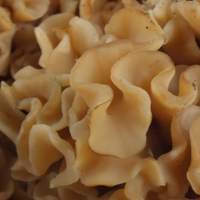
10 to 25cm tall and up to 40cm across, the fruitbody comprises many leaf-like lobes, curled and contorted; creamy white and fairly brittle when young, becoming browner and tougher with age. |
|
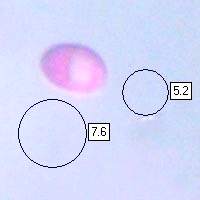 |
SporesBroadly ellipsoidal to ovoid, smooth, 5-7.5 x 4-5.5µm; usually with a single guttule (looking like an oil drop) inside each spore. Spores of Sparassis crispa, Wood Cauliflower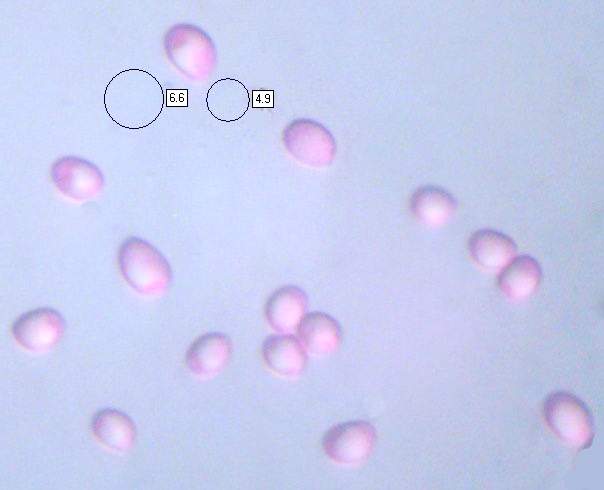 Spore printOff-white. |
Odour/taste |
Faint sweet smell; taste of hazel nuts. |
Habitat & Ecological role |
On the ground beside conifer trees, particularly Scots Pine. |
Season |
July to October in Britain and Ireland. |
Similar species |
Sparassis spathulata is less common in Britain and Ireland. In form the fruitbodies are similar to those of Sparassis crispa but its individual fronds are not wavy or curly but more or less straight (like a spatula!) and more erect. Grifola frondosa is found at the bases of oak trees and also forms a similar cauliflower-like shape, but its fan-shaped segments have pores on the underside; it is grey-brown. |
Culinary Notes
Sparassis crispa is edible when young and fresh, but this fungus should not be eaten when it begins turning brown. Often the hardest part of the preparation process is extracting all of the debris, some of which the fruitbodies may have grown up through. Wood Cauliflower fungi are very good when either baked or fried, and of course you can always add them to soups and stews. Cut the fungus into small florets, making sure that no debris in included within the tortuous folds of the fungus. Wood Cauliflower fungus can be used as the basis of a delicious Cauliflower (Fungus!) Cheese, and once you have made a nice cheesy sauce (Parmesan is an ideal basis for this) you simply pour it over a greased oven-proof dish of florets of Wood Cauliflower and then bake in the oven until the top is golden brown, just as you would if using vegetable cauliflower. The Wood Cauliflower is also one of the very best fungi for drying, because it re-constitutes so well.
Reference Sources
Fascinated by Fungi, 2nd Edition, Pat O'Reilly 2016, reprinted by Coch-y-bonddu Books in 2022.
Dictionary of the Fungi; Paul M. Kirk, Paul F. Cannon, David W. Minter and J. A. Stalpers; CABI, 2008
Taxonomic history and synonym information on these pages is drawn from many sources but in particular from the British Mycological Society's GB Checklist of Fungi.
Fascinated by Fungi. Back by popular demand, Pat O'Reilly's best-selling 450-page hardback book is available now. The latest second edition was republished with a sparkling new cover design in September 2022 by Coch-y-Bonddu Books. Full details and copies are available from the publisher's online bookshop...