Stropharia caerulea Kreisel - Blue Roundhead
Phylum: Basidiomycota - Class: Agaricomycetes - Order: Agaricales - Family: Strophariaceae
Distribution - Taxonomic History- Etymology - Identification - Culinary Notes - Reference Sources
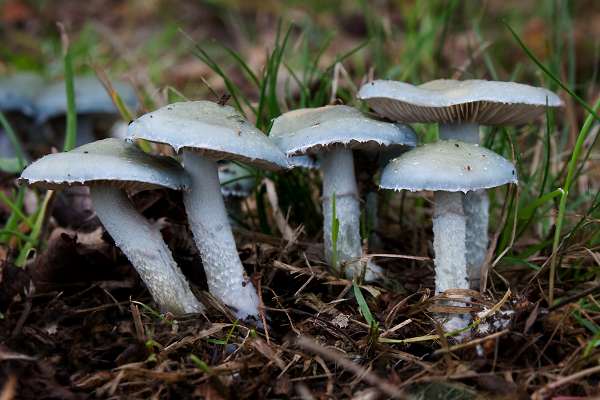
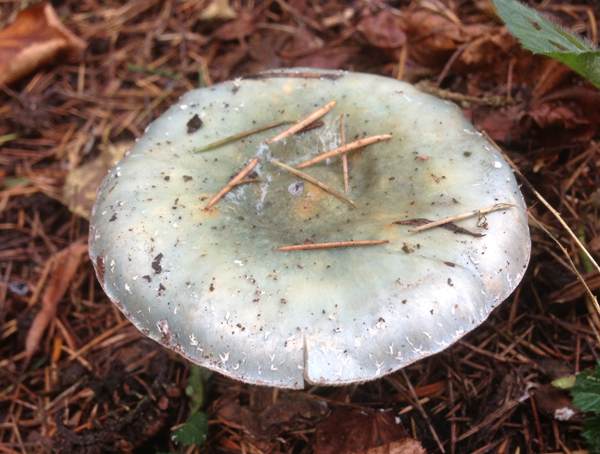
Stropharia caerulea is one of very few blue-green fungi. (In most instances the caps are much nearer to green than to blue, but when young and fresh they are very beautiful and quite startling.) The caps, initially bell-shaped, flatten and turn paler from the centre. White scales near the cap rim help to identify this unusual fungus.
The fine specimens pictured on the left were photographed in Beech woodland near Chamborigaud, in southern France.
Distribution
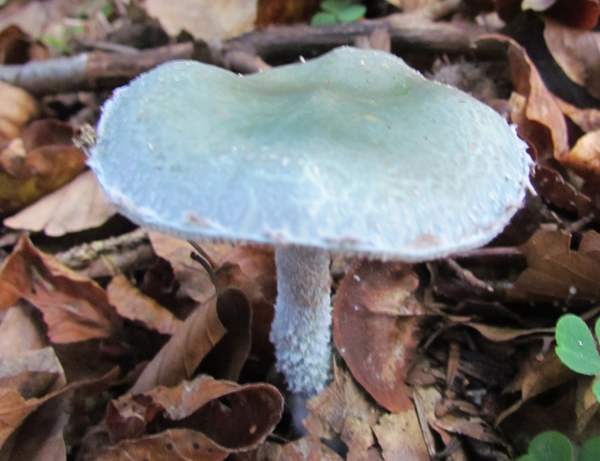
Blue Roundhead mushrooms are an occasional find and very localised in Britain and Ireland, occurring mainly in alkaline areas of humus-rich Beech woodland. These striking mushrooms are found throughout mainland Europe - I have seen them in Sweden, France, Portugal and Slovenia - and they are also recorded in parts of North America.
Taxonomic history
Although this blue mushroom has been known to science for more than two centuries, its separation from Stropharia aeruginosa had not been clearly defined until, in 1979, the German mycologist Hanns Kreisel (b. 1931) published a paper in Sydowia (an international Mycological journal produced in Austria), which established its currently-accepted scientific name Stropharia caerulea.
Long before Kreisel's work on this and related species, the British mycologist James Bolton had described the Blue Roundhead in 1788 and given it the binomial scientific name Agaricus politus.
Etymology
Stropharia, the genus name, comes from the Greek word strophos meaning a belt, and it is a reference to the stem rings of fungi in this generic grouping. The specific epithet caerulea means blue, and often it refers to a deep blue rather than the blue-green colouring of the Blue Roundhead.
Identification Guide
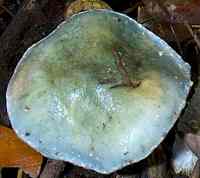 |
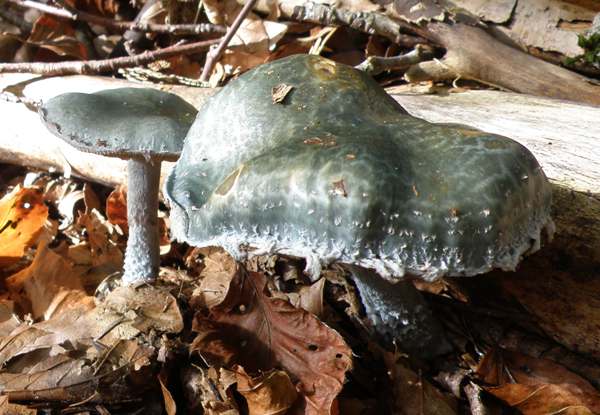
CapYoung caps are bell-shaped, blue-green and slimy, peppered with small white veil fragments. Older specimens, like the one illustrated here, are paler and scaly mainly near the rim of the cap, which expands but does not completely flatten out. In sunlight the slime dries up on older caps, which gradually turn pale tan from the centre outwards. The cap diameter at maturity usually ranges between 2 and 8cm. |
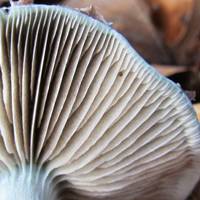 |
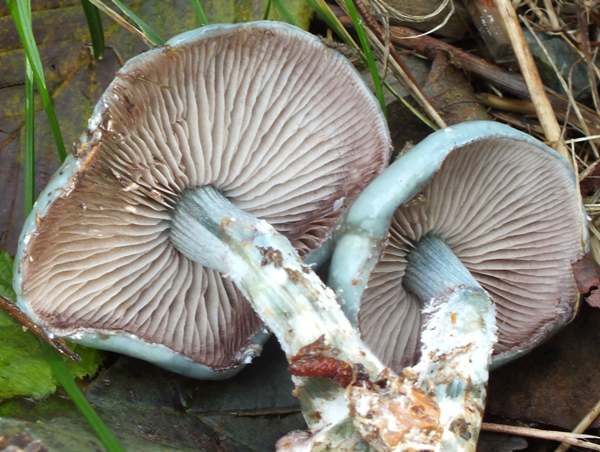
GillsAt first pale grey, the crowded sinuate (notched near to the stem) gills become purple-brown as the spores mature. (The gills of the rarer Verdigris Roundhead, Stropharia aeruginosa are adnate or only slightly notched, and the gill edges of that species remain white as the gill faces mature and turn brown.) |
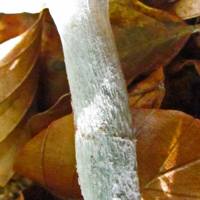 |
StemWhitish above the ring, which is transient and soon discoloured brown by falling spores; slightly more obvious pale blue-green below the ring zone and peppered with small white scales. 5 to 12 mm in diameter and 2 to 6cm tall. In the picture on the left, which shows of the stem and ring zone of a mature fruitbody, the stem ring has almost vanished apart from a slight annular bulge highlighted by brown spore stain. |
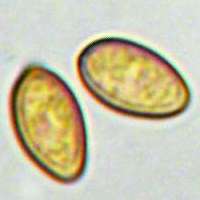 |
SporesEllipsoidal to ovoid, smooth, 7-9.5 x 4.5-6μm, without a germ pore. Spores of Stropharia caerulea, Blue Roundhead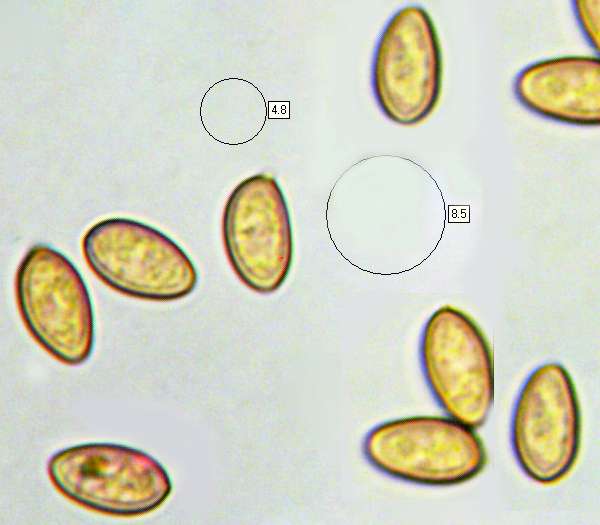 Spore printPurple-black. |
Odour/taste |
Not distinctive. (Caution: probably poisonous.) |
Habitat & Ecological role |
Saprobic, usually in small groups among grass and occasionally leaf litter in woodland and in pastures. |
Season |
July to October in Britain and Ireland; up to three months later in southern Europe. |
Similar species |
Stropharia aeruginosa is darker blue-green and its cap scales are persistent; it has reddish-brown gills with white edges. This species is much less common than Stropharia caerulea. Clitocybe odora is also blue-green but does not have a slimy cap with scales; it has a strong odour of aniseed. |
Culinary Notes
Together with other fungi in the genus Stropharia, the Blue Roundhead is not generally considered a good edible species. In the USA it has been claimed by some authorities that this is one of the mushrooms that can contain significant amounts of the toxic hallucinogens psilobin and psilocybin; however, research has shown that most Stropharia species do not contain detectable amounts of psilocybin (see ref. Kristinsson, below). Although, with the possible exception of Sulphur Tuft Hypholoma fasciculare, no member of the family Stropharicae is known to be dangerously poisonous, some of the Stropharia species can certainly cause very unpleasant gastro-intestinal symptoms. We therefore treat Stropharia caerulea as just for looking, and definitely not for cooking.
Acknowledgements
This page includes pictures kindly contributed by David Adamson and Simon Harding.
Reference Sources
Fascinated by Fungi, 2nd Edition, Pat O'Reilly 2016, reprinted by Coch-y-bonddu Books in 2022.
BMS List of English Names for Fungi
Jakob Kristinsson (2008), Occurrence and use of Hallucinogenic Mushrooms containing Psilocybin alkaloids; Nordin Counsil of Ministers, Iceland; ISBN 978-92-893-1836-5
Dictionary of the Fungi; Paul M. Kirk, Paul F. Cannon, David W. Minter and J. A. Stalpers; CABI, 2008
Taxonomic history and synonym information on these pages is drawn from many sources but in particular from the British Mycological Society's GB Checklist of Fungi.
Fascinated by Fungi. Back by popular demand, Pat O'Reilly's best-selling 450-page hardback book is available now. The latest second edition was republished with a sparkling new cover design in September 2022 by Coch-y-Bonddu Books. Full details and copies are available from the publisher's online bookshop...