
Xylaria polymorpha (Pers.) Grev. - Dead Man's Fingers
Phylum: Ascomycota - Class: Sordariomycetes - Order: Xylariales - Family: Xylariaceae
Distribution - Taxonomic History - Etymology - Identification - Reference Sources
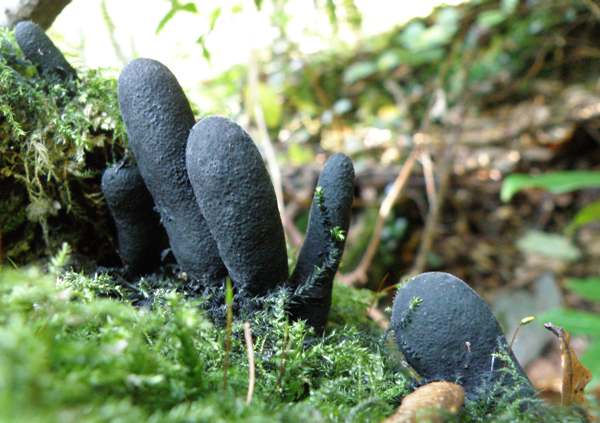
Xylaria polymorpha appears throughout the year at the base of beechwood stumps and occasionally on other buried hardwoods. Dead Man's Fingers is a very apt common name for this dull-looking species, which usually arises in tufts of three to six fingers that are often bent and give the impression of arthritic black knuckles.
Often appearing in palmate bunches, the stromata comprise white infertile finger-like forms with a black coating containing the flasks within which the asci (singular ascus) produce their spores. Known as 'flask fungi', these black compound fruitbodies are difficult to spot in dark woodlands.
Distribution
A fairly common species in Britain and Ireland, Xylaria polymorpha is found also throughout mainland Europe and in many parts of North America.
Taxonomic history
The basionym (original scientific name) Sphaeria polymorpha was given to this ascomycetous fungus in 1797 by Christiaan Hendrik Persoon.
Over the years this morbid-looking fungus has acquired many other scientific names (synonyms) including Hypoxylon polymorphum, (Pers.) Mont., Xylaria corrugata Har. & Pat., Xylaria obovata (Berk.) Berk., and Xylaria rugosa Sacc. Its currently accepted name Xylaria polymorpha dates from 1824, when Scottish mycologist and illustrator Robert Kaye Greville (1794 - 1866) transferred it to the genus Xylaria.
Etymology
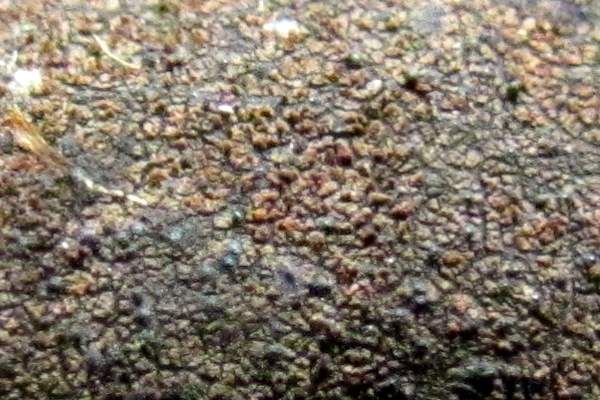
A close-up picture of the surface of an adult fruitbody is shown above, and its granular form is clearly evident; however, the specific epithet polymorpha comes not from the variable surface texture but from the many and varied forms that these fruitbodies can take. Polymorpha means, literally, in many shapes.
Concealed beneath those surface bumps are roundish chambers lined with spore-producing structures known as asci - hence these fungi belong to the phylum Ascomycota, the largest (by species numbers) section of the fungal kingdom.
Dead Man's Finger's is not generally considered to be an edible fungus.
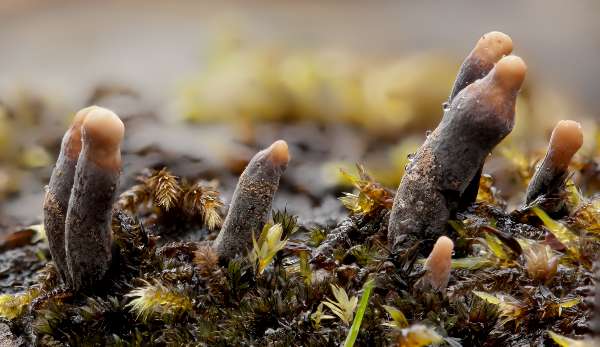
The brownish Dead Man's Fingers shown on the left are in between the asexual and sexual reproductive phases of this ascomycetous fungus.
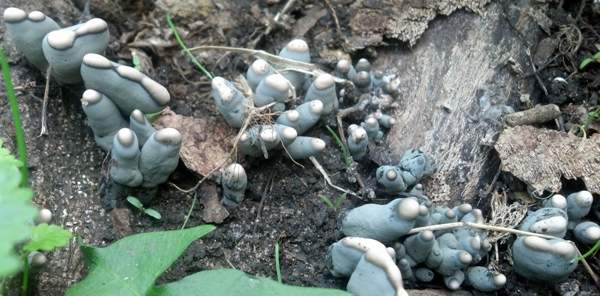
The beatiful specimens of Xylaria polymorpha shown above and immediately below are at the conidial (asexual) spore-producing stage, when the 'fingers' often turn pale blue. The pictures were taken in Wisconsin and in Illinois.
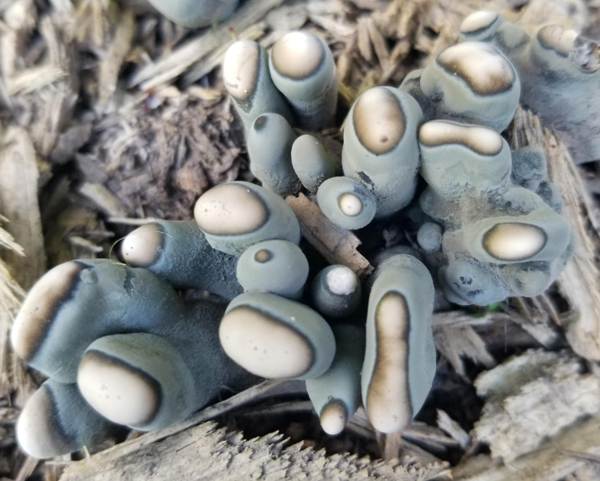
Many of the fungi whose lifecycles include both asexual (via conidiospores) and sexual (via either ascospores or basidiospores caused great confusion in the early days of fungal taxonomy. Several of them were given separate binomial scientific names for each of these stages, because they were thought to be quite different species. If you compare the light blue 'Dead Man's Fingers' with those in the picture at the top of this page, I think you will readily accept that this was hardly a stupid mistake but quite understandable.
Identification guide
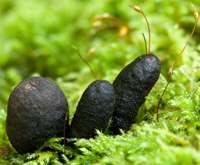 |
DescriptionIndividual fingers vary from 1 to 3cm in diameter and are usually between 3 and 8cm long when fully developed. The surface is initially white or greyish and covered in a fine pallid powder (conidia) during the asexual stage, later becoming slightly granulated and darkening through brown to black, sometimes with greenish or bluish tinges. |
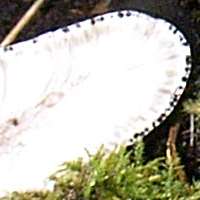 |
Stroma and peritheciaAs seen on the left, inside the communal fruitbody known as a stroma (plural stromata) the flesh is white; it is quite hard. Near the surface are spore-producing cavities known as perithecia - visible in this picture as black dots against the white background. There is a tiny pore-like hole in the top of each perithecium, and when the asci explode and eject their spores this is their exit route to the great world outside. |
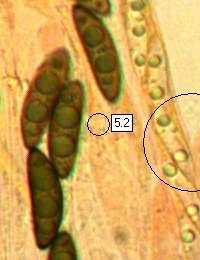 |
SporesProduced within structures known as asci (singular ascus), the ascospores are dark brown (when fully developed), smooth, fusiform (spindle-shaped) or banana shaped, and 20-30 x 5-9μm. (Ascomycete fungi generally have spores much larger than those of most basidiomycete species.) Unusually, the spores shown here contain several guttules (oil-like drops) up to about 5μm in diameter, whereas most authorities refer to the spores of Xylaria polymorpha as containing commonly just one drop and sometimes none at all. The asci are typically 200 x 10μm with eight spores in each ascus. Spore printBlack. |
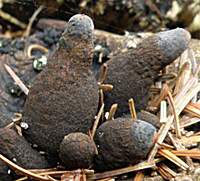 |
ConidiaIn common with other Xylaria species this fungus is also capable of asexual reproduction via conidiospores (often referred to as conidia), which are smaller than the ascospores, smooth, ellipsoidal and hyaline. The pale blue-grey powdery conidiospores are still visible on the tips of young fruitbodies pictured on the left; they will have been blown or washed away by the time that the ascospores are ripe, and then the surface of the 'fingers' will have become a much darker shade of brown. |
Odour/taste |
Not distinctive. |
Habitat & Ecological role |
Saprobic, and so found on or near (and connected) to the stumps of dead beech trees and, less frequently, other broadleaf tree stumps. Xylaria comes from the same Greek work as xylem, and simply means wood. Dead Man's Fingers are indeed wood-rotting fungi, but they specialise in consuming neither the softish cellulose nor the much tougher lignin but rather the polysaccharides - glucan and other minority content compounds of timber that bind the cellulose and lignin together to form what we recognise as wood. As a result, when these and various other ascomycetous fungi have consumed what they can of a dead stump the remainder is a nutrient-rich soft mess that insects and other small creatures are able to feed upon (if other cellulose- or lignin-rotting fungi haven't found it first). |
Season |
Mainly seen in summer and autumn, but some fruitbodies can usually be found throughout the year. Producing ascospores in autumn and early winter. |
Similar species |
Xylaria longipes is similar but slimmer, smaller and less robust. Its fruitbodies are more obviously stalked clubs and they occur most often on the stumps and fallen branches of sycamore trees as well as beeches. |
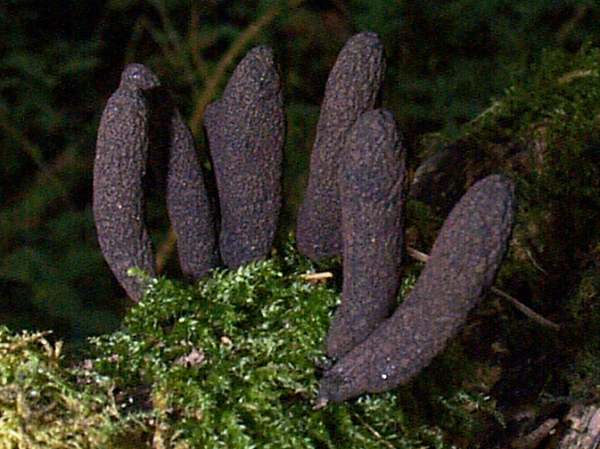
Above: Xylaria polymorpha, Cambridgeshire, England 2013.
Reference Sources
Fascinated by Fungi, 2nd Edition, Pat O'Reilly 2016, reprinted by Coch-y-bonddu Books in 2022.
Dennis, R.W.G. (1981). British Ascomycetes; Lubrecht & Cramer; ISBN: 3768205525.
Breitenbach, J. & Kränzlin, F. (1984). Fungi of Switzerland. Volume 1: Ascomycetes. Verlag Mykologia: Luzern, Switzerland.
Medardi, G. (2006). Ascomiceti d'Italia. Centro Studi Micologici: Trento.
BMS List of English Names for Fungi
Dictionary of the Fungi; Paul M. Kirk, Paul F. Cannon, David W. Minter and J. A. Stalpers; CABI, 2008
Taxonomic history and synonym information on these pages is drawn from many sources but in particular from the British Mycological Society's GB Checklist of Fungi.
Acknowledgements
This page includes pictures kindly contributed by Andrea Aspenson, Kathy Bardoel and David Kelly.
Fascinated by Fungi. Back by popular demand, Pat O'Reilly's best-selling 450-page hardback book is available now. The latest second edition was republished with a sparkling new cover design in September 2022 by Coch-y-Bonddu Books. Full details and copies are available from the publisher's online bookshop...