Cephalanthera longifolia - Sword-leaved Helleborine
Phylum: Magnoliophyta - Class: Liliopsida - Order: Orchidales - Family: Orchidaceae
Description
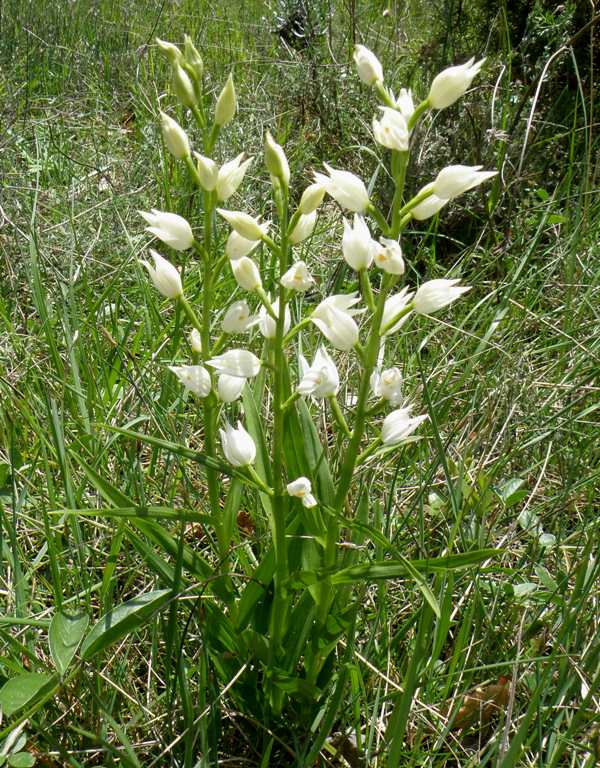
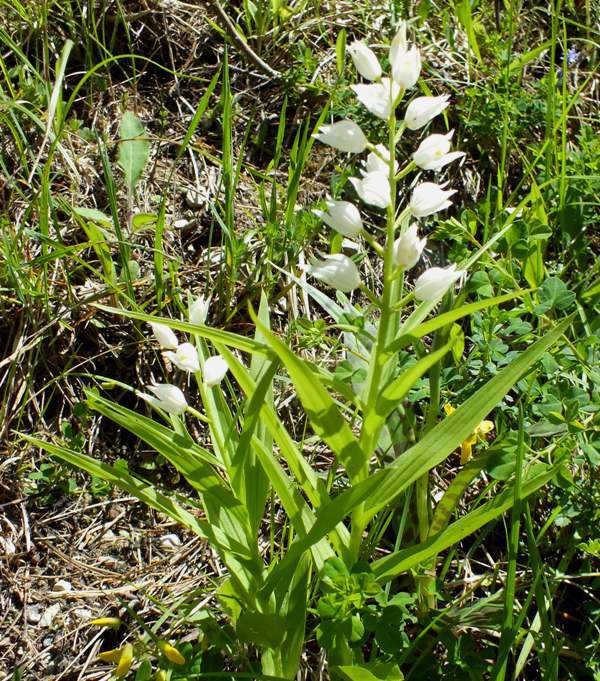
The Sword-leaved Helleborine grows to about 40 cm in height and is distinguished from Cephalanthera damasonium by the shape of its leaves, which are long and narrow. Both the Latin namelongifolia which means long-leaved and the English common name 'sword-leaved' refer to the distinctive shape of the leaves.
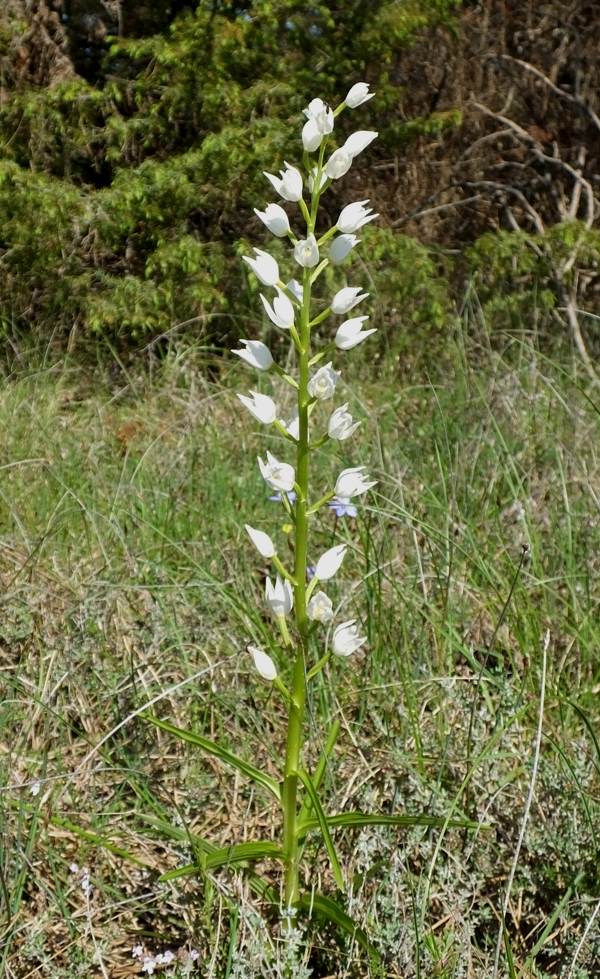
The stately specimen pictured above was seen in the Aveyron region of southern France.
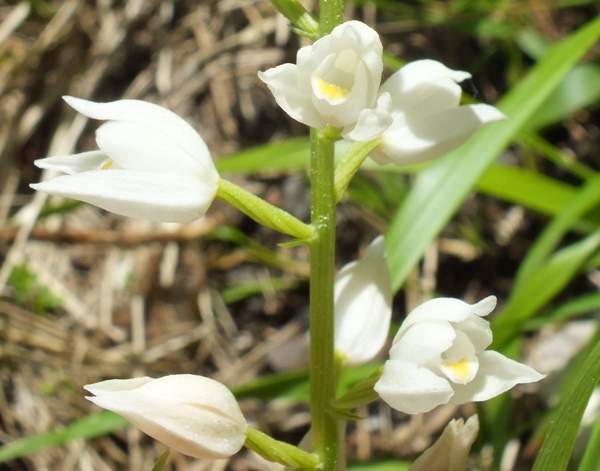
The flowers are white, and there is a distinctive yellow patch on their lips.
Distribution
Although generally associated (in the UK, that is) with the chalk-rich habitats of southern England, the Sword-leaved Helleborine also occurs in western Scotland, in a few sites in Ireland and on the western fringes of Mid and North Wales. This species is in steep decline both in the UK and throughout mainland Europe, where it is widespread but nowhere very common.
We have found these lovely orchids in the Algarve (southern Portugal), in the Lot Valley in France, and also in the Triglav Narodni National Park in Slovenia.
Habitat
Although mainly associated with woodlands in the UK and France, we have seen Sword-leaved Helleborine in a number of other habitats including on roadside verges. In the Algarve region of Portugal Cephalanthera longifolia can be found sheltering in the lee of dry stone walls and at the base of slopes where moisture tends to collect, but always where trees are never far away.
Flowering times
In the UK and France Cephalanthera longifolia flowers in June, but in southern Europe it comes into flower much earlier, often in February and March.

The specimens shown on this page were found in the Algarve during late February and in Slovenia in early June.
Hybrids and Varieties
- Cephalanthera x schulzie is a rare hybrid between Sword-leaved Helleborine Cephalanthera longifolia and White Helleborine Cephalanthera damasonium. It has been recorded from Hampshire and West Sussex.
Etymology
The genus name Cephalanthera means 'anther head', a reference to the globular shape on the stamens, while the specific epithet longifolia means 'long-leaved'.
Reference sources
The Plant List
Sue Parker (2023) Wild Orchids of Wales - how, when and where to find them; First Nature e-book (Amazon Kindle format)
Sue Parker (2023) Wild Orchids of the Algarve - where, when and how to find them; First Nature e-book (Amazon Kindle format)
Chris Thorogood and Simon Hiscock (2014) Field Guide to the Wildflowers of the Algarve; Kew Publishing
Anne and Simon Harrap (2005) Orchids of Britain and Ireland; A&C Black
Pierre Delforge (2005) Orchids of Europe, North Africa and the Middle East; A&C Black


Please Help Us: If you have found this information interesting and useful, please consider helping to keep First Nature online by making a small donation towards the web hosting and internet costs.
Any donations over and above the essential running costs will help support the conservation work of Plantlife, the Rivers Trust and charitable botanic gardens - as do author royalties and publisher proceeds from books by Pat and Sue.