Trees Birds Mammals Fish Amphibians Reptiles
Wild Algarve
Bookshop
Amanita fulva (Schaeff.) Fr. - Tawny Grisette
Phylum: Basidiomycota - Class: Agaricomycetes - Order: Agaricales - Family: Amanitaceae
Distribution - Taxonomic History - Etymology - Identification - Culinary Notes - Reference Sources
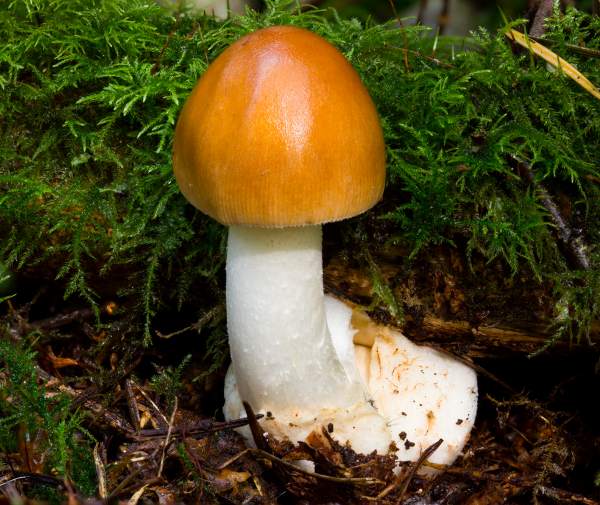
Although Amanita fulva, commonly referred to as
the Tawny Grisette, is not poisonous it must be well cooked before it
may safely be eaten. (Cooking destroys its toxins.) Amanitas are so stately that it seems a shame to collect them. I look for fallen specimens wherever possible when I want to photograph volvas or other features that cannot be seen easily on standing fruitbodies. Pale-capped Amanita fulva fungi can be confused with Deathcaps; occasionally a Tawny Grisette will have a very pale-brown, almost light-ochre cap.
For a detailed description of the Amanita genus and identification of common species see our Simple Amanita Key...
Distribution
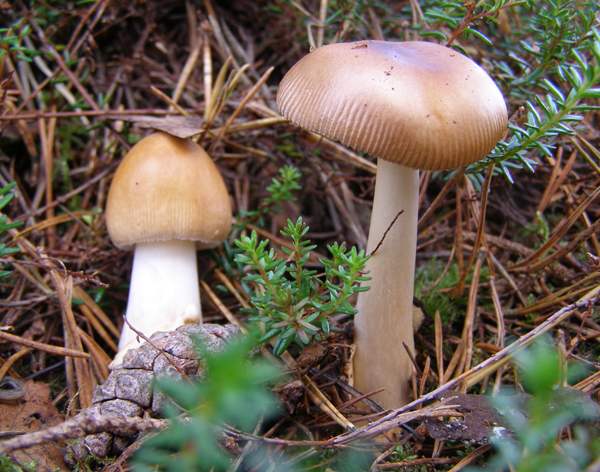
Amanita fulva is a fairly frequent find in most parts of Britain and Ireland, and it tends to be most common in areas where the soil is acidic.(For this reason the Tawny Grisette is often the most abundant Amanita species in the conifer forests of western Wales, northwest England and Scotland.) This species is also found throughout most of mainland Europe. Amanita fulva is also reported from many parts of North America, where although it is quite common it might possibly be a different species from the European mushroom known as the Tawny Grisette.
Taxonomic history
When Jacob Christian Schaeffer first described this species in 1774, he named it Agaricus fulvus. (Most of the gilled mushrooms were included initially in the genus Agaricus!). This was subsequently transferred to the genus Amanita by the great Swedish mycologist Elias Magnus Fries in 1815, when it was renamed Amanita fulva.
Synonyms of Amanita fulva include Agaricus fulvus Schaeff., Amanitopsis vaginata var. fulva (Schaeff.) Sacc., Amanitopsis fulva (Schaeff.) Fayod, and Amanita ochraceomaculata Neville & Poumarat.
Etymology
The specific epithnet fulva means reddish brown (tawny!).
Identification guide
 |
Cap
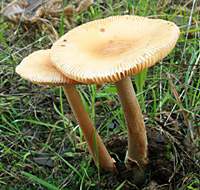
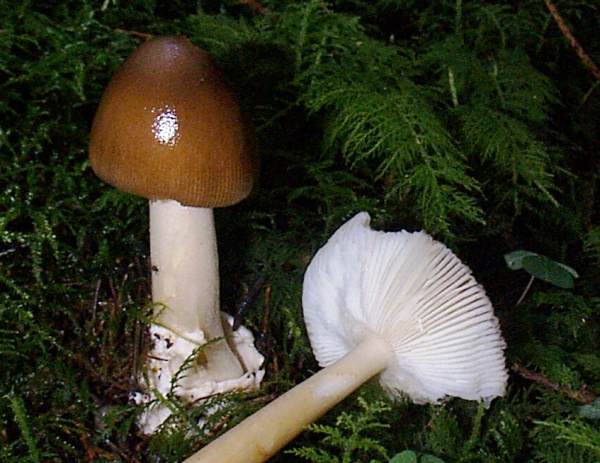
Caps of Amanita fulva range from 5 to 8cm in diameter when fully mature; tawny orange with a paler
area around the edge of the cap. The surface is nearly always devoid of veil fragments.
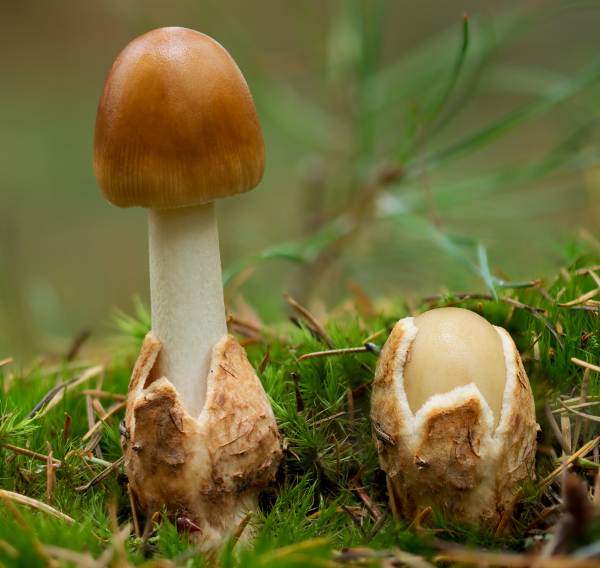
Initially egg-shaped, the cap expands
to become flat but with a small raised central area (an umbo). The
edge of the cap is striated (with comb-like radial ridges). |
 |
Gills
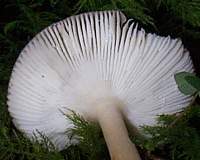
The gills of the Tawny Grisette are white, free and crowded; of variable length, some start at the margin and others start near the stipe; sometimes a few of the gills start well away from the margin and terminate well before reaching the stem. |
 |
Stem
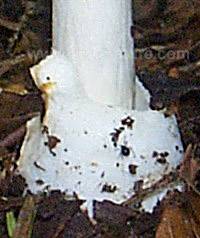
Stems of the Tawny Grisette are 10 to 15cm long and 1 to 1.5cm in diameter, tapering (narrower at the top); white (as on the left) or flushed pale tawny (as in the mature pair of specimens shown above); often with the surface very finely fibrillose. There is no ring, but at
the base of the stipe there is a large white sack-like volva (the upper half of which is visible in the picture on the left). |
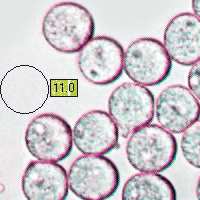 |
Spores
Roughly spherical, smooth, 9.5-12.5 x 9.7-12.5µm; nonamyloid.
Spore print
White. |
Odour/taste |
Not distinctive. |
Habitat & Ecological role |
Amanita fulva is mycorhizal with hardwood and softwood trees;
it is commonly found beside woodland paths. |
Season |
July to October in Britain and Ireland. |
Similar species |
Amanita caesarea (Caesar's Mushroom) is rarely if ever
found except in southern Europe; its cap is brilliant orange with a
striated margin, and the stipe is orange-yellow.
Amanita crocea has a yellowish-orange cap with an apricot
tinge at the centre. It has cream rather than white gills and a more
brittle stipe that is often hollow in mature fruit bodies, and it has a
sweet smell and a nutty taste.
Amanita vaginata is similar but has a greyish cap. (For many years Amanita fulva was considered to be merely a colour form of Amanita vaginata.) |
Culinary Notes
This is an edible mushroom but not highly prized; however, as the genus Amanita contains some of the most deadly poisonous of all fungi only the most expert or the most foolhardy of fungus foragers eat any of the ringless amanitas. Some authorities report that unless very thoroughly cooked Amanita fulva is toxic; that warning together with the risk of confusion with poisonous amanitas is enough to discourage most people from treating the Tawny Grisette as edible.
Reference Sources
Fascinated by Fungi, 2nd Edition, Pat O'Reilly 2016, reprinted by Coch-y-bonddu Books in 2022.
BMS List of English Names for Fungi
Geoffrey Kibby, (2012) Genus Amanita in Great Britain, self-published monograph.
Funga Nordica: 2nd edition 2012. Edited by Knudsen, H. & Vesterholt, J. ISBN 9788798396130
Paul M. Kirk, Paul F. Cannon, David W. Minter and J. A. Stalpers (2008). Dictionary of the Fungi; CABI
Taxonomic history and synonym information on these pages is drawn from many sources but in particular from the British Mycological Society's GB Checklist of Fungi.
Acknowledgements
This page includes pictures kindly contributed by David Kelly.
Top of page...
Fascinated by Fungi. Back by popular demand, Pat O'Reilly's best-selling 450-page hardback book is available now. The latest second edition was republished with a sparkling new cover design in September 2022 by Coch-y-Bonddu Books. Full details and copies are available from the publisher's online bookshop...