
Amanita vaginata (Bull.) Fr. - Grisette
Phylum: Basidiomycota - Class: Agaricomycetes - Order: Agaricales - Family: Amanitaceae
Distribution - Taxonomic History - Etymology - Identification - Culinary Notes - Reference Sources
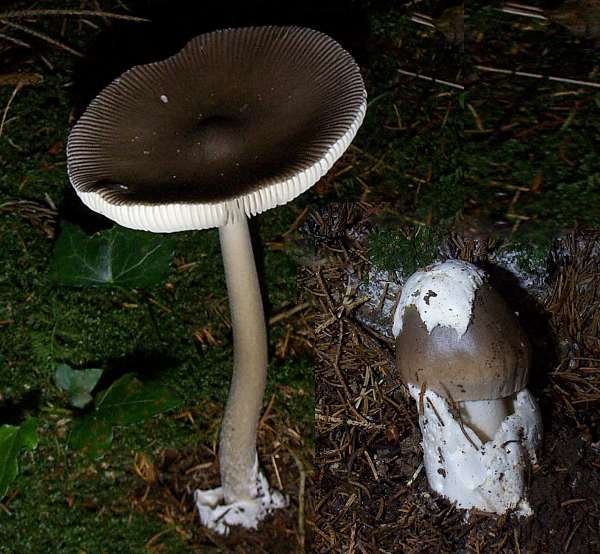
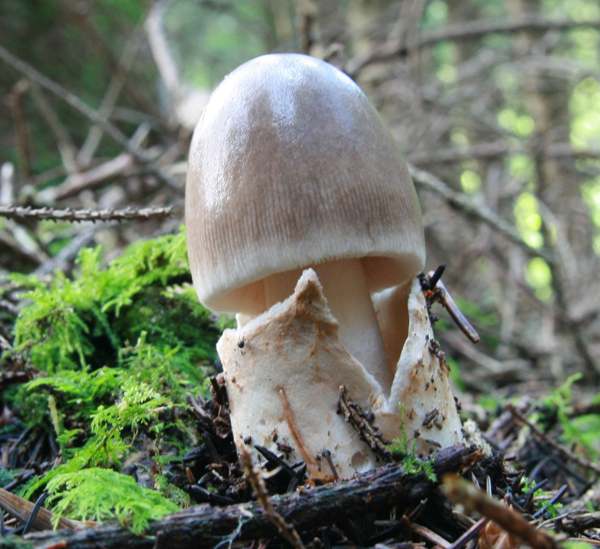
Unlike many other Amanita species, Amanita vaginata, the Grisette, does not have a ring on its stem. Grisettes are not poisonous, but they are easily confused with Deathcaps.
Distribution
Infrequent in most parts of Britain and Ireland, Amanita vaginata can, however, be locally common. This species is also found throughout most of mainland Europe and in many parts of North America, where it is quite common.
For a detailed description of the Amanita genus and identification of species see our Simple Amanita Key...
Taxonomic history
When French mycologist Jean Baptiste Francois (Pierre) Bulliard described this species in 1782 he named it Agaricus vaginatus. (Most of the gilled mushrooms were included initially in the genus Agaricus!) Then in 1783, the great Swedish mycologist Elias Magnus Fries moved it into the genus Amanita and gave it the name Amanita vaginata which it retains to this day.
Other Amanita species without stem rings include Amanita fulva, the Tawny Grisette, which at one time was considered to be merely a colour variant of Amanita vaginata, and Amanita crocea, the Orange Grisette.
Synonyms of Amanita vaginata that are no longer in current use include Agaricus vaginatus Bull., Agaricus plumbeus Schaeff., and Amanitopsis vaginata (Bull.) Roze.
Etymology
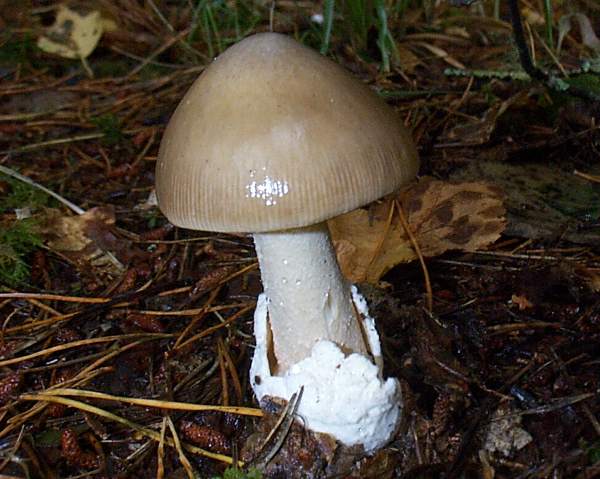
The specific epithet vaginata comes from the Latin vaginatus, meaning 'protected by a sheath'; it is a reference to the sheathing form of the volva that surrounds the stem base.
The common name 'Grisette' comes from the French word gris which means grey and was also applied to a coarse grey woollen material. The name was by association given to young working-class French women who wore grey dresses made from this material.
Identification guide
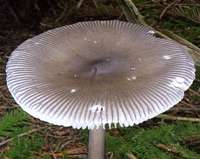 |
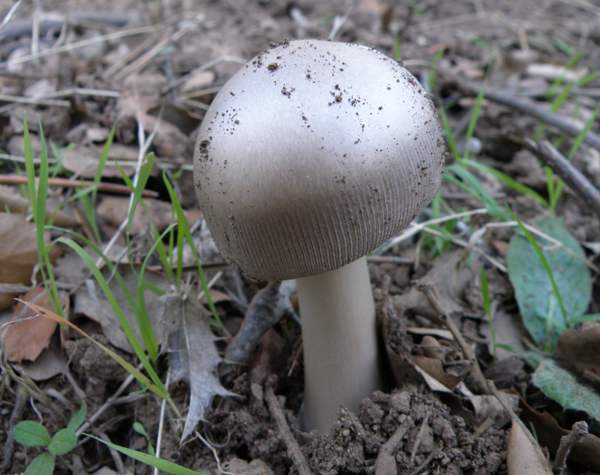
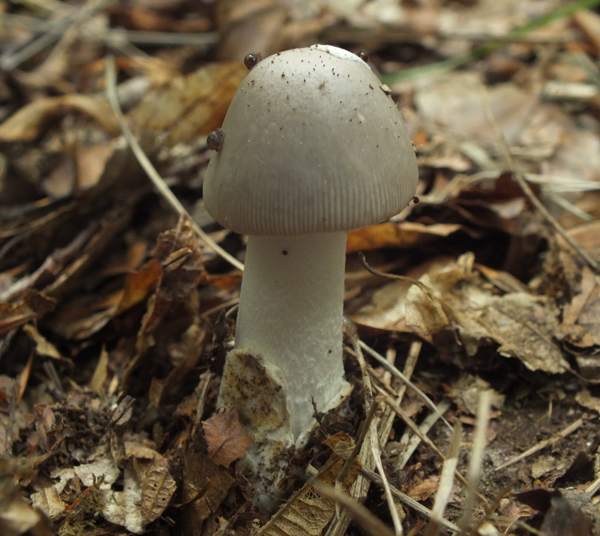
CapGrisettes have caps 5 to 10cm diameter; grey, normally retaining no velar remains. Initially egg-shaped, the cap expands to become flat but always with a small raised central area (an umbo). The edge of the cap is striated (with comb-like radial ridges). Below the pellicle (skin of the cap) the flesh is white and firm. |
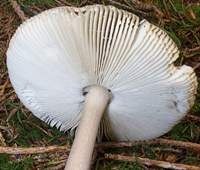 |
GillsWhite, adnexed (only slightly attached to the stem) or sometimes free; crowded. |
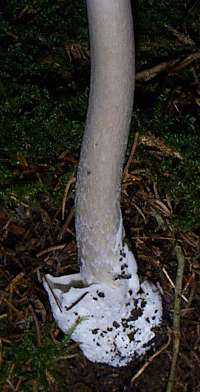 |
StemThe stem of Amanita vaginata ranges from 12 to 20cm long and 1 to 1.5cm in diameter, tapering only slightly (narrower near the cap); white or tinged with the cap colour. The stipe usually becomes hollow as the fruitbody matures. VolvaThere is no stem ring on this Amanita species; however, at the base of the stipe there is a large white sack-like volva. |
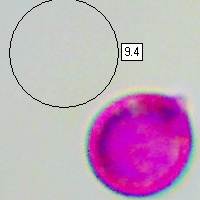 |
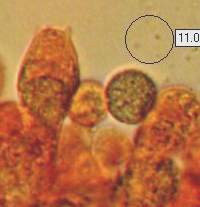
SporesSpherical, smooth, 8-12µm in diameter; inamyloid. Show larger imageSpores of Amanita vaginata, Grisette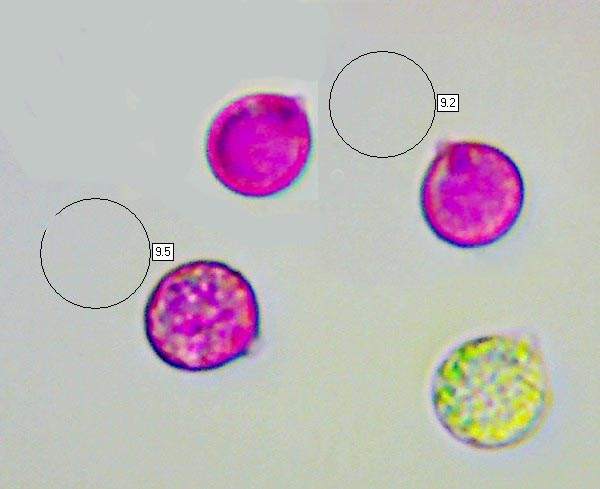 Spore printWhite. |
 |
Basidia4-spored. |
Odour/taste |
Not distinctive. |
Habitat & Ecological role |
Amanita vaginata, the Grisette, is an ectomycorrhizal fungus; it is found in deciduous forests and occasionally in mixed woodland. |
Season |
July to October in Britain and Ireland. |
Similar species |
Amanita ceciliae often has a more orange-tinged cap with grey veil fragments, and it has a distinctive snakeskin pattern on the stem. Amanita caesarea (Caesar's Mushroom) is rarely if ever found in southern Europe; its cap is brilliant orange with a striated margin, and the stipe is yellow. Amanita crocea has a yellowish-orange cap with an apricot tinge at the centre. It has cream rather than white gills, and a sweet smell and a nutty taste. |
Culinary Notes
This is an edible mushroom but not highly prized; however, as the genus Amanita contains some of the most deadly poisonous of all fungi only the most expert or the most foolhardy of fungus foragers eat any of the ringless amanitas.
Reference Sources
, Pat O'Reilly, 2016.
BMS List of English Names for Fungi
Geoffrey Kibby, (2012) Genus Amanita in Great Britain, self-published monograph.
Funga Nordica: 2nd edition 2012. Edited by Knudsen, H. & Vesterholt, J. ISBN 9788798396130
Paul M. Kirk, Paul F. Cannon, David W. Minter and J. A. Stalpers (2008). Dictionary of the Fungi; CABI
Taxonomic history and synonym information on these pages is drawn from many sources but in particular from the British Mycological Society's GB Checklist of Fungi.
Fascinated by Fungi. Back by popular demand, Pat O'Reilly's best-selling 450-page hardback book is available now. The latest second edition was republished with a sparkling new cover design in September 2022 by Coch-y-Bonddu Books. Full details and copies are available from the publisher's online bookshop...