Geoglossum cookeanum Nannf.
Phylum: Ascomycota - Class: Leotiomycetes - Order: Helotiales - Family: geoglossaceae
Distribution - Taxonomic History - Etymology - Identification - Reference Sources
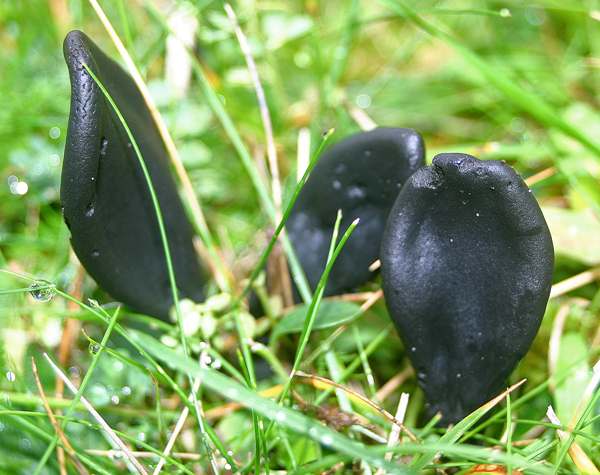
Sometimes mistakenly recorded as Dead Man’s Fingers, Xylaria polymorpha, this earthtongue has some even closer lookalikes, including Trichoglossum hirsutum, Hairy Earthtongue. (The stem of the latter is minutely hirsute, but in other macroscopic characters it matches closely the description of Geoglossum cookeanum.)

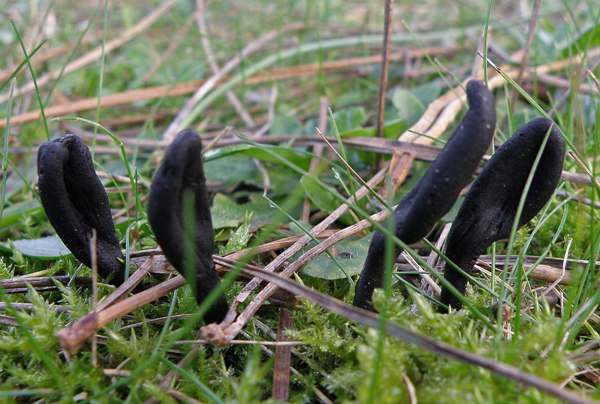
This fairly common earthtongue fungus is found mainly in mossy, sandy grassland, often in dune slacks or on the edges of coastal pine forests.
Distribution
Only occasionally recorded in Britain (including England, Wales and Scotland) and Ireland, Geoglossum cookeanum occurs also in several countries on mainland Europe including southwest France, where the main pictures shown on this page were taken.This earthtongue species is also reported to occur in some parts of North America.
Taxonomic history
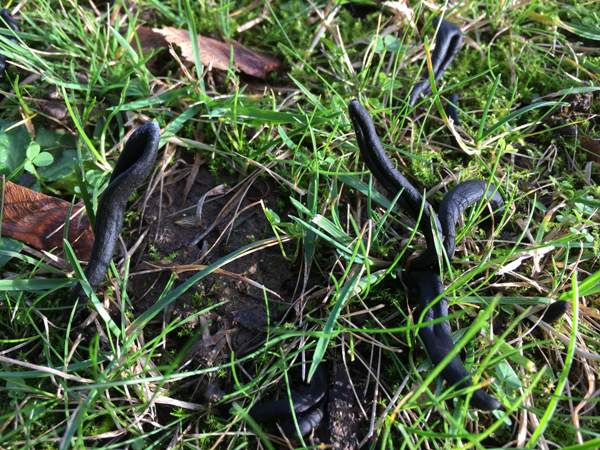
This sombre earthtongue species was described in 1942 by Swedish botanist and mycologist John Axel Nannfeldt (1904 - 1985), who gave it the scientific binomial name Geoglossum cookeanum.Some authorities include an 'i' is the specific epithet, thus making Geoglossum cookeianum. Apart from this alternative spelling, I know of no other synonyms of this name.
Etymology
The genus Geoglossum, set up by Christian Hendrik Persoon in 1794, is named from Geo- meaning earth and -glossum meaning tongue - hence fungi in this genus are referred to as earthtongues (or, as some authors prefer to write it, earth tongues). The specific epithet cookeanum honours the famous British mycologist Mordecai Cubitt Cooke.
Identification guide
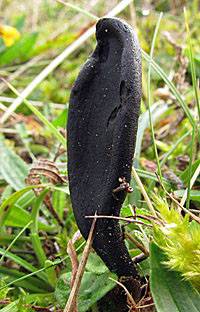 |
FruitbodyStromata are black, club-like, comprising a longitudinally indented fertile section above a more or less cylindrical infertile stem. The fertile section, shaped like a flattened club, covers the upper 50 to 70% of the fruitbody and is finely scurfy. Individual tongues are typically 3 to 7cm tall. The specimen shown on the left was one of many seen in coastal dune grassland on the Isle of Anglesey, North Wales, UK during the autumn of 2011. |
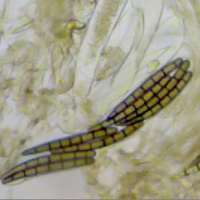 |
AsciCylindrical, 140-180 x 16-18µm; fairly thick walled; 8-spored.
Asci of Geoglossum cookeanum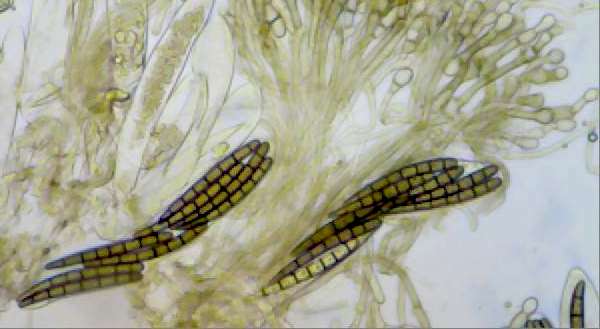 |
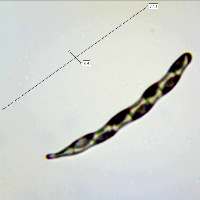 |
SporesAscospores elongated cylindrical to fusiform with an acute base and a rounded apex; fairly thick-walled; smooth, 55-90 x 5-7µm; multiseptate (very occasionally 6-septate but usually 7-septate).
Spores of Geoglossum cookeanum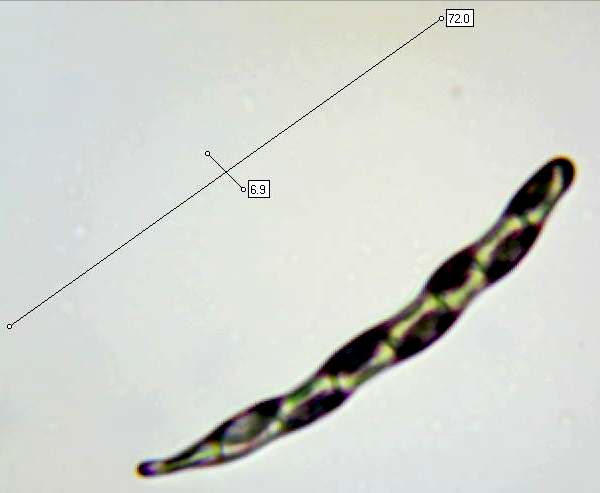 Spore printLight brown. |
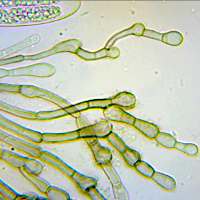 |
ParaphysesParaphyses, borne in separate clusters, are diagnostic of this species. Filiform, 2-3µm in diameter and extending slightly beyond the asci tips; not curved or coiled at the apex; base section hyaline and upper parts pale to mid brown with thicker walls and increasingly more closely septate towards tips, which comprise a chain of doliform to ovoid cells 4-6µm in diameter.
Paraphyses of Geoglossum cookeanum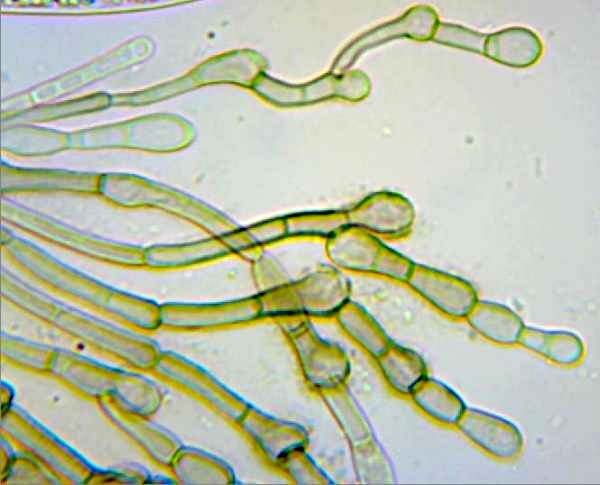 |
Odour/taste |
Not distinctive. |
Habitat & Ecological role |
On the ground in unimproved grassland and in mossy dune slacks. |
Season |
June to November in Britain and Ireland. |
Similar species |
Xylaria polymorpha is an ascomycete of similar size. It grows on dead hardwood and its stromata (compound ascomycetous fruitbodies) are not usually laterally compressed or indented. Trichoglossum hirsutum, commonly referred to as the Hairy Earthtongue, has a stem that is minutely hirsute rather than scaly. |
Reference Sources
Fascinated by Fungi, 2nd Edition, Pat O'Reilly 2016, reprinted by Coch-y-bonddu Books in 2022.
Dictionary of the Fungi; Paul M. Kirk, Paul F. Cannon, David W. Minter and J. A. Stalpers; CABI, 2008
Taxonomic history and synonym information on these pages is drawn from many sources but in particular from the British Mycological Society's GB Checklist of Fungi.

Above: mature spores of Geoglossum cookeanum.
Acknowledgements
This page includes pictures kindly contribited by Simon Harding.

Fascinated by Fungi. Back by popular demand, Pat O'Reilly's best-selling 450-page hardback book is available now. The latest second edition was republished with a sparkling new cover design in September 2022 by Coch-y-Bonddu Books. Full details and copies are available from the publisher's online bookshop...