Trees Birds Mammals Fish Amphibians Reptiles
Wild Algarve
Bookshop
Hygrocybe conica (Schaeff.) P. Kumm. - Blackening Waxcap
Phylum: Basidiomycota - Class: Agaricomycetes - Order: Agaricales - Family: Hygrophoraceae
Distribution - Taxonomic History - Etymology - Identification - Culinary Notes - Reference Sources
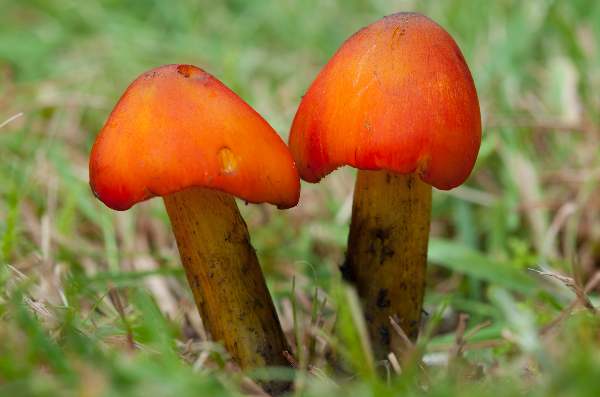
Commonly known as the Blackening Waxcap, this very variable grassland
mushroom is one of several species whose caps turn black with age; however, it can be readily distinguished from other similar waxcaps by its long-lasting fruitbodies which, once mature, turn jet black all over and then can remain standing for many weeks.
Hygrocybe
conica sometimes appears in lines along roadside verges, particularly on hillsides or where the grass is well shaded, moist and mossy.
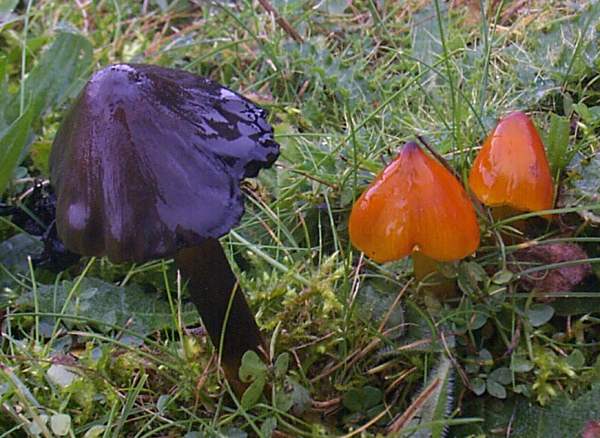
Although undeniably beautiful when seen in bright sunshine, these conical waxcap fungi look just as good in wet weather, when they stand out boldly against the green background of their grassland habitats.
Blackening Waxcaps can be red, orange, yellow or, of course, jet black. Sometimes you will see all of these colours in a group and occasionally in a single cap. Equally varied are the shapes of the caps: some remain stubbornly sharply conical while others gradually open, out occasionally becoming almost flat but always retaining at least a slight central umbo. Fortunately in Britain and Ireland we get plenty of practice in recognising Blackening Waxcaps in all their many forms and colours, because next to the Ivory Waxcap Hygrocybe virginea they are the most common of the waxcaps found in northern Europe.
Distribution
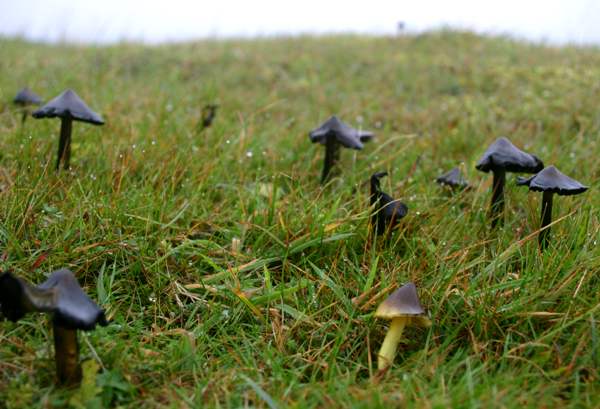
Localised in Britain and Ireland due to most grassland habitats being 'improved' so that they are too rich in nutrients to support waxcaps; however, where they do occur Blackening Waxcaps are often abundant and seen in large trooping groups. Unimproved parkland, golf course margins, the embankments of water resources reservoirs and man-made boating lakes, and country churchyards are often spangled with these 'Tellytubby' Toadstools.
Taxonomic history
Described scientifically in 1762 by pioneering German mycologist Jacob Christian Schaeffer, who gave it the name Agaricus conicus (at a time when most of the gilled mushrooms were included initially in the genus Agaricus), the Blackening Waxcap was transferred to the genus Hygrocybe by another German mycological giant, Paul Kummer, in 1871, when it acquired its currently accepted scientific name Hygrocybe conica.
Hygrocybe conica is the type species of the genus Hygrocybe. The Hygrocybe group name was first published in 1821 by the great Swedish mycologist Elias Magnus Fries as a subsection of the then massive genus Agaricus. It was not until 1871 that Hygrocybe acquired genus status, a rank to which it was raised by the German mycologist Paul Kummer.
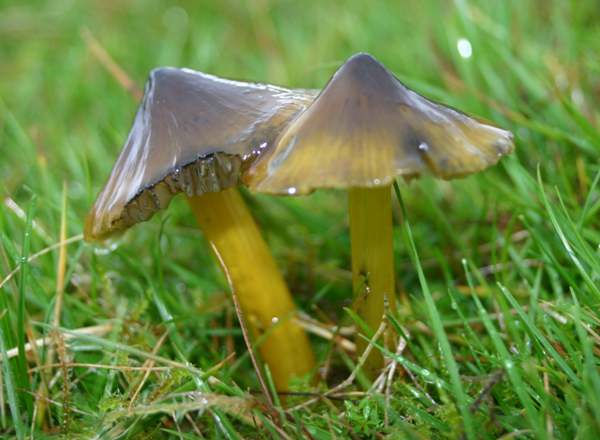
This waxcap was also described and named by many of the pioneering mycologists, and so it has a plethora of synonyms. Among these are Agaricus tristis Pers. Hygrophorus conicus (Schaeff.) Fr., Hygrophorus tristis (Pers.) Bres., Hygrocybe tristis (Pers.) F.H. Møller, Hygrophorus olivaceoniger P.D. Orton, Hygrocybe olivaceonigra (P.D. Orton) M.M. Moser, Hygrocybe conica var. olivaceonigra (P.D. Orton) Arnolds, and Hygrocybe cinereifolia Courtec. & Priou.
Etymology
The genus Hygrocybe is so named because fungi in this group are always very moist. Hygrocybe means 'watery head'.
Witch's Hat is a name sometimes applied to the group of waxcap fungi that have sharply conical caps, and not surprisingly the specific epithet conica simply means conical.
Identification guide
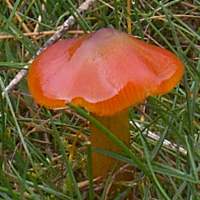 |
The carmine beauty of these little waxcaps is
but transient, as they soon turn black all over, usually from the centre of the cap. If you touch the cap, gills or stem they soon turn black, so that specimens collected for later study soon look very different from the beautiful fungi found in the field.
Blackening Waxcaps can appear remarkably quickly after rain in late summer and
autumn, but once mature they remain standing sometimes for more than two weeks. |
 |
Cap
4 to 7cm in diameter; varying from an initial light orange to
orange-red, often paler at the margin. The surface is greasy in damp weather but in dry weather it becomes dry and silky.
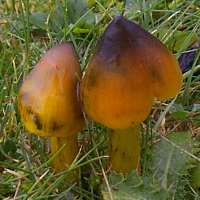
The conical caps rarely open out fully and they soon turn black - at
first in patches but eventually they blacken all over.
Even when blackened the caps of these fungi remain quite shiny. The
surface is very slippery in wet weather. |
 |
Gills
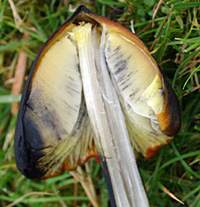
The gills are at first a pale lemon yellow,
becoming more orange and then blackening as the rest of the mushroom
changes colour. Basidia 2-, 3- or 4-spored.
Stem
Cylindrical, 5 to 10mm in diameter x 4 to 10cm tall; no ring; initially yellow with a scarlet tinge
near the cap but remaining much paler at the base; full, rather
than hollow; flesh initially white but quickly turns black when cut. As the fruitbody matures, the whole stem blackens, usually from the top
downwards. |
 |
Basidia
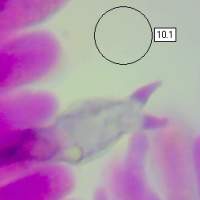
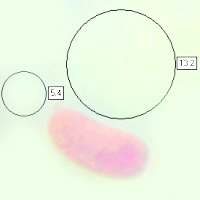
Some fruitbodies have mainly four-spored basidia, with clamps; others have mainly two-spored basidia (see left) without clamps. |
 |
Spores from fruitbodies with predominantly 4-spored basidia
Ellipsoidal, smooth, 8.5-10 x 6-7µm; inamyloid.
Spores (left) from fruitbodies with predominantly 2-spored basidia
Ellipsoidal to oblong, smooth, 9-11.5 x 5.5-7.5µm; inamyloid.
Spore print
White. |
Odour/taste |
Not distinctive. |
Habitat & Ecological role |
On roadside verges, in churchyards and on
meadows and other areas of closely cropped or mown grassland where
artificial fertilisers are not spread.
Waxcaps have long been considered to be saprobic on the dead roots of grasses and other grassland plants, but it is now considered likely that there is some kind of mutual relationship between waxcaps and mosses. |
Season |
July to November in Britain and Ireland. |
Similar species |
Hygrocybe punicea is similar in general appearance, but this species does not blacken.
Hygrocybe conicoides, the Dune Waxcap, has yellow-orange gills and blackens much
more slowly and rarely all over. |
|
Culinary Notes
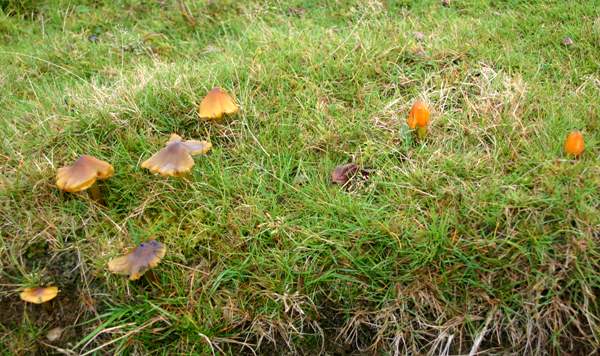
The Blackening Waxcap is one of the most common of the Hygrocybe species seen in Britain and Ireland, and it is fairly common also on a European scale. (The picture on the right shows Blackening Waxcaps along the bank of the River Teme near Knighton, on the border of Wales and England, where they occur in their hundreds in good waxcap years.) There would be rather less concern if people collected these grassland fungi rather than some of the rarer Hygrocybe species; however, although various field guides say that it is edible there is at least one report (from China) of mushroom poisoning attributed to this species. The fact that these insubstantial waxcaps are slimy and quickly turn black when handled is probably enough to deter all but the most fanatical (or famished) fungiphage from making a meal of Blackening Waxcaps.
Reference Sources
Fascinated by Fungi, 2nd Edition, Pat O'Reilly 2016, reprinted by Coch-y-bonddu Books in 2022.
Fungi of Northern Europe, Volume 1 - The Genus Hygrocybe, David Boertmann, 2010.
British Mycological Society English Names for Fungi
Dictionary of the Fungi; Paul M. Kirk, Paul F. Cannon, David W. Minter and J. A. Stalpers; CABI, 2008
Taxonomic history and synonym information on these pages is drawn from many sources but in particular from the British Mycological Society's GB Checklist of Fungi.
Acknowledgements
This page includes pictures kindly contributed by David Kelly.
Top of page...
Fascinated by Fungi. Back by popular demand, Pat O'Reilly's best-selling 450-page hardback book is available now. The latest second edition was republished with a sparkling new cover design in September 2022 by Coch-y-Bonddu Books. Full details and copies are available from the publisher's online bookshop...