Hygrocybe conicoides (P.D. Orton) P.D. Orton & Watling - Dune Waxcap
Phylum: Basidiomycota - Class: Agaricomycetes - Order: Agaricales - Family: Hygrophoraceae
Distribution - Taxonomic History - Etymology - Identification - Culinary Notes - Reference Sources
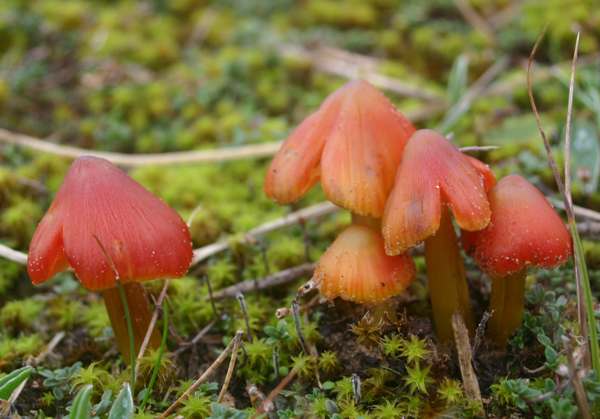
This moderately common waxcap occurs in short grass mainly on coastal sand dunes - particularly on the edges of dune slacks and beside sandy paths across dunes.
The specific epithet conicoides implies that this waxcap resembles Hygrocybe conica, the Blackening Waxcap. When young it certainly does; however, whereas Hygrocybe conica turns black all over as soon as it is mature, the Dune Waxcap blackens only slightly, mainly in the stem rather than all over.
Distribution
Nowhere near as common as the Blackening Waxcap Hygrocybe conica, with which it is often confused, in Britain and Ireland the Dune Waxcap is mainly confined to coastal sand dune systems.
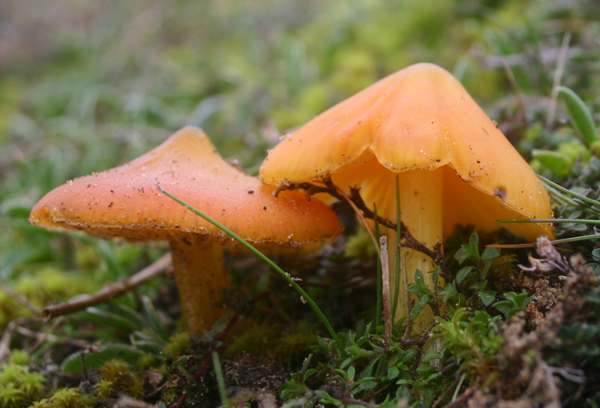
With dark red, crimson, orange and yellow caps usually occurring together, in those places where these colourful fungi do occur they are often plentiful and sometimes form groups or lines of ten or more fruitbodies. The European distribution of Hygrocybe conicoides is also largely coastal, with several known sites Scandinavia and Germany. The most southerly Dune Waxcap population we have heard of is in Spain.
Hygrocybe conicoides is a very rare find in North America, where it is reported from the eastern coast of the USA and Canada; there is also a record of this species being found in Hawaii at a site to which it may have been introduced.
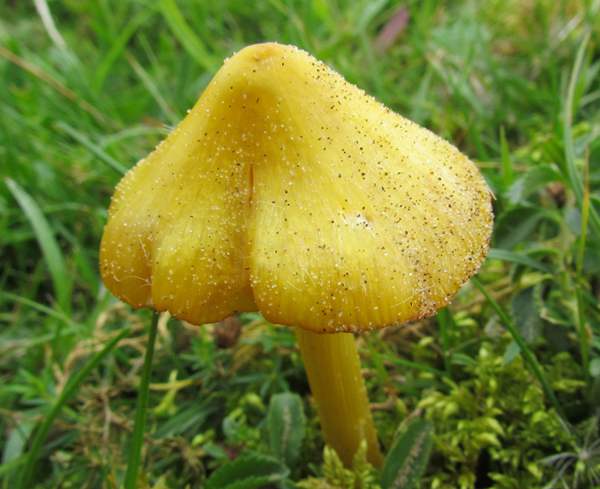
When found outside sand dune habitats it is difficult to separate on initial visual inspection Hygrocybe conicoides from the Blackening Waxcap Hygrocybe conica; however, the Dune Waxcap does not blacken rapidly and does not become entirely black.
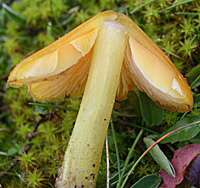
Above: yellow form of Dune Waxcap, North Wales.
Taxonomic history
Described in 1960 by the British mycologist Peter Darbishire Orton (1916 - 2005) who named it Hygrophorus conicoides, the Dune Waxcap was transferred to the genus Hygrocybe in 1969 by P. D. Orton and Roy Watling, at which time it acquired its currently accepted scientific name Hygrocybe conicoides.
Synonyms of Hygrocybe conicoides include Hygrophorus conicoides P. D. Orton and Hygrocybe conica var. conicoides (P.D. Orton) Boertm.
Etymology
The genus Hygrocybe is so named because fungi in this group are always very moist. Hygrocybe means 'watery head'. Because the specific epithet conica had already been taken by another Hygrocybe species whose caps are in the form of pointy witch's hats - the Blackening Waxcap Hygrocybe conica - the epithet coinicoides, which means similar to conica, has been allocated to this less common species. There can surely be little doubt that had the Dune Waxcap been found and described first then it rather than the Blackening Waxcap would have been awarded the prime epithet conica.
Identification guide
 |
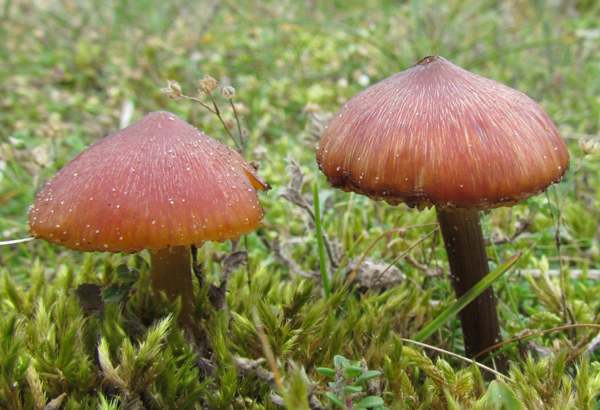
CapThe red, orange or yellow caps, which are broadly conical and typically 2 to 4cm in diameter, are silky in dry weather but become greasy when wet. The caps blacken only slightly and slowly in places with age or when cut or bruised. |
 |
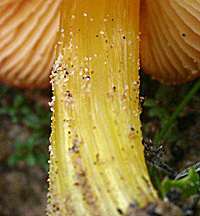
GillsThe broad, pink-tinged yellow gills are adnexed or free and fairly crowded. |
 |
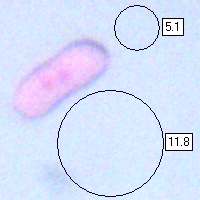
StemYellow, blackening slowly with age or when cut, the level stipe has nostem ring and is distinguished by fibrous longitudinal striations. Typically 5 to 10mm in diameter, stems range between 2 and 7cm tall. |
 |
SporesOblong to sub-cylindrical; 10-13 x 5-6.9μm; hyaline; inamyloid.
Spores of Hygrocybe conicoides, Dune Waxcap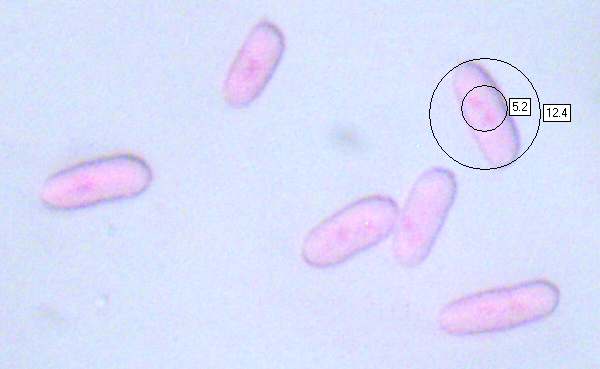 Spore printWhite. |
Odour/taste |
None detectable. |
Habitat & Ecological role |
Short grass on sandy soil, most often in coastal sand-dune areas. Waxcaps have long been considered to be saprobic on the dead roots of grasses and other grassland plants, but it is now considered likely that there is some kind of mutual relationship between waxcaps and mosses. |
Season |
August to November in Britain and Ireland. |
Similar species |
Hygrocybe conica blackens all over as soon as it reaches maturity. Gliophorus laetus is smaller and has greyish decurrent gills. Hygrocybe intermedia is very similar but usually more orange and has a fibrous, non-greasy cap that does not smell soapy when squashed. |
Culinary Notes
The Dune Waxcap is one of the more common of the Hygrocybe species seen in Britain and Ireland, and it is fairly common also on a European scale. There would be rather less concern if people collected these grassland fungi rather than some of the rarer Hygrocybe species; however, although various field guides say that the Dune Waxcap is edible the fact that these insubstantial mushrooms are nearly always heavily ingrained with sand is offputting.
The Dune Waxcaps pictured immdiately above were photographed at Morfa Dyffryn National Nature Reserve in Wales - note the sand particles on the caps; there are many more trapped between gills!. I suppose some people might simply grit their teeth and...
Reference Sources
Fascinated by Fungi, 2nd Edition, Pat O'Reilly 2016, reprinted by Coch-y-bonddu Books in 2022.
Fungi of Northern Europe, Volume 1 - The Genus Hygrocybe, David Boertmann, 2010.
Funga Nordica: 2nd edition 2012. Edited by Knudsen, H. & Vesterholt, J. ISBN 9788798396130
BMS List of English Names for Fungi
Dictionary of the Fungi; Paul M. Kirk, Paul F. Cannon, David W. Minter and J. A. Stalpers; CABI, 2008
Taxonomic history and synonym information on these pages is drawn from many sources but in particular from the British Mycological Society's GB Checklist of Fungi.

Fascinated by Fungi. Back by popular demand, Pat O'Reilly's best-selling 450-page hardback book is available now. The latest second edition was republished with a sparkling new cover design in September 2022 by Coch-y-Bonddu Books. Full details and copies are available from the publisher's online bookshop...