Lactarius chrysorrheus Fr. - Yellowdrop Milkcap
Phylum: Basidiomycota - Class: Agaricomycetes - Order: Russulales - Family: Russulaceae
Distribution - Taxonomic History - Etymology - Identification - Culinary Notes - Reference Sources
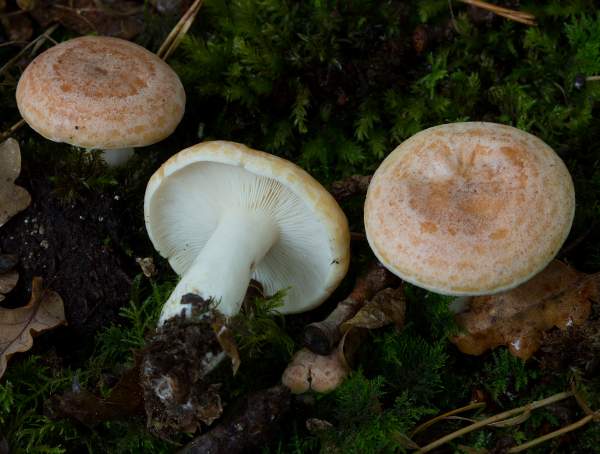
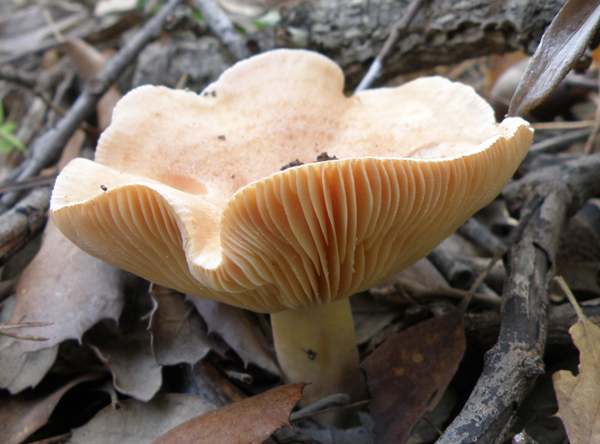
Small to medium-sized, this milkcap is mycorrhizal almost exclusively with one genus of trees: Quercus (oaks). The cap blends in well with a background of dry leaves, but its white milk dries sulphur yellow on any damaged gills, and these spots of colour are the tell-tale signs to look for, especially on sunny days. (It is not uncommon for animals scurrying through the forest to tip over and damage these and other woodland mushrooms on their way - just touching the gills of the Yellowdrop Milkcap is often enough to release spots of latex.)
Distribution
Widespread and common in oak woodlands on acid soils throughout Britain and Ireland, where it usually fruits in vast numbers, this distinctive milkcap mushroom is found throughout Europe, from Scandinavia right down to the Mediterranean; it occurs also in northern Africa and in parts of North America.
Taxonomic history
This mushroom was described in 1838 by the great Swedish mycologist Elias Magnus Fries, who gave it the binomial scientific name Lactarius chrysorrheus, which is still the name by which it is generally known today.
Lactarius chrysorrheus has a few synonyms including Agaricus theiogalus, Lactarius theiogalus, and Lactarius theiogalus var. chrysorrheus Quél.
Note: In some field guides the specific epithet is spelt chrysorheus (with just one ‘r’ before the second 'h' ).
Etymology
The generic name Lactarius means producing milk (lactating) - a reference to the milky latex that is exuded from the gills of milkcap fungi when they are cut or torn. The specific epithet chrysorrheus comes from the ancient Greek words chryso- meaning golden, and -rheos meaning stream. A stream of golden latex does indeed flow from the cut gills of these lovely woodland mushrooms.
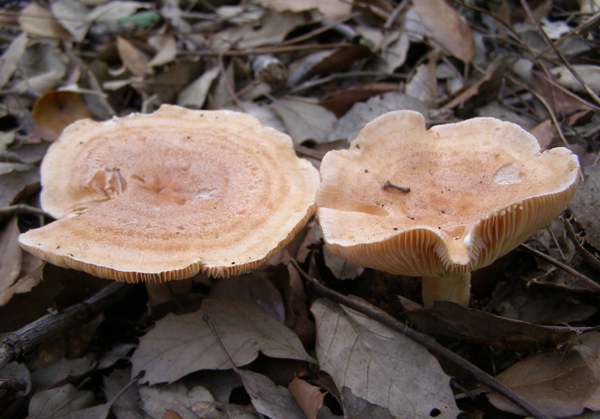
In the picture on the left, tiny yellow droplets of latex onthe gills of these Yellowdrop Milkcaps are evidence of slight damage caused by passing animals or nibbling bugs. In bright sunlight these latex droplets shine like bright yellow stars and can often be seen at a distance of several metres.
Identification guide
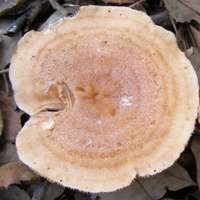 |
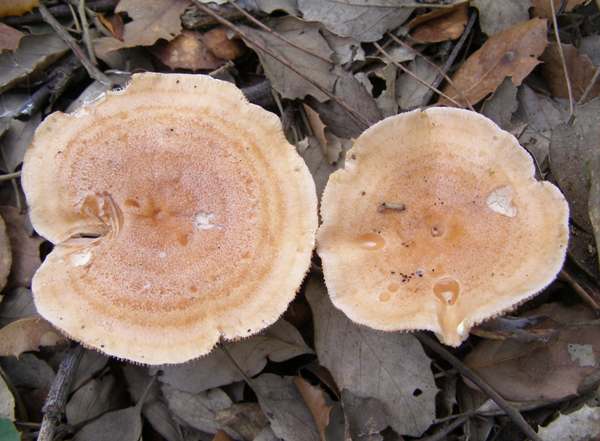
CapSalmon pink with faint rings of darker watery blotches or bands; convex, becoming flat and then shallowly funnel-shaped; smooth; slightly greasy in wet weather; 3 to 8cm across. StemCream or buff, pinker towards base; cylindrical with a slightly swollen base; 3 to 8cm long, 0.9 to 2cm in diameter.
|
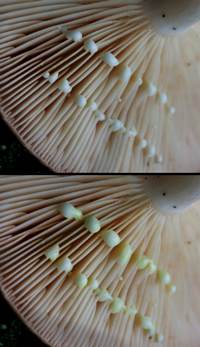 |
GillsCreamy orange-buff; adnate or slightly decurrent; crowded; when cut releasing a latex that is Initially white (upper picture, left) but quickly turns sulphur yellow (lower picture, left) when exposed to air. |
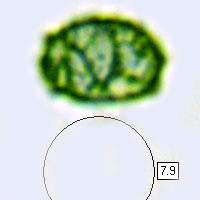 |
SporesSubglobose, 7–8.5 x 6–6.5µm; ornamented with an incomplete network of ridges. Spores of Lactarius chrysorrheus, Yellowdrop Milkcap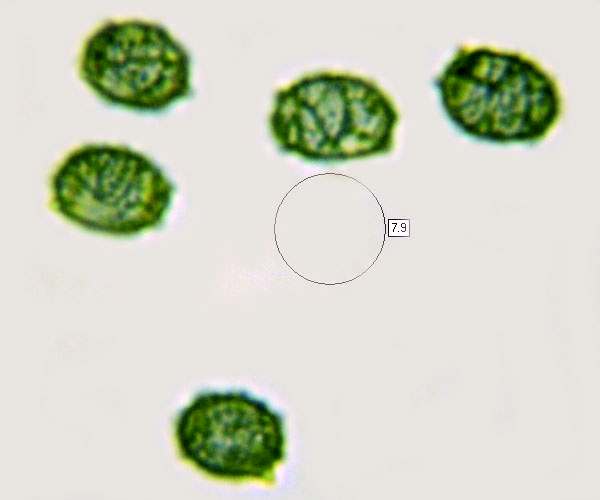 Spore printCreamy white with a salmon pink tinge. |
Odour/taste |
No significant odour; initially tasting mild then rapidly becoming bitter and hot. |
Habitat & Ecological role |
Mycorrhizal, in broadleaf woodland; nearly always with oak trees. |
Season |
August to November in Britain and Ireland; through to February in some Mediterranean countries. |
Similar species |
Lactarius quietus is of similar size and also occurs under oaks, but its latex is creamy white and does not turn yellow on exposure to air. |
Culinary Notes
Despite its attractive appearance, the Yellowdrop Milkcap is known to be poisonous even when cooked thoroughly. This is a great pity because it is one of the few millkcaps that occurs in great abundance.
Reference Sources
Fascinated by Fungi, 2nd Edition, Pat O'Reilly 2016, reprinted by Coch-y-bonddu Books in 2022.
Funga Nordica, Henning Knudsen and Jan Vesterholt, 2008.
Fungi of Switzerland, volume 6: Russulaceae, Kränzlin, F.
BMS List of English Names for Fungi.
Dictionary of the Fungi; Paul M. Kirk, Paul F. Cannon, David W. Minter and J. A. Stalpers; CABI, 2008
Taxonomic history and synonym information on these pages is drawn from many sources but in particular from the British Mycological Society's GB Checklist of Fungi.
Acknowledgements
This page includes pictures kindly contributed by David Kelly.
Fascinated by Fungi. Back by popular demand, Pat O'Reilly's best-selling 450-page hardback book is available now. The latest second edition was republished with a sparkling new cover design in September 2022 by Coch-y-Bonddu Books. Full details and copies are available from the publisher's online bookshop...