
Lactarius pallidus Pers. - Pale Milkcap
Phylum: Basidiomycota - Class: Agaricomycetes - Order: Russulales - Family: Russulaceae
Distribution - Taxonomic History - Etymology - Identification - Culinary Notes - Reference Sources
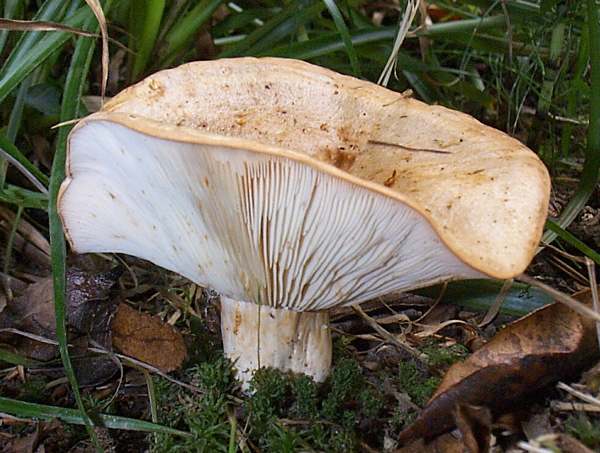
Lactarius pallidus is found in deciduous woodland, mainly under beech trees. It has a very slimy cap when wet, drying to a smooth gloss. The pale, flesh-coloured cap has a fruity scent.
Distribution
Uncommon in southern Britain and Ireland but more often found in parts of Scotland, the Pale Milkcap is also found throughout much of northern mainland Europe and this (or a similar species sharing the same name) in parts of North America.
Taxonomic history
The Pale Milkcap was described scientifically in 1797 by Christiaan Hendrik Persoon, who gave it te binomial name Lactarius pallidis by which mycologists still refer to it today.
Synonyms of Lactarius pallidus include Agaricus lactifluus var. pallidus (Pers.) Pers., and Agaricus pallidus (Pers.) Fr.
Etymology
The generic name Lactarius means producing milk (lactating) - a reference to the milky latex that is exuded from the gills of milkcap fungi when they are cut or torn.
The specific epithet pallidus is a Latin adjective meaning pallid - and I'm sure that comes as no great surprise!
Identification guide
 |
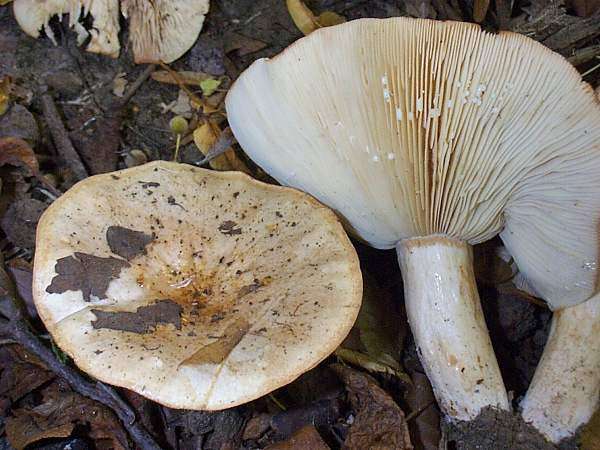
Cap4 to 10cm in diameter, convex and then depressed, the cap is pale buff with a rosy, flesh-coloured tint, sometimes with indistinct circular zoning near the rim. The surface of the cap is smooth; it is slimy in wet weather and usually remains sticky but with a glossy shine during dry spells. |
 |
GillsShortly decurrent and fairly crowded, the gills are pale rosy buff or pale ochre and occasionally, but not always, blotchy. This milkcap releases copious amounts of white latex that is usually, but not always, quite mild tasting. StemVery variable in diameter from 1 to 2.5cm, and 3 to 8cm long, the stem is more or less cylindrical or tapering in slightly at the base. The stem surface is smooth and paler than the cap; it tends to become hollow with age. |
SporesBroadly ellipsoidal, 7.5-8.5 x 6-6.5µm; ornamented with ridges and a few cross-connections that sometimes form a partial reticulum. Spore printPale ochre. |
|
Odour/taste |
Slight fruity smell; the milk (latex) usually has a mild taste but not always: occasionally Pale Milkcaps are found which taste very hot. |
Habitat & Ecological role |
Mycorrhizal; in deciduous woodland, mainly under beech trees. Although an infrequent find, where the Pale Milkcap does occur it is often in sizeable groups. |
Season |
August to October in Britain and Ireland. |
Similar species |
Lactarius musteus is a similar but much rarer milkcap; its stem is pitted, it leaves a pale cream spore print, and it occurs under pine trees. |
Culinary Notes
The Pale Milkcap is reported by some authorities to be edible when cooked, although other sources list it as inedible because sometimes these mushrooms have a very hot taste. In any case, because this is an uncommon find in most parts of Britain and Ireland it is not much sought as a source of food for free.
Reference Sources
Pat O'Reilly (2016). Fascinated by Fungi, First Nature Publishing
Jacob Heilmann-Clausen, Annemieke Verbeken, & Jan Vesterholt (1998). The Genus Lactarius (Fungi of Northern Europe—Vol. 2) The Danish Mycological Society.
Funga Nordica, Henning Knudsen and Jan Vesterholt, 2008.
Fungi of Switzerland, volume 6: Russulaceae, Kränzlin, F.
BMS List of English Names for Fungi.
Paul M. Kirk, Paul F. Cannon, David W. Minter and J. A. Stalpers. (2008). Dictionary of the Fungi; CABI.
Taxonomic history and synonym information on these pages is drawn from many sources but in particular from the British Mycological Society's GB Checklist of Fungi.
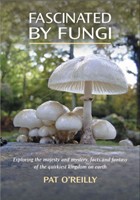
Fascinated by Fungi. Back by popular demand, Pat O'Reilly's best-selling 450-page hardback book is available now. The latest second edition was republished with a sparkling new cover design in September 2022 by Coch-y-Bonddu Books. Full details and copies are available from the publisher's online bookshop...