
Lactarius torminosus (Schaeff.) Pers. - Woolly Milkcap
Phylum: Basidiomycota - Class: Agaricomycetes - Order: Russulales - Family: Russulaceae
Distribution - Taxonomic History - Etymology - Identification - Culinary Notes - Reference Sources
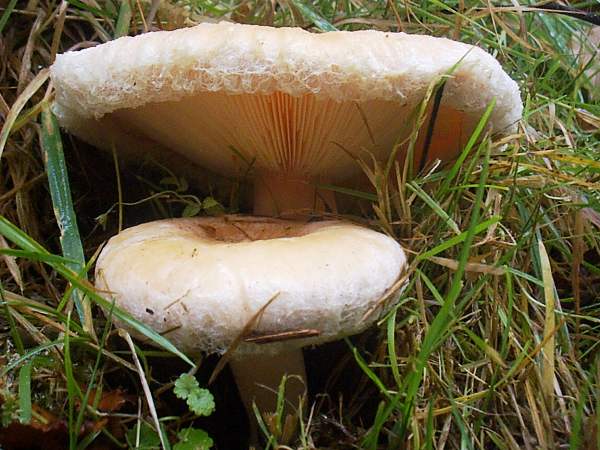
This attractive milkcap is mycorhizal with birch trees, usually in open grassy sites at the edge of woodland or on heath rather than deep inside dense woods.
Distribution
Lactarius torminosus, the Woolly Milkcap, grows beneath birch trees in damp areas, mainly on acid soil. In Britain and Ireland it is a widespread but uncommon species that occurs either solitarily or in small scattered groups.
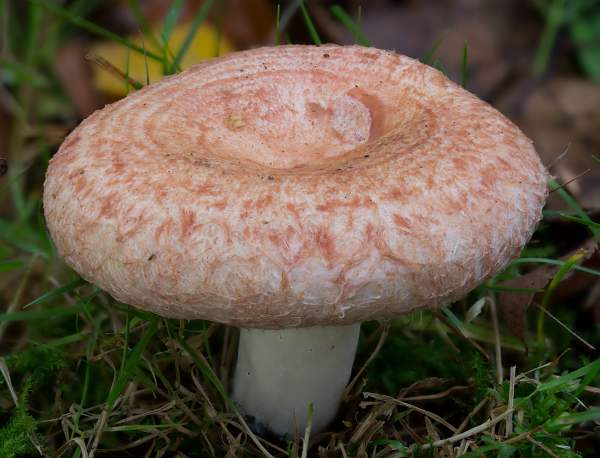
This very attractive milkcap is found throughout most of Europe and in northern Africa and parts of Asia; a variety of Lactarius torminosus is also reported from North America.
Taxonomic history
The Woolly Milkcap was described in 1762 by the great German mycologist Jacob Christian Schaeffer, who established the basionym of this species when he gave it the binomial scientific name Agaricus torminosus. (Vast numbers of gilled fungi were dumped into the Agaricus genus in the early days of fungal taxonomy; most have since been moved to other genera leaving in the present-day Agaricus genus a much smaller number of gilled mushrooms that are sometimes referred to as the 'true mushrooms'.) It was Christiaan Hendrik Persoon who, in 1797, transferred this milkcap mushroom to the genus Lactarius, thus creating its currently-accepted scientific name Lactarius torminosus.
Lactarius torminosus has several synonyms including Agaricus torminosus Schaeff., Agaricus lactifluus var. torminosus (Schaeff.) Pers., and Lactarius torminosus var. sublateritius Kühner & Romagn.
Etymology
The generic name Lactarius means producing milk (lactating) - a reference to the milky latex that is exuded from the gills of milkcap fungi when they are cut or torn. The specific epithet torminosus is a Latin adjective that translates to 'cause of colic'.
Another of the common names given to Lactarius torminosus is the Bearded Milkcap (and in the USA the Bearded Milk Cap); however, Woolly Milkcap is the name preferred in the British Mycological Society's list of English Names of Fungi.
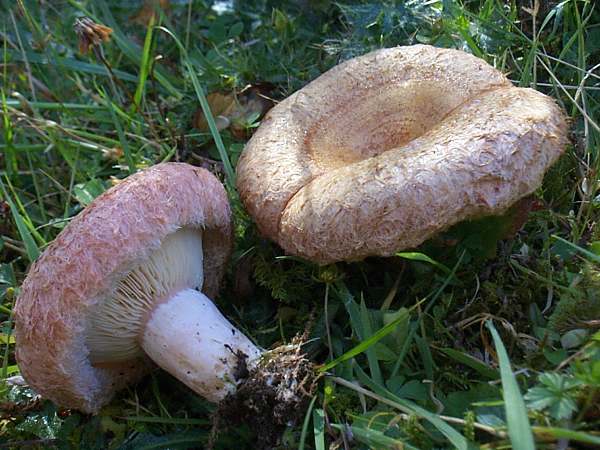
The specimens shown on the left were found in Scotland in a dry spell following heavy and prolonged rain. The woolly nature of the caps is barely evident; however, the incurved margins had been sheltered from the rain and so their 'beards' had not been pressed down onto the cap surface.
Identification Guide
 |
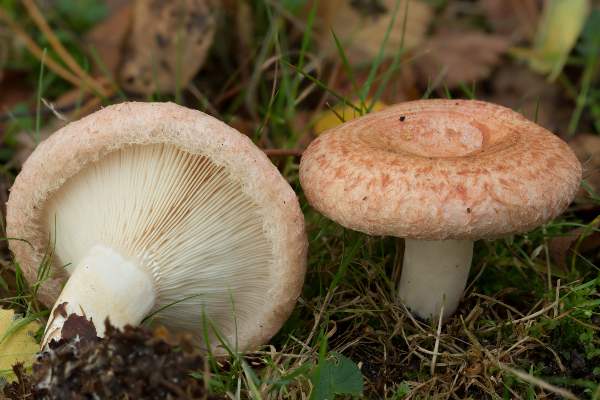
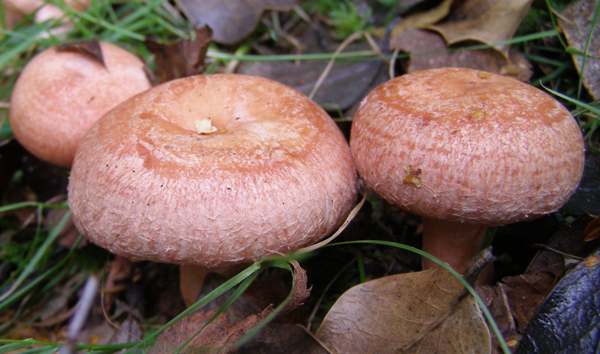
Cap5 to 15cm in diameter, convex and then flattening and developing a slight central depression, the buff and pink caps are woolly, particularly at their inrolled margins, and they have slightly darker concentric circles most noticeably towards the centre; this zoning tends to fade as the fruitbodies age. Beneath the woolly cuticle, the thick cap flesh is white and brittle. |
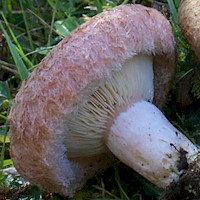 |
The distinctive shaggy margin of the cap and its lovely pink colouring makes identification of this milkcap particularly easy - something that cannot be said of the great majority of mushrooms in this genus. Seen in black-and-white print, pictures of the Woolly Milkcap are remarkably similar to those of the Brown Rollrim, Paxillus involutus. |
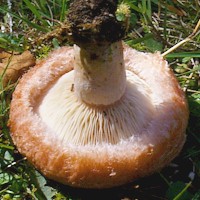 |
GillsThe shortly decurrent, crowded pale pink gills exude a white or pale cream latex when damaged. The latex, which is very acrid, does not change colour as it dries. |
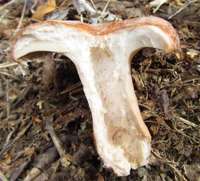 |
Stem1 to 2cm in diameter and 4 to 8cm tall, the cylindrical stems are paler than the cap. Stems of young specimens are downy and solid, but as the fruitbody matures the stems become smooth and hollow - as seen on the left. In common with other Lactarius species, there is no stem ring. |
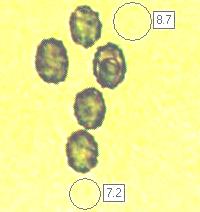 |
SporesSubglobose to broadly ellipsoidal, 8-10 x 5.5-7μm, hyaline; ornamented with a well developed network of ridges and a few isolated warts to 0.7μm tall. Spore printPale yellowish-cream. |
Odour/taste |
Slight odour of turpentine; hot acrid taste. |
Habitat & Ecological role |
Mycorrhizal, found under birch trees nearly always in damp places. |
Season |
August to October in Britain and Ireland. |
Similar species |
Lactarius pubescens has a buff-white or cream, woolly cap and grows under birch on sandy soil. |
Culinary Notes
If eaten without very careful preparation, Lactarius torminosus can cause very unpleasant stomach upsets. (Be warned: the Latin torminosus means 'cause of colic'.) Some authorities suggest that the Woolly Milkcap is edible after it has been salted and pickled, but many more assert that it should be treated as poisonous.
Reference Sources
Fascinated by Fungi, 2nd Edition, Pat O'Reilly 2016, reprinted by Coch-y-bonddu Books in 2022.
Funga Nordica, Henning Knudsen and Jan Vesterholt, 2008.
Fungi of Switzerland, volume 6: Russulaceae, Kränzlin, F.
BMS List of English Names for Fungi.
Dictionary of the Fungi; Paul M. Kirk, Paul F. Cannon, David W. Minter and J. A. Stalpers; CABI, 2008
Taxonomic history and synonym information on these pages is drawn from many sources but in particular from the British Mycological Society's GB Checklist of Fungi.
Acknowledgements
This page includes pictures kindly contributed by David Kelly.
Fascinated by Fungi. Back by popular demand, Pat O'Reilly's best-selling 450-page hardback book is available now. The latest second edition was republished with a sparkling new cover design in September 2022 by Coch-y-Bonddu Books. Full details and copies are available from the publisher's online bookshop...