Trees Birds Mammals Fish Amphibians Reptiles
Wild Algarve
Bookshop
Lycoperdon pratense Pers. - Meadow Puffball
Phylum: Basidiomycota - Class: Agaricomycetes - Order: Agaricales - Family: Agaricaceae
Distribution - Taxonomic History - Etymology - Identification - Culinary Notes - Reference Sources
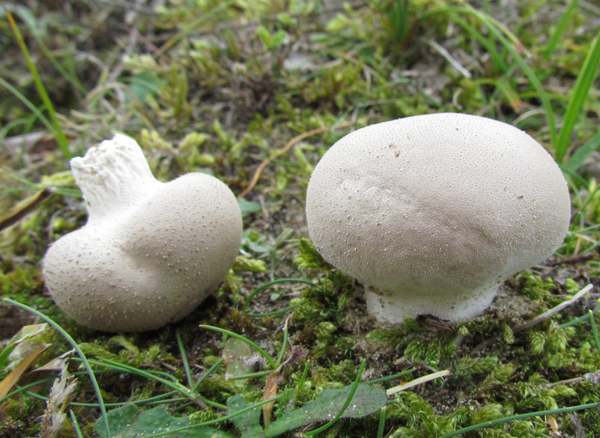
One of the most common puffball fungi found in meadows, Lycoperdon pratense looks rather like a baby Giant Puffball when viewed from the top, although in the early stages of development its skin is scurfy whereas its larger cousins have smooth skins. Both the Meadow Puffball and the Giant Puffball are edible, so confusing the two is not disastrous. To differentiate these puffballs look underneath: the Meadow Puffball has a stump-like stem whereas there is no stem on a Giant Puffball.
Distribution
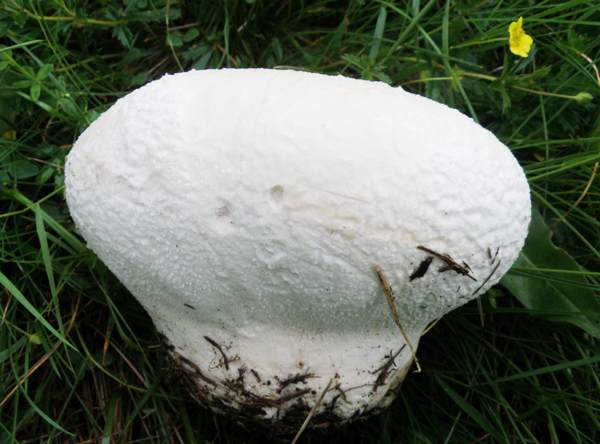
A common find in Britain and Ireland, the Meadow Puffball is quite commonly seen in sand dune systems, where it can be abundant in dune slacks (as was the case with the specimen above).
This puffball is widespread and abundant across mainland Europe, and it is also recorded in parts of North America.
Taxonomic history
This largish edible fungus was first described in scientific literature by Christiaan Hendrik Persoon in 1797, when it was given the binomial name Lycoperdon pratense - still its accepted scientific name.
Synonyms of Lycoperdon pratense include Lycoperdon hiemale Bull., Lycoperdon depressum Bonord. Vascellum depressum (Bonord.) F. Šmarda, and Vascellum pratense (Pers.) Kreisel.
Etymology
The specific epithet pratense simply means 'of meadows', while the genus name Lycoperdon literally translates to 'wolf's flatulence' and begs the question who got close enough to a wolf to become an expert on the matter. For most of us, surely such an odour cannot be considered a particularly helpful diagnostic feature for identifying the Meadow Puffball, Lycoperdon pratense.
Identification guide
 |
Fruitbody
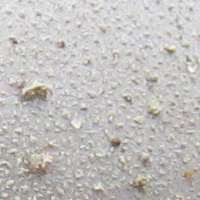
An elongated ovoid form 4 to 8cm across and 2 to 4cm tall, with a short sterile stem typically half the width of the fruitbody; the stem is separated from fertile upper section by a skin-like membrane; the outer surface is white and scurfy with an irregular scattering of short spines (see left) when young, becoming smooth and eventually turning brown and rupturing at the apex; internally white at first, turning olive and finally brown as the spore mass matures; spores disperse through a large apical hole.
The stem is 1 to 2cm tall and typically 1.5cm diameter, swollen towards the base; colour as the fertile head but with shorter spines. |
| |
Spores
Spherical, with finely warted surfaces; 3 - 5.5µm in diameter.
Spore mass
Light brown, eventually becoming dark brown when fully mature. |
Odour/taste |
Not significant. |
Habitat & Ecological role |
In permanent pastures, old lawns, dune slacks, golf courses and parks; occasionally also on roadside verges. |
Season |
June to October in Britain and Ireland. |
Occurrence |
Common and widespread. |
Similar species |
Lycoperdon perlatum is covered in warts rather than
spines.
Lycoperdon pyriforme occurs on stumps and buried wood.
Lycoperdon mammiforme has a surface covered initially in woolly patches. |
Culinary notes
Lycoperdon perlatum is edible but not highly valued. This species and can make a good meal if prepared and cooked properly. Here are a couple of tips. The first important step is to remove the outer skin - a fiddly job perhaps best done with a sharp knife. The second point is all to do with quality: use only fresh young fruitbodies which, when cut in half along the vertical axis, are white all through. Discard any that have begun turning yellow, olive or brown, as this indicates that the spores are maturing and the flavour will be seriously marred if you include them in your dish. Probably the simplest meal that you can make with puffballs is a mushroom omelet; they can also be fried or used to make soups.
Toxic imposters
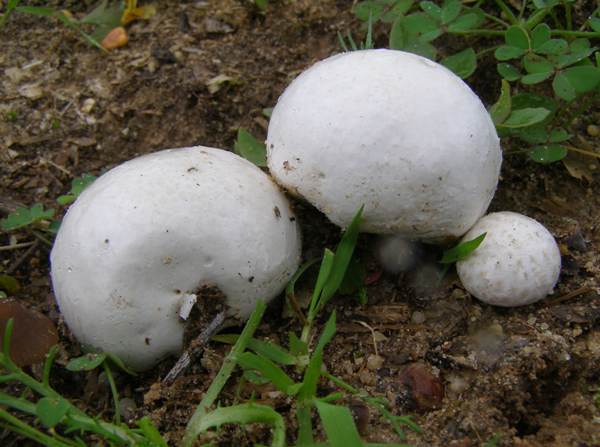
A note of caution for newcomers to fungal foraging: there are ball-shaped fungi known as earthballs, and some of them can look quite similar to Meadow Puffballs; however, their spore-bearing inner material starts off very pale grey and gradually becomes brown or black as the spores mature. Earthballs are inedible and some of them can cause serious poisoning. The most common of these, sometimes found along with meadow puffballs on woodland edges), is Scleroderma citrinum, the Common Earthball. The differences in features between puffballs and earthballs are quite obvious once you know what to look for, but it is important to learn how to distinguish these two groups if you plan on gathering edible puffballs for the pot.
For a very easy to recognise edible puffball that cannot be mistaken for any other mushroom, see Calvatia gigantea, the Giant Puffball. Unfortunately it's not every day that you stumble across Giant Puffballs, as they are not only uncommon but also very localised in their distribution. If you find a good spot for these mighty meaty meal sources, make a note of it because Giant Puffballs usually reappear in the same places for many years.
Reference Sources
Fascinated by Fungi, 2nd Edition, Pat O'Reilly 2016, reprinted by Coch-y-bonddu Books in 2022.
Pegler, D.N., Laessoe, T. & Spooner, B.M (1995). British Puffballs, Earthstars and Stinkhorns. Royal Botanic Gardens, Kew.
Dictionary of the Fungi; Paul M. Kirk, Paul F. Cannon, David W. Minter and J. A. Stalpers; CABI, 2008
Taxonomic history and synonym information on these pages is drawn from many sources but in particular from the British Mycological Society's GB Checklist of Fungi.
Top of page...
Fascinated by Fungi. Back by popular demand, Pat O'Reilly's best-selling 450-page hardback book is available now. The latest second edition was republished with a sparkling new cover design in September 2022 by Coch-y-Bonddu Books. Full details and copies are available from the publisher's online bookshop...