
Pluteus salicinus (Pers.) P. Kumm. - Willow Shield
Phylum: Basidiomycota - Class: Agaricomycetes - Order: Agaricales - Family: Pluteaceae
Distribution - Taxonomic History - Etymology - Identification - Culinary Notes - Reference Sources
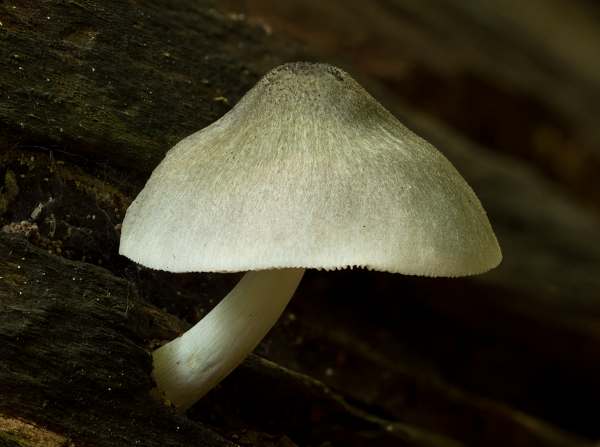
Pluteus salicinus is a wood-rotting fungus that occurs mainly on broadleaf (hardwood) stumps and large logs of buried hardwood timber, particularly of old willow trees. This attractive mushroom can appear at any time from early summer right through to the end of autumn.
Distribution
Widespread but uncommon in Britain and Ireland, this wood-rotting mushroom is also found in parts of mainland Europe.
Taxonomic history
The basionym of this species was established when the Willow Shield was described in 1798 by Christiaan Hendrik Persoon, who gave it the binonial scientific name Agaricus salicinus (at a time when most gilled fungi were placed in the genus Agaricus, since largely redistributed to newer genera). The Willow Shield was transferred to the genus Pluteus by German mycologist Paul Kummer in 1871, thus establishing its currently-accepted scientific name Pluteus salicinus.
Synonyms of Pluteus salicinus include Pluteus salicinus var. floccosus P. Karst., Agaricus salicinus Pers., and Pluteus salicinus var. beryllus Sacc.
Etymology
Pluteus, the genus name, comes from Latin and literally means a protective fence or screen - a shield for example!
The specific epithet salicinus means of or pertaining to willow trees (Salix species.)
Identification guide
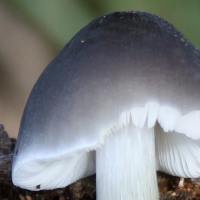 |
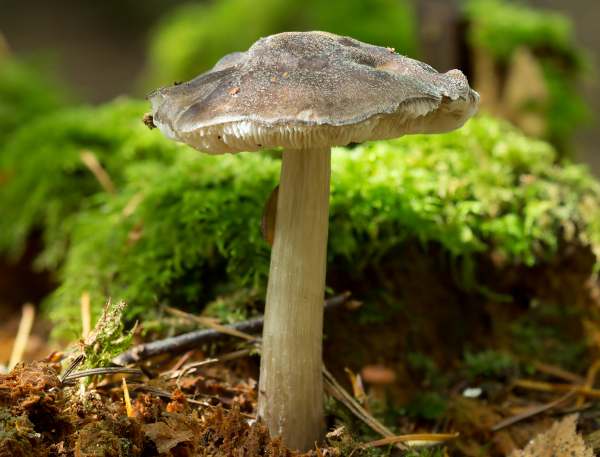
CapSmooth, convex and usually mid grey to dark greyish-brown, often with blue tints, the caps are unlined and typically 3 to 5cm in diameter. Caps often have a darker grey central region, sometimes with a slight umbo when fully mature. The cap flesh is white and firm. |
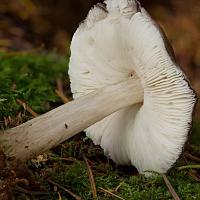 |
GillsWhite at first, becoming pale pink, the gills are broad, crowded and free. StemWhite and untapering, typically 5 to 7mm in diameter and 4 to 7cm long, sometimes slightly bulbous at the base. The stem flesh is white and firm, and it does not become hollow as it ages. In some forms of this mushroom the stem surface bruises slightly blue-green. |
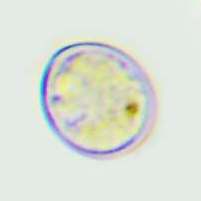 |
SporesBroadly ellipsoidal, smooth, 7-9 x 4.5-6µm. Spores of Pluteus salicinus, Willow Shield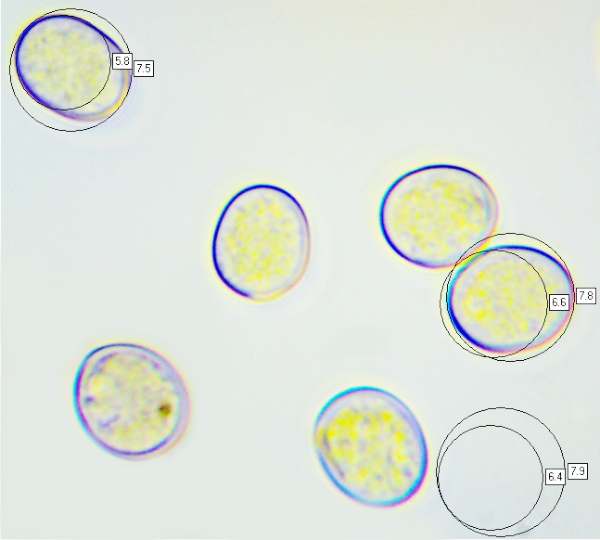 Spore printPale pink. |
Odour/taste |
Not distinctive. |
Habitat & Ecological role |
Saprobic, solitary or in small groups on stumps, rotting fallen branches and other woody debris of broadleaf trees, particularly willow and less often alder. |
Season |
Fruiting from early summer to late autumn, provided the weather is mild. Most often fruiting from mid summer to mid autumn. |
Similar species |
Pluteus umbrosus has a wrinkled cap and is generally a little smaller. Pluteus cervinus has a smooth brown or fawn cap. |
Culinary Notes
Although some sources list this as an edible mushroom, Pluteus salicinus has a form known to contain Psilocybin, a hallucinogenic substance, and so it is inadvisable to gather these mushrooms for eating.
Reference Sources
Fascinated by Fungi, 2nd Edition, Pat O'Reilly 2016, reprinted by Coch-y-bonddu Books in 2022.
Alfredo Justo, Andrew M. Minnis, Stefano Ghignone, Nelson Menolli Jr., Marina Capelari, Olivia Rodríguez, Ekaterina Malysheva, Marco Contu, Alfredo Vizzini (2011). 'Species recognition in Pluteus and Volvopluteus (Pluteaceae, Agaricales): morphology, geography and phylogeny'. Mycological Progress 10 (4): 453–479.
Orton, P.D. (1986). British Fungus Flora: Agarics and Boleti. Vol 4. Pluteaceae: Pluteus & Volvariella. Royal Botanic Garden: Edinburgh, Scotland.
Funga Nordica: 2nd edition 2012. Edited by Knudsen, H. & Vesterholt, J. ISBN 9788798396130
BMS List of English Names for Fungi
Dictionary of the Fungi; Paul M. Kirk, Paul F. Cannon, David W. Minter and J. A. Stalpers; CABI, 2008
Taxonomic history and synonym information on these pages is drawn from many sources but in particular from the British Mycological Society's GB Checklist of Fungi.
Acknowledgements
This page includes pictures kindly contributed by David Adamson, Simon Harding and David Kelly.
Fascinated by Fungi. Back by popular demand, Pat O'Reilly's best-selling 450-page hardback book is available now. The latest second edition was republished with a sparkling new cover design in September 2022 by Coch-y-Bonddu Books. Full details and copies are available from the publisher's online bookshop...