
Pseudoinonotus dryadeus (Pers.) T. Wagner & M. Fischer - Oak Bracket
Phylum: Basidiomycota - Class: Agaricomycetes - Order: Polyporales - Family: Hymenochaetaceae
Distribution - Taxonomic History - Etymology - Identification - Culinary Notes - Reference Sources
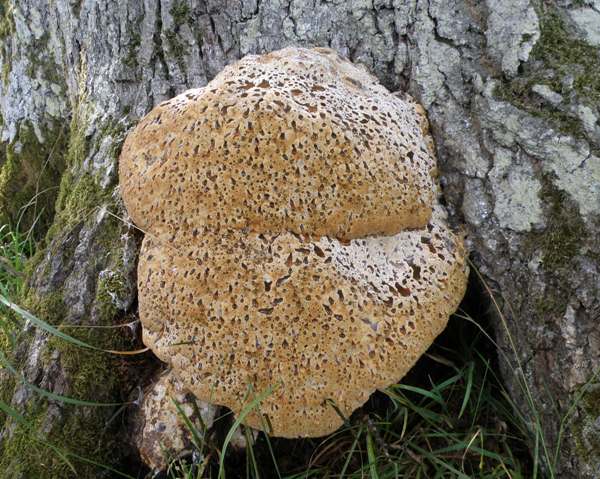
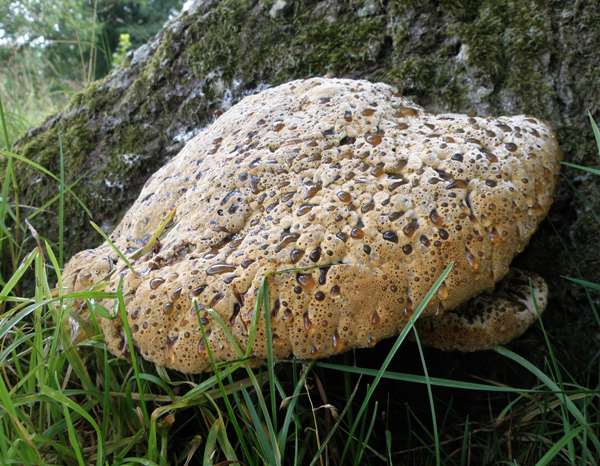
A distinguishing feature of this orange-brown bracket fungus is that its felted surface exudes amber droplets, most noticeably towards the broad growing margin. Although commonly referred to as the Oak Bracket, Pseudoinonotus dryadeus also occurs sometimes on beech, birch and alder trees.
One of the most beautiful of bracket fungi, the Oak Bracket looks like runny honey oozing from the surface of set honey. It is not as tasty as honey!
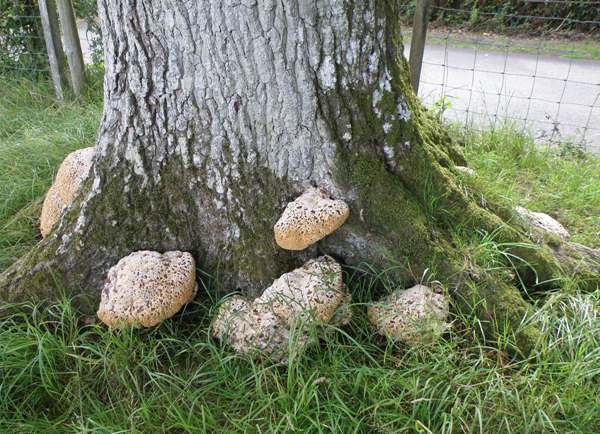
Above: There were 14 large brackets on the base and roots of this oak tree, in North Wales UK.
Distribution
Quite a rare sight in northern Britain but fairly common in Wales and southern England, Pseudoinonotus dryadeus is also found in northern and central mainland Europe (wherever oak trees can grow!) and in North America.
Taxonomic history
Described scientifically in 1799 by Christiaan Hendrik Persoon, who established the basionym of this species when he gave it the binomial scientific name Boletus dryadeus, the Oak Bracket's currently-accepted scientific name dateas from a 2001 publication by German mycologists Tobias Wagner and Michael Fischer. Prior to 2001 this species was recorded in field guides as Inonotus dryadeus.
Synonyms of Pseudoinonotus dryadeus include Boletus dryadeus Pers., Polyporus dryadeus (Pers.) Fr., and Inonotus dryadeus (Pers.) Murrill.
Pseudoinonotus dryadeus is thev type species of the genus Pseudoinonotus, which was circumscribed by Tobias Wagner and Michael Fischer in 2001.
Etymology
The generic name Pseudoinonotus is made up of Pseudo- meaning false, easily confused with, or masquerading as, ino- meaning fibrous, and ot, which means an ear (the -us extension is there merely to make it into a Latinised noun. This suggests that species in the Pseudoinonotus genus (of which only this one occurs in Britain and Ireland) look rather like Inonotus fungi, which are fibrous and ear-like. The specific epithet is much easier: dryad means oak, and the suffix -eus means belonging to or pertaining to; so, fungi with dryadeus as part of their scientific name are found with or on oaks. Some people refer to this as the Weeping Polypore, which seems quite apt until you realise that other brackets in the genus Inonotus also weep - for example see Inonotus hispidus and Inonotus radiatus.
Identification guide
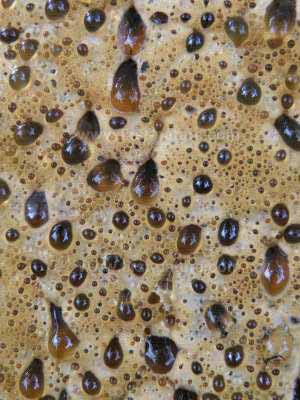 |
Cap infertile surfaceUp to 40cm across and typically 10 to 15cm thick, the orange-brown brackets of Pseudoinonotus dryadeus become irregularly shaped as the fruitbody matures. Occasionally they occur in tiers of three or more brackets. As the infection increases, fruitbodies can occur on roots some distance away from the trunk of the tree. The cap flesh is felty or even slightly hairy at first and becomes harder and more uneven with age. Drops of an amber 'runny honey' liquid ooze from a paler 'set honey' background to create a most attractive patterned surface. Unfortunately the similarity with honey does not extend to the taste. Tubes and PoresThe greyish tubes of the Oak Bracket, spaced at 4 to 6 per mm, also exude a thick amber liquid when young. |
SporesBroadly ellipsoidal, smooth, 7.5-8.5 x 5.5-6.5μm. Spore printWhite. |
|
Odour/taste |
The smell of old fruitbodies is strongly unpleasant; the taste is slightly acidic but not distinctive. |
Habitat & Ecological role |
Oak Bracket occurs at or near the base of living and dead broad-leaf trees, nearly always oaks but occasionally beech and other hardwoods; it causes white rot. |
Season |
Late summer to early winter. |
Similar species |
Fistulina hepatica, the Beefsteak Fungus, is soft and oozes red juice when cut. |
Culinary Notes
Oak Bracket Pseudoinotus dryadeus is as bitter, tough and inedible as the bark of the oak tree on which it grows, and so it can have no culinary value.
Reference Sources
Pseudoinonotus T. Wagner & M. Fisch., Mycol. Res. 105(7): 781 (2001)
Mattheck, C., and Weber, K. Manual of Wood Decays in Trees. Arboricultural Association 2003.
Pat O'Reilly, Fascinated by Fungi, 2016.
Dictionary of the Fungi; Paul M. Kirk, Paul F. Cannon, David W. Minter and J. A. Stalpers; CABI, 2008
Taxonomic history and synonym information on these pages is drawn from many sources but in particular from the British Mycological Society's GB Checklist of Fungi.
Fascinated by Fungi. Back by popular demand, Pat O'Reilly's best-selling 450-page hardback book is available now. The latest second edition was republished with a sparkling new cover design in September 2022 by Coch-y-Bonddu Books. Full details and copies are available from the publisher's online bookshop...