Pycnoporus cinnabarinus (Jacq.) P. Karst.
Phylum: Basidiomycota - Class: Agaricomycetes - Order: Polyporales - Family: Polyporaceae
Distribution - Taxonomic History - Etymology - Identification - Culinary Notes - Reference Sources
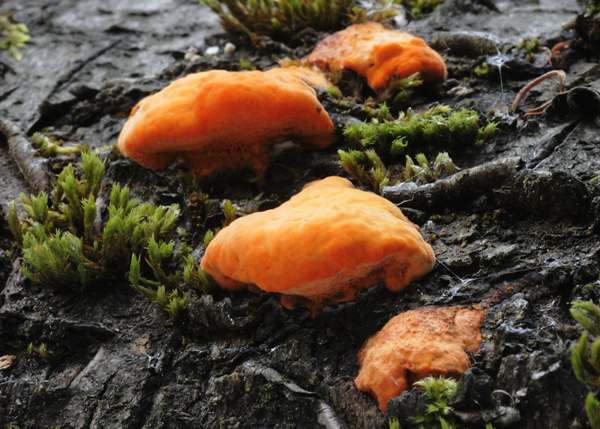
This very rare (in Britain and Ireland) and beautiful polypore is saprophytic on hardwood trees, including Beech, birches and Cherry. Only once have I seen this species, and that was in Bulgaria.
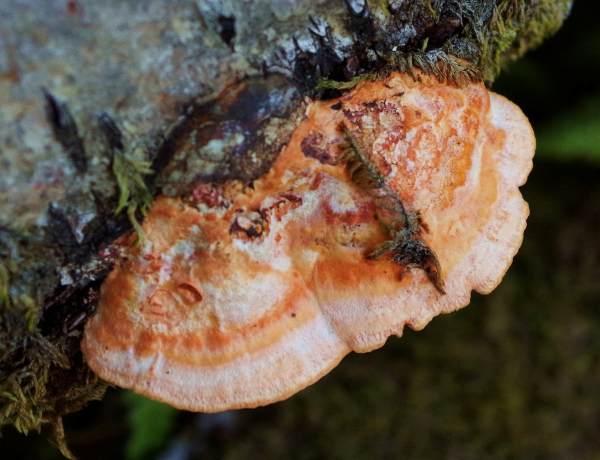
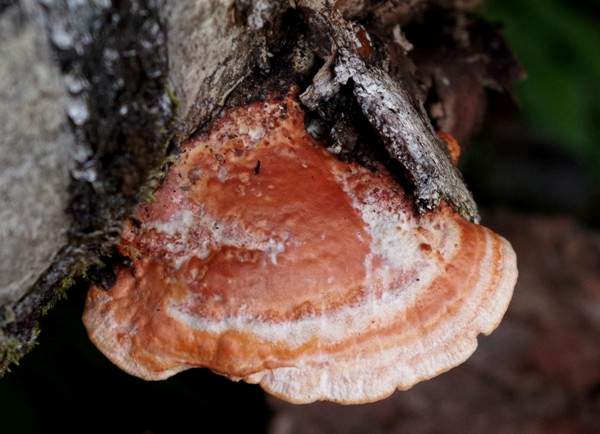
If you think that you have found one, check again: often the Beefsteak Fungus, Fistulina hepatica, is mistaken for this cinnabar polypore. (Both are beautiful fungi, so it’s no cause for tears.) If you do come across this colourful bracket fungus in Britain or Ireland count it as the find of a lifetime.
Distribution
Pycnoporus cinnabarinus occurs on dead deciduous hardwood. There are very few reports of this species being found in Britain and none in recent years. It was - Classed as Endangered on the UK Red Data List produced by Bruce Ing in 1992, and it was declared Extinct in the Red Data List produced by Shelley Evans et al. in 2006. This species is rather more likely to turn up in foray records on mainland Europe but in many countries it is very rare and so should not be picked.
Pycnoporus cinnabarinus is the type species of the genus Pycnoporus.
Taxonomic history
When Dutch naturalist Nicolaus Joseph von Jacquin (1727 - 1817) described this bracket fungus in 1776 he gave it the binomial scientific name Boletus cinnabarinus.
It was Finnish mycologist Petter Adolf Karsten (1834 - 1917) who, in 1881, transferred this species to the genus Pycnoporus, thus establishing its currently-accepted scientific name Pycnoporus cinnabarinus.
Synonyms of Pycnoporus cinnabarinus include Boletus cinnabarinus Jacq., Polyporus cinnabarinus (Jacq.) Fr., and Trametes cinnabarina (Jacq.) Fr.
Etymology
Pycnoporus, the genus name, comes from the prefix pycn- meaning thick or dense, and -porus meaning with pores. Fungi in this genus are thick and they do indeed have densely-packed pores...
Just as it sounds, the specific epithet cinnabarinus is a reference to the bright orange-red (cinnabar) colour of this strikingly beautiful bracket fungus.
Identification guide
 |
FruitbodyThe whole fruitbody is bright orange; up to 10cm across and when in bracket form projecting typically 4 to 6cm from substrate; usually between 1 and 2cm thick; the upper (infertile) surface is rough or wrinkled, orange-red, fading with age; margins are rounded (left) in young specimens, which are downy or finely hairy on the upper surface; margin becomes more acute as fruitbody ages; lower (fertile) surface with tubes. |
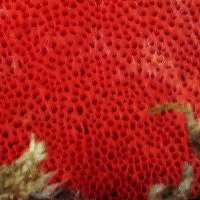 |
TubesPale orange; 2 to 6mm deep. PoresCinnabar red; round or angular, spaced at 2 to 4 per mm. |
SporesCylindrical or slightly allantoid (sausage-shaped), smooth, 5-6 x 2-2.5µm; inamyloid. Spore printWhite. |
|
Odour/taste |
Not distinctive. |
Habitat & Ecological role |
Saprophytic on hardwoods, particularly Beech and birches. |
Season |
Late summer and autumn. |
Similar species |
Fistulina hepatica is bright red when young; its spores are pinkish yellow. |
Culinary Notes
This species is generally regarded as inedible, but in any case because of its rarity it should not be collected.
Reference Sources
Fascinated by Fungi, 2nd Edition, Pat O'Reilly 2016, reprinted by Coch-y-bonddu Books in 2022.
Dictionary of the Fungi; Paul M. Kirk, Paul F. Cannon, David W. Minter and J. A. Stalpers; CABI, 2008
Taxonomic history and synonym information on these pages is drawn from many sources but in particular from the British Mycological Society's GB Checklist of Fungi.
Acknowledgements
This page includes pictures kindly contributed by David Adamson and Arnor Gullanger.

Fascinated by Fungi. Back by popular demand, Pat O'Reilly's best-selling 450-page hardback book is available now. The latest second edition was republished with a sparkling new cover design in September 2022 by Coch-y-Bonddu Books. Full details and copies are available from the publisher's online bookshop...