
Russula farinipes Romell - Floury Brittlegill
Phylum: Basidiomycota - Class: Agaricomycetes - Order: Russulales - Family: Russulaceae
Distribution - Taxonomic History - Etymology - Identification - Culinary Notes - Reference Sources
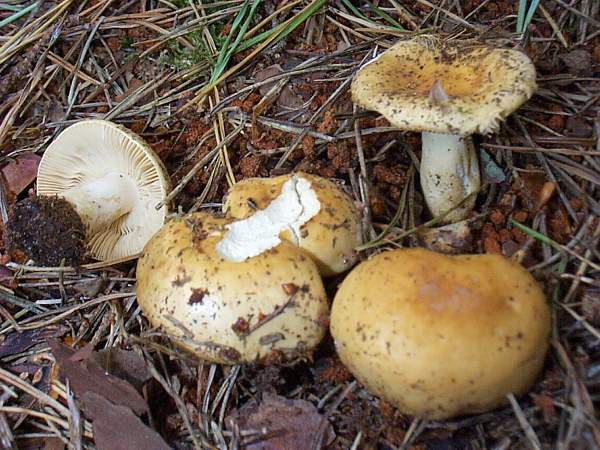
A less common find than other yellowish brittlegills, and most often on calcareous soil in broadleaf woodland, this beautiful mushroom is quite distinctive. Oaks, Beech and birches are common mycorrhizal partners of this mushroom.
Distribution
This brittlegill is fairly common in broadleaf and mixed woodlands in Britain and Ireland; it is also found throughout mainland Europe, from northern Scandinavia right down to the Mediterranean.
Taxonomic history
The currently-accepted scientific name of the attractive brittlegill dates from an 1893 publication by the Swedish mycologist Lars Romell (1854 - 1927).
Etymology
Russula, the generic name, means red or reddish, and indeed many of the brittlegills do have red or somewhat reddish caps (but many more of the brittlegill mushrooms are not red, and several of those that are usually red can also occur in a range of other colours!).
The specific epithet farinipes refers to the surface of the stem, the upper section of which has a farinaceous textures, meaning that it is covered in a flour-like powder.
Identification guide
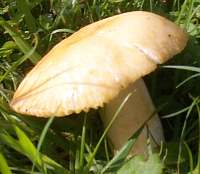 |
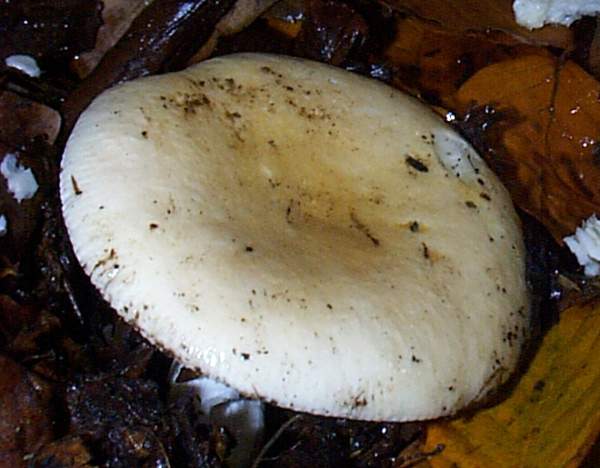
CapRufous yellow, becoming russet brown with age; margin sulcate (furrowed); convex, sometimes developing a central depression; grainy, esp. at margin; cuticle peels very little; 3 to 6cm across. The cap and stem flesh is distinctive, being much tougher and more elastic than is the norm for a brittlegill mushroom. |
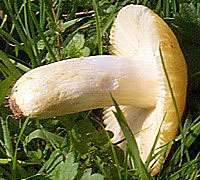 |
GillsPale straw yellow; quite distant; arching upwards; slightly decurrent. StemWhite or very pale straw yellow; powdery towards apex; with cavities; 3 to 7cm long, 1 to 1.8cm diameter. |
SporesEllipsoidal, 6-8 x 5-6.5µm, ornamented with small isolated warts up to 0.6µm tall. Spore printWhite. |
|
Odour/taste |
Odour: slightly fruity. Taste: very acrid. |
Habitat & Ecological role |
Oaks, Beech and birches are common mycorrhizal partners of this mushroom. |
Season |
August to November in Britain and Ireland. |
Similar species |
Russula claroflava has a bright yellow cap and white gills; it is found on wet ground under birch trees. It has a strong fruity odour, has yellowish gills and provides a yellow-ochre spore print. Russula ochroleuca has ochre-yellow caps with white gills. |
Culinary Notes
Russula farinipes is a very hot-tasting mushroom, and so it is generally regarded as inedible.
Reference Sources
Pat O'Reilly (2016). Fascinated by Fungi, First Nature Publishing
Geoffrey Kibby (2011).The Genus Russula in Great Britain, published by G Kibby.
Roberto Galli (1996). Le Russule. Edinatura, Milan.
Dictionary of the Fungi; Paul M. Kirk, Paul F. Cannon, David W. Minter and J. A. Stalpers; CABI, 2008
Taxonomic history and synonym information on these pages is drawn from many sources but in particular from the British Mycological Society's GB Checklist of Fungi.
Fascinated by Fungi. Back by popular demand, Pat O'Reilly's best-selling 450-page hardback book is available now. The latest second edition was republished with a sparkling new cover design in September 2022 by Coch-y-Bonddu Books. Full details and copies are available from the publisher's online bookshop...