
Russula grata Britzelm. - Bitter Almond Brittlegill
Phylum: Basidiomycota - Class: Agaricomycetes - Order: Russulales - Family: Russulaceae
Distribution - Taxonomic History - Etymology - Identification - Culinary Notes - Reference Sources
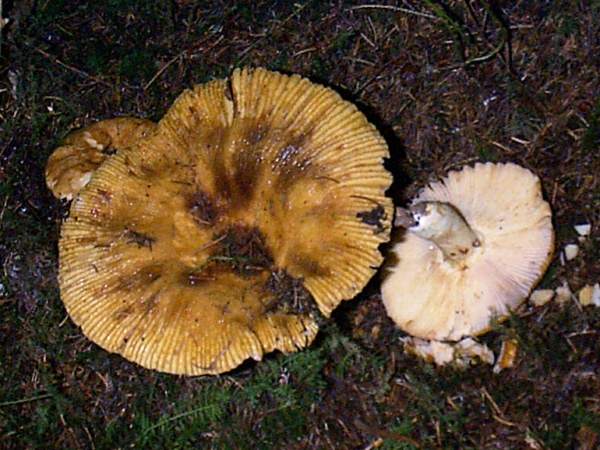
Russula grata is an untidy fungus, often damaged before it emerges from the forest floor. Crushing the gills between your fingers will release a strong bitter almonds odour that helps to verify the identity of this species.
Distribution
This is widespread and fairly common in Britain and Ireland as well as in other European countries. There are reports of Russula grata occurring in North America, most commonly in the north east.
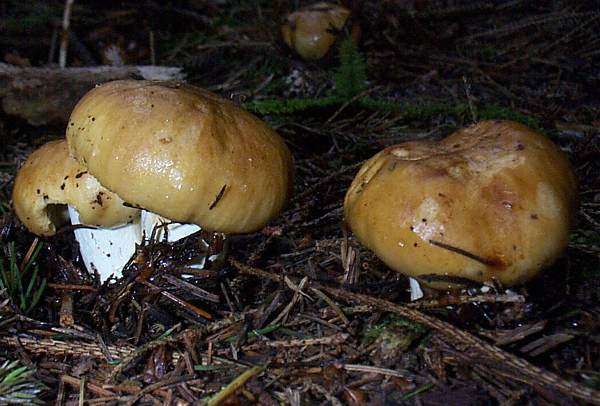
It is hard to find a perfect specimen of this fairly common woodland mushroom, because slugs are attracted to it - perhaps by the strong odour of bitter almonds.
Taxonomic history
The Bitter Almond Brittlegill was described in 1893 by German mycologist Max Britzelmayr (1939 - 1909), who established its currently-accepted scientific name Russula grata.
Synonyms of Russula grata include Russula laurocerasi Melzer, and Russula subfoetens var. grata (Britzelm.) Romagn.
This brittlegill is included in many current field guides as Russula laurocerasi, the name given to it in 1921 by Czech mycologist Václav Melzer (1878 - 1968), the creator of Melzer's reagent which is used to stain certain parts of white fungi.
Etymology
Russula, the generic name, means red or reddish, and indeed many of the brittlegills have red caps (but many more are not, and several of those that are usually red can also occur in a range of other colours!). The specific epithet grata means welcome (just as persona non grata means a person who is not welcome).
Identification guide
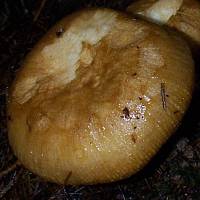 |
Cap5 to 9cm in diameter and more or less flat or slightly depressed in the centre when fully developed, the caps are spherical only when very young. Honey brown and rather blotchy, the cap surface is viscid and develops intense radial ridges and warty bumps as it ages. |
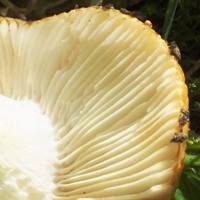 |
GillsThe narrow, adnexed gills are moderately close together; they are very brittle. Initially cream, the gills darken with age and develop rust spots. Stem15 to 35mm in diameter and 4 to 8cm tall, the brittle stems are white and solid, developing internal cavities as they age. |
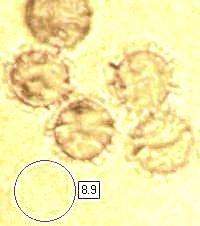 |
SporesGlobose, 8-9.5 x 8-8.5µm; uniquely ornamented with warts and protruding wings, sometimes branching; the warts and ridges are up to 2µm tall. Spore printPale to mid cream. |
Odour/taste |
Strong odour of bitter almonds (some say rather like marzipan); taste can be either mild or quite hot. |
Habitat & Ecological role |
Coniferous and broadleaf woodland. In common with other members of the Russulaceae, Russula grata is an ectomycorrhizal mushroom. |
Season |
July to November in Britain and Ireland. |
Similar species |
Russula fragrantissima has much the same macroscopic appearance and strong almond fragrance but its spores do not have the distinctive wings associated with Russula grata. Russula illota, a rare species in Britain, and considered by some authorities as a subspecies of Russula grata, is very similar in appearance, habitat and season. Only experts can tell the two apart without resorting to microscopic examination. Russula foetens is typically somewhat larger and has an unpleasant smell. |
Culinary Notes
Despite having one of the most attractive odours of all fungi (at least, to anyone who is fond of almonds and marzipan!), this is an inedible mushroom.
Reference Sources
Pat O'Reilly (2016). Fascinated by Fungi, First Nature Publishing
Geoffrey Kibby (2011).The Genus Russula in Great Britain, published by G Kibby.
Roberto Galli (1996). Le Russule. Edinatura, Milan.
Paul M. Kirk, Paul F. Cannon, David W. Minter and J. A. Stalpers. (2008). Dictionary of the Fungi; CABI.
Taxonomic history and synonym information on these pages is drawn from many sources but in particular from the British Mycological Society's GB Checklist of Fungi.
Fascinated by Fungi. Back by popular demand, Pat O'Reilly's best-selling 450-page hardback book is available now. The latest second edition was republished with a sparkling new cover design in September 2022 by Coch-y-Bonddu Books. Full details and copies are available from the publisher's online bookshop...