
Suillus placidus (Bonord.) Singer - Slippery White Bolete
Phylum: Basidiomycota - Class: Agaricomycetes - Order: Boletales - Family: Suillaceae
Distribution - Taxonomic History - Etymology - Identification - Culinary Notes - Reference Sources
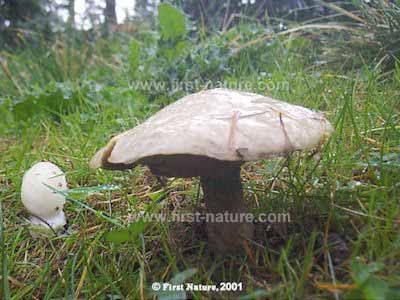
This very rare (in Britain) ivory-coloured bolete appears in and at the edges pine plantations.
Distribution
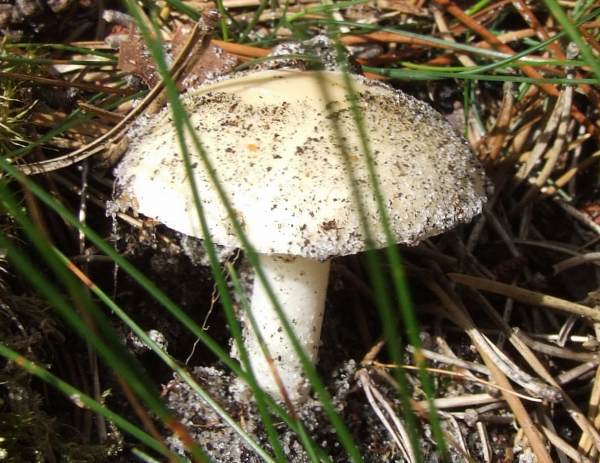
In Britain this bolete has very occasionally been recorded (formally) only in the county of Kent, in southern England; however, much further south in mainland Europe these striking slimy-capped mushrooms are more common. Suillus placidus is also found also in North America, and there too it is mycorrhizal with pine trees.
The picture below was taken in a northern Europe pine forest by Axel Kuhlmann.
Taxonomic history
When in 1861 German naturalist Hermann Friedrich Bonorden (1801 - 1884) described this boletoid fungus he gave it the scientific name Boletus placidus. In 1945 German-born mycologist Rolf Singer, who worked mainly in North America, transferred this species to its present genus, whereupon its currently-accepted scientific name Suillus placidus was established.
Synonyms of Suillus placidus include Boletus placidus Bonord., Gyrodon placidus (Bonord.) Fr., and Ixocomus placidus (Bonord.) E.-J. Gilbert.
Etymology
Suillus, the generic name, means of pigs (swine) and is a reference to the greasy nature of the caps of fungi in this genus. The specific epithet placidus means mild or gentle - referring to appearance rather than behaviour, I assume!
Identification Guide
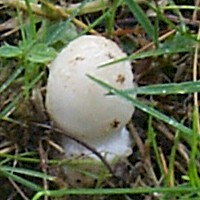 |
CapThe young cap shown here is pure ivory white and very slimy. Older caps remain viscid and darken only slightly as they expand from convex to almost flat. Beneath the viscid cuticle, the cap flesh is very pale grey at first, yellowing somewhat as the fruiting body matures. |
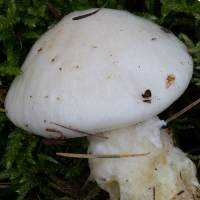 |
At maturity, the cap diameter is usually 7 to 10cm. The flesh is initially white and becomes yellowish with age, sometimes staining slightly pink. |
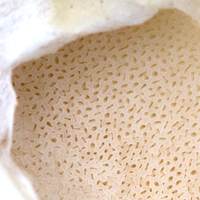 |
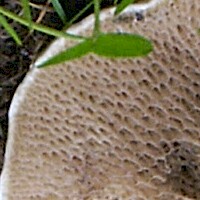
PoresInitially ivory (left) and spaced at 1 to 2 per mm, the pore openings darken slightly (below left) as they become stained by falling spores. |
 |
TubesThe largish tubes are pale grey at first, yellowing slightly with age. |
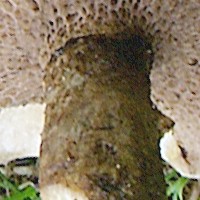 |
StemThe slender stem is ivory-white with vinaceous blotches near the apex. There is no stem ring. Typically 1.5 to 2cm in diameter, stems range from 5 to 10cm in height. |
SporesEllipsoidal to oblong, smooth, 7-9 x 2.5-4µm. Spore printBrownish ochre. |
|
Odour/taste |
Not distinctive. |
Habitat & Ecological role |
On or beside stumps; also beside woodland footpaths. |
Season |
August to November in southern Britain. |
Similar species |
Suillus viscidus is a Larch associate, typically darker and with a membranous stem ring. Leccinum holopus, a rare bolete found under birch, is pure white when young but develops a blue tinge as it matures. When cut, the flesh at the base of the stem turns blue-green. |
Culinary Notes
Although reportedly edible and of reasonable quality, Suillus placidus is not noted as an esculent. In any case the rarity of this lovely little bolete makes it inappropriate to collect for eating.
Reference Sources
Fascinated by Fungi, 2nd Edition, Pat O'Reilly 2016, reprinted by Coch-y-bonddu Books in 2022.
British Boletes, with keys to species, Geoffrey Kibby (self published) 3rd Edition 2012
Roy Watling & Hills, A.E. 2005. Boletes and their allies (revised and enlarged edition), – in: Henderson, D.M., Orton, P.D. & Watling, R. [eds]. British Fungus Flora. Agarics and boleti. Vol. 1. Royal Botanic Garden, Edinburgh.
BMS List of English Names for Fungi
Dictionary of the Fungi; Paul M. Kirk, Paul F. Cannon, David W. Minter and J. A. Stalpers; CABI, 2008
Taxonomic history and synonym information on these pages is drawn from many sources but in particular from the British Mycological Society's GB Checklist of Fungi.
Acknowledgements
This page includes pictures kindly contributed by David Kelly.
Fascinated by Fungi. Back by popular demand, Pat O'Reilly's best-selling 450-page hardback book is available now. The latest second edition was republished with a sparkling new cover design in September 2022 by Coch-y-Bonddu Books. Full details and copies are available from the publisher's online bookshop...