
Cantharellus aurora (Batsch) Kuyper - Golden Chanterelle
Phylum: Basidiomycota - Class: Agaricomycetes - Order: Cantharellales - Family: Cantharellaceae
Distribution - Taxonomic History - Etymology - Identification - Culinary Notes - Reference Sources
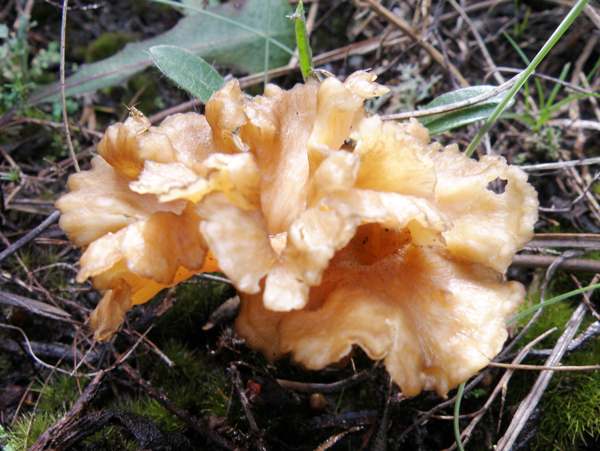
The key identifying feature of this mushroom is the underside of its cap, which is smooth or only very slightly wrinkled with sometimes a few very broad veins rather than the deep false gills that characterise the much larger and more commonly seen Cantharellus cibarius and Cantharellus tubaeformis.
I have found these little mushrooms mainly under old oaks, and invariably in small scattered groups rather than singly.
Distribution
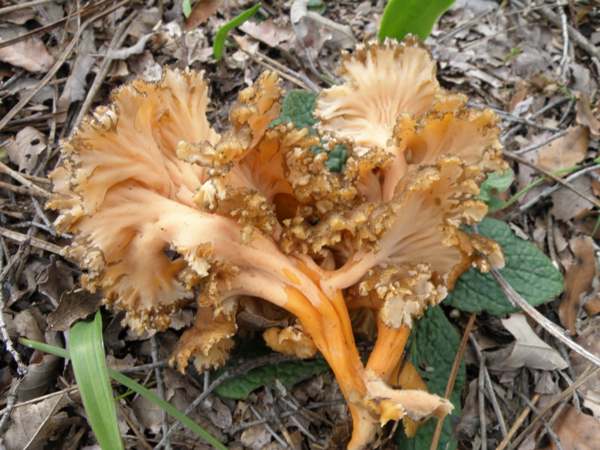
The Golden Chanterelle is quite a rare find in Britain, but it does occur in many parts of England, Scotland and Wales, and it is recorded also from Ireland. On mainland Europe these curly-kale-shaped mushrooms can be found from from Scandinavia to the Mediterranean. Cantharellus aurora is also common in some parts of North America.
Taxonomic history
Cantharellus aurora, the Golden Chanterelle mushroom, was described scientifically in 1783 by German mycologist August Johann Georg Karl Batsch (1761 - 1802), who gave it the binomial name Agaricus aurora. When Elias Magnus Fries referred to this species in his Systema mycologicum of 1821 he used the name Cantharellus lutescens, under which name appears in some field guides.
The currently-accepted name Cantharellus aurora dates from work by Dutch mycologist Thomas W Kuyper (b. 1954), which was published in 1991. (DNA sequencing results suggest that this species is closer to Craterellus cornucopioides than to Cantharellus cibarius, and so another change of genus may occur before very long.)
Cantharellus aurora has several synonyms including Cantharellus lutescens Fr., Agaricus aurora Batsch, Merulius xanthopus Pers., and Cantharellus xanthopus (Pers.) Duby. (In some field guides it is given the name Craterellus aurora.)
Etymology
The generic name Cantharellus is derived from the Latin word cantharus (originally from the Greek 'kantharos') meaning a drinking vessel (usually with handles), a bowl or a chalice. The Greek noun kantharos was applied to (among other things) an ancient Greek clay vessel which, in turn, was so named for its resemblance to a red-tinged scarab beetle of the same name. See also the Soldier Beetle, Cantharis rustica...
The specific epithet aurora means golden.
Identification guide
 |
CapBrown scales cover a golden background that shows through more as the cap expands; funnel-shaped with a wavy, irregular margin that is often multi-lobed; 2 to 5cm across. |
 |
VeinsNot strictly gills at all, the wrinkled veins on the underside of the cap distinguish chanterelles from true agaricoid mushrooms. The cap underside is cream or pale pinkish-yellow; smooth and matt; with very few shallow veins (false gills). |
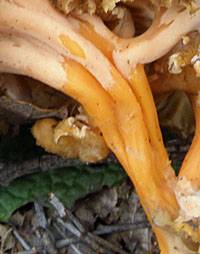 |
StemYellow; cylindrical or tapering towards base; becoming hollow; 2 to 5cm long, 0.5 to 1cm diameter. Stems often branch towards the apex and carry two or more curly caps. |
SporesEllipsoidal, smooth, 9-11 x 6-7.5µm. Spore printWhite or pale yellow. |
|
Odour/taste |
Not distinctive. |
Habitat & Ecological role |
This mycorrhizal species is most frequently found under oaks. |
Season |
June to October in Britain and Ireland - even into November in mild autumns; through to at least February most years in the Mediterranean region. |
Similar species |
Cantharellus cibarius is larger, with a less contorted golden cap. Could be confused with Hygrophoropsis aurantiaca, the False Chanterelle, which is a bright orange gilled boletoid fungus.
|
Culinary Notes
The rich fruity aroma and pleasant texture of cooked chanterelles of various kinds are among Nature's finest culinary delights, and the Golden Chanterelle is, in culinary terms, just as good as its larger relatives. Unfortunately it is a lot smaller and much less common, but if you can sufficient without seriously depriving wildlife of their share then treat them just as you would Cantharellus cibarius.
Reference Sources
Fascinated by Fungi, 2nd Edition, Pat O'Reilly 2016, reprinted by Coch-y-bonddu Books in 2022.
Dictionary of the Fungi; Paul M. Kirk, Paul F. Cannon, David W. Minter and J. A. Stalpers; CABI, 2008
Taxonomic history and synonym information on these pages is drawn from many sources but in particular from the British Mycological Society's GB Checklist of Fungi.
Fascinated by Fungi. Back by popular demand, Pat O'Reilly's best-selling 450-page hardback book is available now. The latest second edition was republished with a sparkling new cover design in September 2022 by Coch-y-Bonddu Books. Full details and copies are available from the publisher's online bookshop...