
Entoloma sericellum (Fr.) P. Kumm. - Cream Pinkgill
Phylum: Basidiomycota - Class: Agaricomycetes - Order: Agaricales - Family: Entolomataceae
Distribution - Taxonomic History - Etymology - Identification - Culinary Notes - Reference Sources
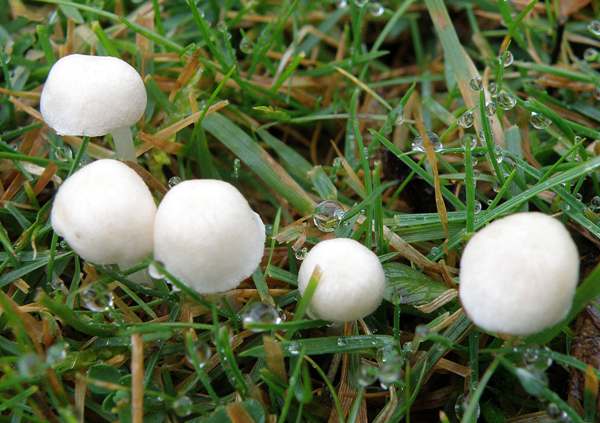
This tiny white-capped pinkgill is very common in pastures, in grassy and mossy areas under broadleaf trees in parkland, and in or on the edges of open deciduous woodland. Cream Pinkgills are often ignored, as they are easily mistaken for the much more common Snowy Waxcaps when seen from a distance.
Although mainly seen as singletons or in small groups, Cream Pinkgills occasionally appear in arcs or in complete fairy rings.
Distribution
The Cream Pinkgill is an occasional find in Britain and Ireland, where it is widely distributed. This pinkgill occurs also throughout most mainland Europe, where it is an occasional to fairly common find.
Taxonomic history
When in 1818 the Swedish mycological pioneer Elias Magnus Fries described this pinkgill mushroom he gave it the name Agaricus sericeus ß sericellus. It was the German mycologist Paul Kummer who in 1871 transferred this species to the genus Entoloma, thereby establishing its currently-accepted binomial name as Entoloma sericellum.
Entoloma sericellum has attracted a vast array of synonyms including Agaricus sericeus ß sericellus Fr., Leptonia sericella var. sublutescens Henn., Rhodophyllus carneoalbus (With.) Quél., Clitopilus carneoalbus (With.) Sacc., and Alboleptonia sericella (Fr.) Largent & R.G. Benedict.
Etymology
The generic name Entoloma comes from ancient Greek words entos, meaning inner, and lóma, meaning a fringe or a hem. It is a reference to the inrolled margins of many of the mushrooms in this genus.
The specific epithet sericellum refers to the silkiness of the cap surface, although this feature is unreliable as some specimens have very smooth caps.
Identification guide
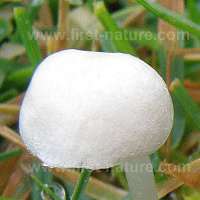
Cap0.6 to 3cm across, conical becoming convex, flattening with an undulating and slightly incurved margin; white, becoming pale ochre from the centre with age; surface usually silky smooth. |
|
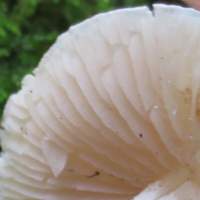 |
GillsSinuate; white, turning pale pink as the spores mature. Stem2 to 3cm long and 2 to 3mm diameter; smooth; the base sometimes slightly swollen; white, becoming gradually yellow-ochre with age; no stem ring. Original image by Richard Sullivan/Wikipedia |
SporesAngular, pentagonal in side view; 8-12 x 6-9μm. Spore printPink. |
|
Odour/taste |
Not distinctive. |
Habitat & Ecological role |
Saprobic, usually in small groups in grassland or under broadleaf trees in parkland and open woodland. |
Season |
Fruiting from summer to late autumn in Britain and Ireland. |
Similar species |
The Cream Pinkgill is often mistaken for one of the small white waxcaps such as Hygrocybe virginea, the Snowy Waxcap. The distinction becomes much clearer when the fruitbodies reach maturity, as the gills of the waxcaps remain white while those of pinkgills turn pink.
|
Culinary Notes
Reported in some field guides to be inedible and perhaps suspect, Entoloma sericellum is in any case insubstantial and of no culinary interest.
Reference Sources
Fascinated by Fungi, 2nd Edition, Pat O'Reilly 2016, reprinted by Coch-y-bonddu Books in 2022.
Knudsen H., Vesterholt J. (eds) Funga Nordica: agaricoid, boletoid and cyphelloid genera - Nordsvamp, 2008
Dictionary of the Fungi; Paul M. Kirk, Paul F. Cannon, David W. Minter and J. A. Stalpers; CABI, 2008
Taxonomic history and synonym information on these pages is drawn from many sources but in particular from the British Mycological Society's GB Checklist of Fungi.
Fascinated by Fungi. Back by popular demand, Pat O'Reilly's best-selling 450-page hardback book is available now. The latest second edition was republished with a sparkling new cover design in September 2022 by Coch-y-Bonddu Books. Full details and copies are available from the publisher's online bookshop...