
Gymnopilus junonius (Fr.) P. D. Orton - Spectacular Rustgill
Phylum: Basidiomycota - Class: Agaricomycetes - Order: Agaricales - Family: Strophariaceae
Distribution - Taxonomic History - Etymology - Toxicity - Identification - Reference Sources
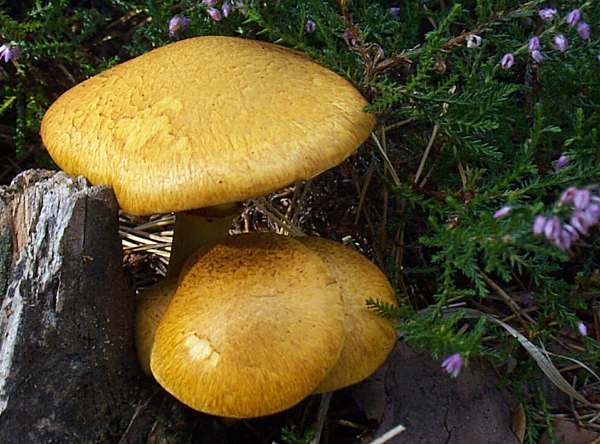
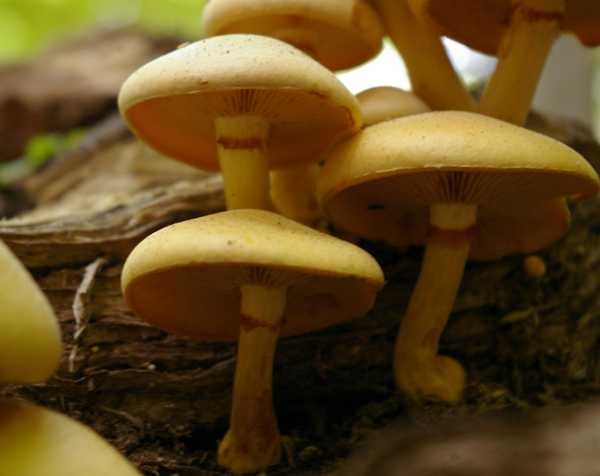
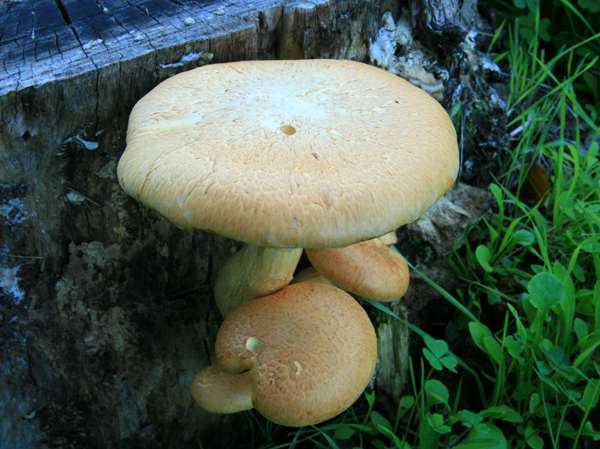
Gymnopilus junonius is a large and colourful wood-rotting species that occurs in small groups at the bases of dead broad-leaf trees and occasionally conifers from spring through to early winter. When seen in full sunlight, this mushroom deserves the name 'Spectacular'. The cap colour is very variable - sometimes beautiful gold colour, while at other times the dominant colour is deep orange, as seen on the left. This fine display of Spectacular Rustgills was growing from the stump of a pine, and the largest cap was nearly 20cm across.
Distribution
Fairly common and widespread in Britain and Ireland, Gymnopilus junonius is found in many other parts of the world including mainland Europe (from Scandinavia down to the Mediterranean region) much of Asia and North Africa, and many parts of North America.
Taxonomic history
Described in 1821 by the famous Swedish mycologist Elias Magnus Fries, who called it Agaricus junonius (most gilled fungi were placed in the Agaricus genus in the early days of fungal taxonomy, but the majority have since been relocated to new genera leaving Agaricus for the 'true mushrooms') the Spectacular Rustgill was transferred to its present genus in 1960 by British mycologist Peter Darbishire Orton (1916-2005).
Synonyms of Gymnopilus junonius include Agaricus spectabilis, Pholiota spectabilis, Agaricus junonius Fr., Lepiota aurea Gray, Pholiota junonia (Fr.) P. Karst., Pholiota grandis Rea, and Pholiota spectabilis var. junonia (Fr.) J. E. Lange.
Etymology
Gymnopilus was proposed as a new genus name in 1879 by the Finnish mycologist Petter Adolf Karsten (1834 - 1917). The origin of this generic name is the prefix Gymn- meaning naked, and the suffix -pilus which means cap - hence naked or bald caps would be an expected feature of the mushrooms in this genus.
The specific epithet Junonius refers to the Roman goddess Juno, daughter of Saturn and wife (but also sister) of Jupiter. Juno was reputed to be statuesque and beautiful, but she is also de[picted as a warlike woman. (Juno was also the mother of Mars, god of war).
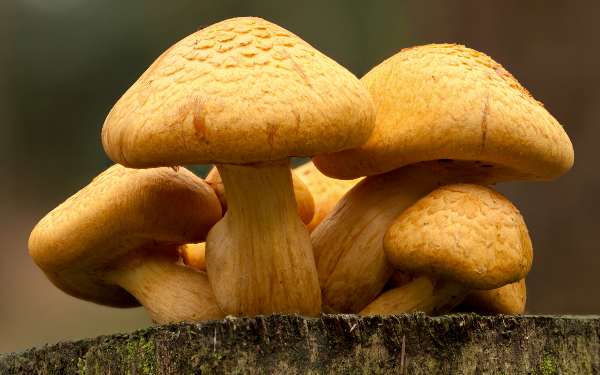
Juno was also in some way linked to processes of rejuvenation - quite appropriate, you might think, for a mushroom that is reborn annually from its long-lived mycelium. The beauty of these mushrooms is, I feel, captured perfectly in the closeup of the cap surface shown below.
Toxicity
This large fleshy mushroom looks tasty, but please don't treat it as a 'Golden Delicious', because it is inedible. Several authorities (including Tom Volk) state that specimens from various parts of the world have been found to contain toxins, including the hallucinogens psilocybin and psilobin. The common names Laughing Jack and Laughing Jim (or Gym) have been given to this toxic toadstool because of its hallucinogenic properties.
Identification guide
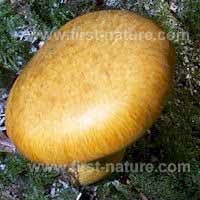 |
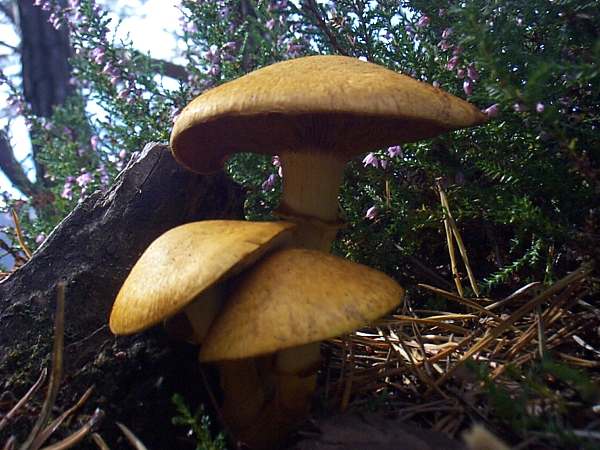
CapThe cap diameter of Gymnopilus junonius usually ranges from 4 to 20cm, although exceptional specimens to 30cm are encountered occasionally; initially convex with an in-rolled margin, it eventually flattens but often retains a slight umbo (central raised area). Radial orange or apricot-coloured fibres on a yellow or sienna background give the cap of the Spectacular Rustgill an overall golden appearance, which darkens towards orange brown as the fruitbody ages. The colour of the cap flesh is cream to straw-yellow, and it is firm and quite thick. |
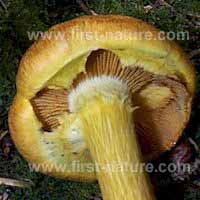 |
GillsA yellow cortina covers the gills of the immature fruitbodies, breaking and shriveling to leave fragments around the rim of the cap and around the stipe. The crowded gills of Gymnopilus junonius are adnate with broad attachment to the stipe. They are straw yellow to buff at first, changing to a bright rusty colour as the spores mature. |
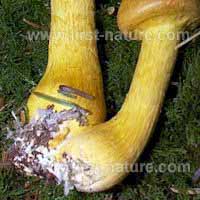 |
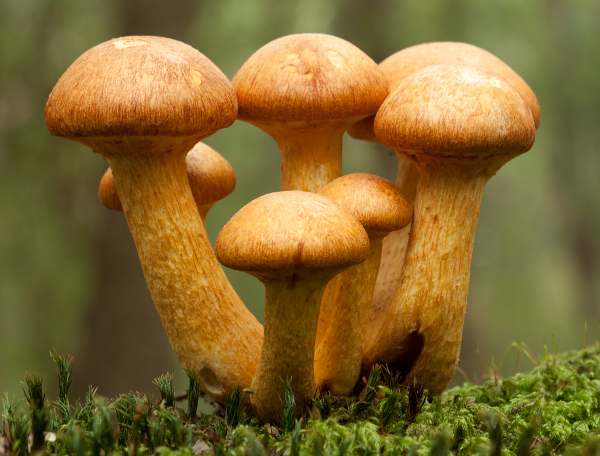
StemThe robust stipe of the Spectacular Rustgill is the same colour as the cap; its surface is fibrous below the ring, which soon gathers spores and turns rusty brown. At the base, the stipe is either bulbous or clavate (club shaped), and the stem is solid with yellow flesh. |
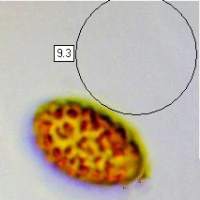 |
SporesEllipsoidal to almond shaped, 8-10 x 5-6µm. Spores of Gymnopilus junonius, Spectacular Rustgill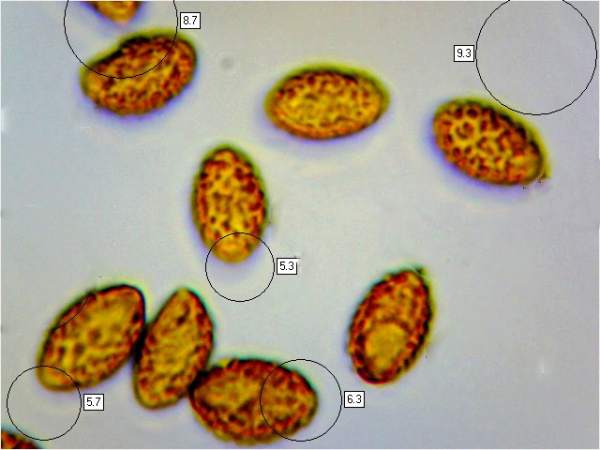 Spore printRusty brown. |
Odour/taste |
Faint fruity smell; stronger when the flesh is cut. Bitter taste |
Habitat & Ecological role |
Gymnopilus junonius is saprobic and appears on stumps in deciduous woodland; occasionally also on conifer stumps and trunks. |
Season |
June to November in Britain and Ireland; through to January in southern Europe. |
Similar species |
Gymnopilus penetrans is yellow-brown, much smaller and lacks a stem ring; it occurs in similar habitat, but unlike Gymnopilus junonius it is more frequently seen on conifer stumps and on sawdust heaps. Phaeolepiota aurea is a rare mushroom with a granular cap and lower stem; its spores are light yellow-brown. |
Reference Sources
Pat O'Reilly (2016). 2nd edition; First Nature.
Funga Nordica: 2nd edition 2012. Edited by Knudsen, H. & Vesterholt, J. ISBN 9788798396130
Lincoff, G. and D. J. Mitchel. (1977). Toxic and Hallucinogenic Mushroom Poisoning. Van Nostrand Reinhold, New York.
Bresinsky A, Besl H. (1990). A Colour Atlas of Poisonous Fungi. Wolfe Publishing. ISBN 0-7234-1576-5.
Dictionary of the Fungi; Paul M. Kirk, Paul F. Cannon, David W. Minter and J. A. Stalpers; CABI, 2008
Taxonomic history and synonym information on these pages is drawn from many sources but in particular from the British Mycological Society's GB Checklist of Fungi.
Acknowledgements
This page includes pictures kindly contributed by Simon Harding and David Kelly.
Fascinated by Fungi. Back by popular demand, Pat O'Reilly's best-selling 450-page hardback book is available now. The latest second edition was republished with a sparkling new cover design in September 2022 by Coch-y-Bonddu Books. Full details and copies are available from the publisher's online bookshop...