Gymnopilus penetrans (Fr.) Murrill - Common Rustgill
Phylum: Basidiomycota - Class: Agaricomycetes - Order: Agaricales - Family: Strophariaceae
Distribution - Taxonomic History - Etymology - Toxicity - Identification - Reference Sources
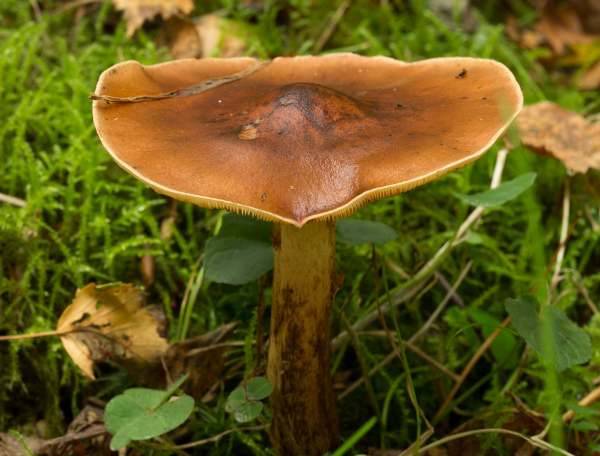
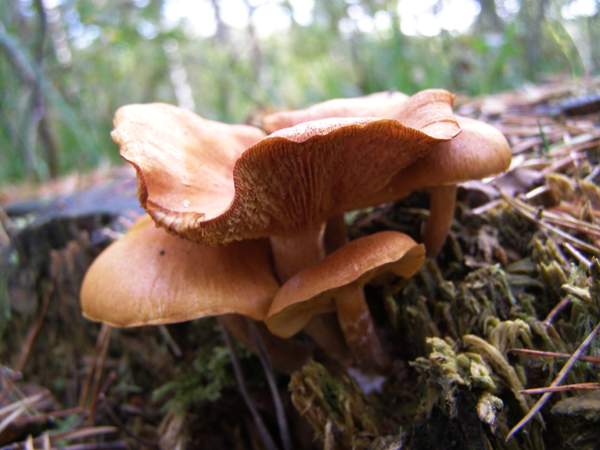
Most of the rustgills seen in pine forests and other coniferous plantations in Britain and Ireland are Common Rustgills, and they seem to like one another’s company: find one and you are likely to spot dozens more nearby.
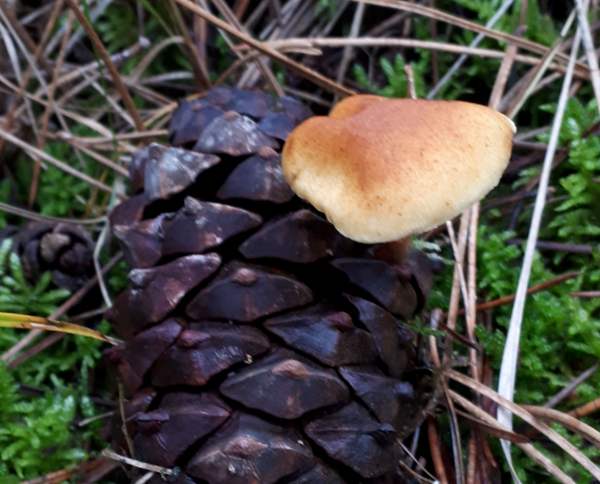
Above: Gymnopilus penetrans growing on an old pine cone, northern France
Common Rustgills grow on rotting stumps, fallen branches and the forest floor wherever conifer debris has become buried beneath needle litter. Conifer cones, sawdust or wood chippings seem to be equally acceptable fare for these fiery fungi.
Distribution
Fairly common and widespread in Britain and Ireland, Gymnopilus penetrans is found in many other parts of the world including most of mainland Europe (from Scandinavia down to the Mediterranean region), North Africa, and many parts of North America.
Taxonomic history
The Common Rustgill was described in 1815 by the great Swedish mycologist Elias Magnus Fries, who called it Agaricus penetrans. In 1912 American mycologist William Alphonso Murrill (1869 - 1957) transferred this species to the genus Gymnopilus, thereby establishing its currently-accepted scientific name Gymnopilus penetrans.
Synonyms of Gymnopilus penetrans include Flammula hybrida,Gymnopilus hybridus, Agaricus penetrans Fr., Flammula penetrans (Fr.) Quél., and Dryophila penetrans (Fr.) Quél.
Etymology
Gymnopilus was proposed as a new genus name in 1879 by the Finnish mycologist Petter Adolf Karsten (1834 - 1917). The origin of this generic name is the prefix Gymn- meaning naked, and the suffix -pilus which means cap - hence naked or bald caps would be an expected feature of the mushrooms in this genus.
The specific epithet penetrans means penetrating, of course.
Toxicity
The Common Rustgill is inedible and may be poisonous. Certainly several species in the genus Gymnopilus are known to be seriously poisonous, and there is evidence that rustgills from certain parts of the world contain hallucinogenic substances such as psilocybin. We therefore recommend that all fungi in the genus Gymnopilus should be treated as toxic toadstools.
Identification guide
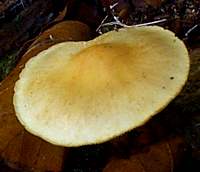 |
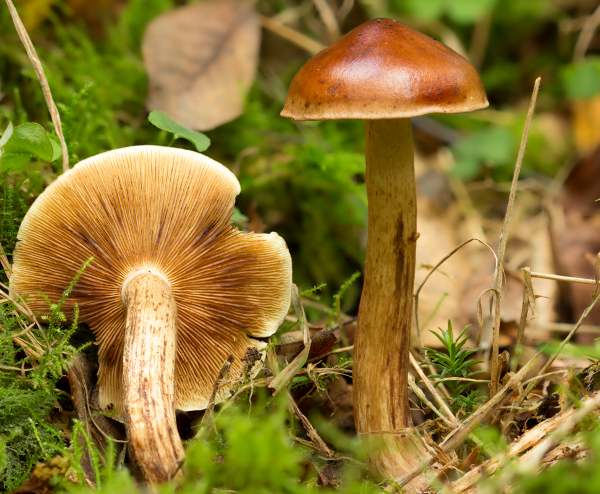
Cap4 to 8cm across; becoming flatter and sometimes developing a shallow central depression, caps of the Common Rustgill are silky smooth or occasionally felty but not breaking up into scales; various shades of fiery orange-brown, lighter at the margin. |
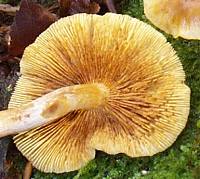 |
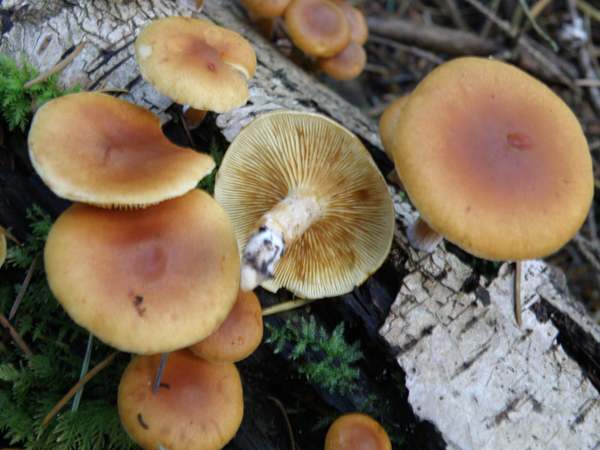
GillsAdnate and crowded, the gills of Gymnopilus penetrans are initially yellow, soon turning reddish-brown with rusty-brown spots. Stem4 to 7cm long and 0.6 to 1.2cm in diameter; yellowish, becoming flushed orange-brown; with fine longitudinal fibres; no ring. |
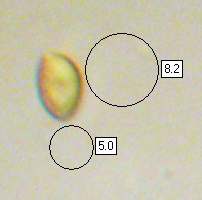 |
SporesEllipsoidal, 7-9 x 4-5.5µm; covered in very small warts.
Spores of Gymnopilus penetrans, Common Rustgill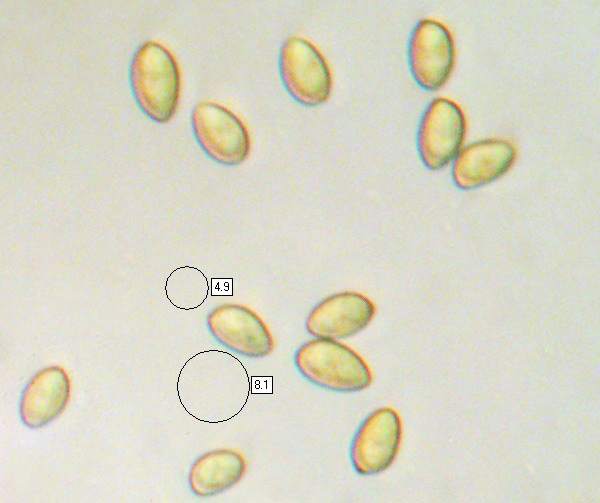 Spore printRusty orange-brown. |
Odour/taste |
Faint fruity small; stronger when the flesh is cut. Bitter taste |
Habitat & Ecological role |
The Common Rustgill appears in tufts on stumps and logs in coniferous woodland and very occasionally also on hardwoods. This species is becoming increasingly common because it grows on woodchip mulch that is now so popular with gardeners as a means of controlling weeds in shrubberies. |
Season |
June to November in Britain and Ireland. |
Similar species |
Gymnopilus junonius is larger and retains a stem ring; it occurs in woodland habitat, but unlike Gymnopilus penetrans it is seen more often on hardwood stumps and ailing trees, and only occasionally on conifers. Phaeolepiota aurea is a much larger and rarer mushroom with a granular cap and lower stem; its spores are light yellow-brown. |
Reference Sources
Pat O'Reilly (2016). 2nd edition; First Nature.
Lincoff, G. and D. J. Mitchel. (1977). Toxic and Hallucinogenic Mushroom Poisoning. Van Nostrand Reinhold, New York.
Bresinsky A, Besl H. (1990). A Colour Atlas of Poisonous Fungi. Wolfe Publishing. ISBN 0-7234-1576-5.
BMS List of English Names for Fungi
Dictionary of the Fungi; Paul M. Kirk, Paul F. Cannon, David W. Minter and J. A. Stalpers; CABI, 2008
Taxonomic history and synonym information on these pages is drawn from many sources but in particular from the British Mycological Society's GB Checklist of Fungi.
Acknowledgements
This page includes pictures kindly contributed by David Kelly.

Fascinated by Fungi. Back by popular demand, Pat O'Reilly's best-selling 450-page hardback book is available now. The latest second edition was republished with a sparkling new cover design in September 2022 by Coch-y-Bonddu Books. Full details and copies are available from the publisher's online bookshop...