Hygrocybe acutoconica var. acutoconica (Clem.) Singer - Persistent Waxcap
Phylum: Basidiomycota - Class: Agaricomycetes - Order: Agaricales - Family: Hygrophoraceae
Distribution - Taxonomic History - Etymology - Identification - Culinary Notes - Reference Sources
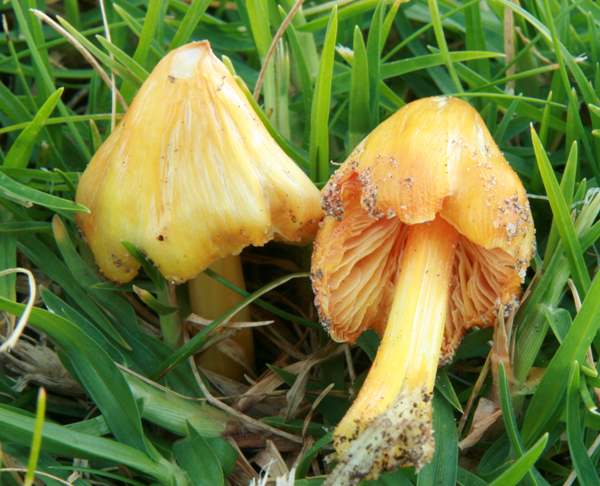
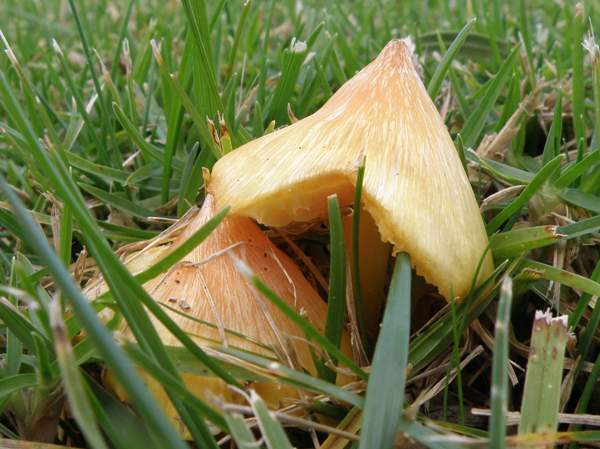
In wet weather easily mistaken for a young Blackening Waxcap, Hygrocybe conica, in its yellow form, the Persistent Waxcap does not blacken. As the name implies, the fruitbodies are relatively long lasting and remain conical.
Most often found on sandy soil on limestone-rich or chalky substrates, these attractive medium-sized waxcaps are infrequent or rare finds in many of the areas where many other Hygrocybe species are abundant.
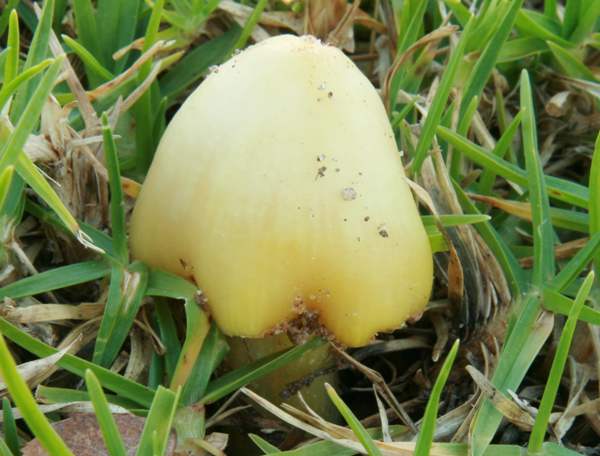
Above: Hygrocybe acutoconica var. konradii is usually yellow with gills that do not develop an orange tinge; cricially to identification, its spores are broadly ellipsoidal. (Unusual in this specimen but far from exceptional is the obtuse rather than acute form of the cap.)
Distribution
No waxcap species can be called 'common', and the Persistent Waxcap, while not one of the rarer species, is at best an occasional find. Often bright yellow, usually with an obvious orange flush, these are large, conspicuous fungi, so the fact that they are encountered only occasionally in Britain and Ireland signals that they are neither widespread nor abundant. They are widespread, however, and can be found from the south coast of England right up to northern Scotland, and their distribution also extends throughout Ireland.
On mainland Europe I have seen the Persistent Waxcap not only in Scandinavia but also as far south as the Algarve Coast, in southern Portugal, where during wet winters (November through to February) this lovely grassland mushroom sometimes fruits in great hordes on villa lawns and in grassy woodland edges along with the occasional Scarlet Waxcap Hygrocybe coccinea.
Not all European waxcaps occur in North America, but Hygrocybe acutoconica is one that does, although as only an occasional find. In the southeast of the USA the Persistent Waxcap is found not only in meadows and on grassy roadside verges but also in deciduous and mixed woodland..
Taxonomic history
Described scientifically in 1893 by American mycologist Frederick Edward Clements (1874 - 1945), who gave this waxcap the scientific name Mycena acutoconica, the Persistent Waxcap was moved to the genus Hygrocybe by German-born mycologist Rolf Singer in 1949, at which point its scientific name became Hygrocybe acutoconica. The basionym (a term used to indicate which name was the original, validly published name of a taxon) was for many years considered to be persistens, but Clements' publication on this species predates others and so the accepted scientific name was changed recently to Hygrocybe acutoconica. You will still see the specific epithet persistens in many recently-published field guides, and indeed the common name Persistent Waxcap has been included in the British Mycological Society's list of Common Names of Fungi.
In Britain Hygrocybe acutoconica occurs in two varieties. The most common of these (described and pictured above) is Hygrocybe acutoconica var. acutoconica. The much rarer Hygrocybe acutoconica var. konradii. is similar in shape and growing habitat; its cap is sometimes pure yellow with whitish-yellow gills, but it can also have a red or orange tinge similar to the nominate form. The main distinguishing characteristics (and according to Danish waxcap expert David Boertmann the only reliable way of distinguishing it from Hygrocybe acutoconica var. acutoconica) are its spores, which are subglobose (9-12 x 7.5-10μm) rather than elongated ellipsoidal like those of var. acutoconica.
Hygrocybe acutoconica var. acutoconica has several synonyms including Mycena acutoconica Clem., Hygrophorus cuspidatus Peck, Bull., Hygrocybe constans J. E. Lange, Hygrocybe langei Kühner, Hygrophorus rickenii Maire, Bull., Hygrocybe persistens (Britzelm.) Singer, Hygrophorus langei (Kühner) A.H. Sm. & Hesler, Hygrocybe persistens var. langei (Kühner) Bon, and Hygrocybe aurantiolutescens P. D. Orton).
Hygrocybe acutoconica var. konradii (R. Haller Aar.) Boertm., has also acquired a number of synonymous scientific names among which are Hygrocybe konradii R. Haller Aar., Hygrophorus subglobisporus P. D. Orton, and Hygrocybe subglobispora (P. D. Orton) M.M. Moser.
Etymology
The genus Hygrocybe is so named because fungi in this group are always very moist. Hygrocybe means 'watery head'. Much more obvious is the meaning of the specific epitet acutoconica, which refers to the acutely (sharply) conical form of caps of the Persistent Waxcap.
Identification guide
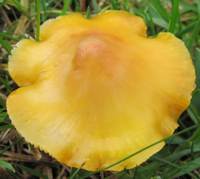 |
CapCaps of Hygrocybe acutoconica var. acutoconica are 3 to 6cm across; initially acutely conical, expanding to become sharply umbonate; margin irregularly lobed and tending to split as cap expands; yellow, tinged with orange or red, especially towards the centre of the cap; viscid in wet weather, especially when young and fresh, with a translucent striate margin, drying silky smooth or with very fine radial fibrils. |
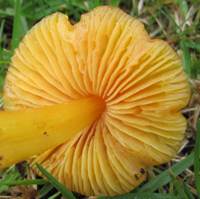 |
GillsAdnexed to free, the gills of Hygrocybe acutoconica var. acutoconica are broad and fairly distant; gill colour is pale yellow, becoming yellow-orange at maturity. (The gills of Hygrocybe acutoconica var. konradii are whitish yellow and do not develop an orange tinge.) StemUp to 9cm long and 5 to 8mm diameter; yellow tinged with orange; tapering towards apex; often with one or more longitudinal grooves; either slightly greasy or dry, finely fibrillose; no stem ring. |
BasidiaFour spored with clamps or two-spored (with one-, three-spored) without clamps. Gill tramaRegular, long (up to 1mm), with tapering ends. |
|
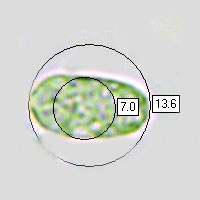 |
SporesSpores of Hygrocybe acutoconica var. acutoconica (left) are elongated ellipsoidal or cylindrical, sometimes with a slight constriction; smooth; inamyloid. From four-spored basidia: 10-12.5 x 5-6.5μm. From two-spored basidia: 11.5-14 x 5.5-7.5 μm. (Ref. Boertmann, see below.) As either two-spored or four-spored basidia may predominate, measuring spores is of limited help.
Spores of Hygrocybe acutoconica, Persistent Waxcap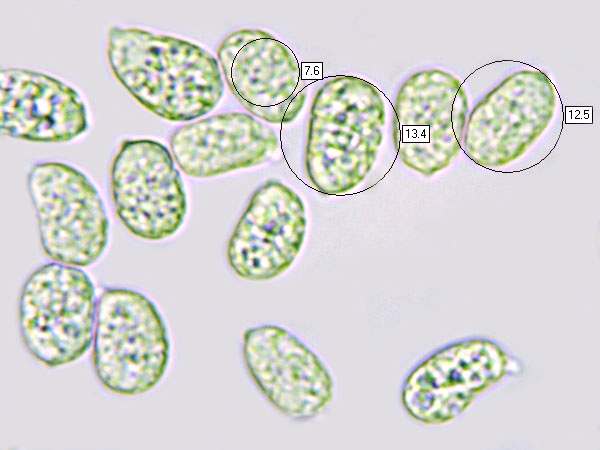 Spore printWhite. |
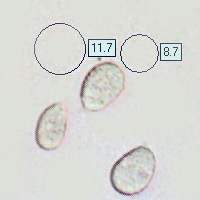 |
SporesSpores of Hygrocybe acutoconica var. konradii (left) are broadly ellipsoidal to globose; smooth; inamyloid.
Spores of Hygrocybe acutoconica, var. konradii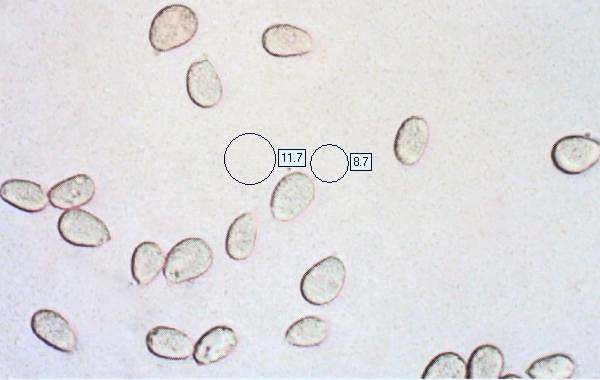 |
Odour/taste |
Not distinctive. |
Habitat & Ecological role |
In low-nutrient grassland often on sandy alkaline soil but also found in some areas where the soil is acidic. This waxcap sometimes appears on sandy riverbanks, particularly where the grass is well shaded and mossy. Waxcaps have long been considered to be saprobic on the dead roots of grasses and other grassland plants, but it is now considered likely that there is some kind of mutual relationship between waxcaps and mosses. |
Season |
August to November in Britain and Ireland; later in southern Europe. |
Similar species |
Hygrocybe conica, the Blackening Waxcap, is similar in form and can occur with yellowish caps, but it blackens completely once the cap has expanded or if damaged by handling. Hygrocybe conicoides, the Dune Waxcap, has yellow-orange gills and blackens slowly (and rarely all over); its cap is not markedly striate or radially fibrillose. |
Culinary Notes
The Persistent Waxcap is one of the most common of the Hygrocybe species seen in Britain and Ireland, and it is fairly common also on a European scale. There would be rather less concern if people collected these grassland fungi rather than some of the rarer Hygrocybe species; however, although some field guides (including Alan E Bessette et al Mushrooms of the Southeastern United States, published in 2007) say that it is edible, the Persistent Waxcap is not highly rated.
Reference Sources
Fascinated by Fungi, 2nd Edition, Pat O'Reilly 2016, reprinted by Coch-y-bonddu Books in 2022.
Fungi of Northern Europe, Volume 1 - The Genus Hygrocybe, David Boertmann, 2010.
Dictionary of the Fungi; Paul M. Kirk, Paul F. Cannon, David W. Minter and J. A. Stalpers; CABI, 2008
Taxonomic history and synonym information on these pages is drawn from many sources but in particular from the British Mycological Society's GB Checklist of Fungi.

Fascinated by Fungi. Back by popular demand, Pat O'Reilly's best-selling 450-page hardback book is available now. The latest second edition was republished with a sparkling new cover design in September 2022 by Coch-y-Bonddu Books. Full details and copies are available from the publisher's online bookshop...